0498 70 98 60
Small Business SEO in 2026: The Complete Guide for the AI Era
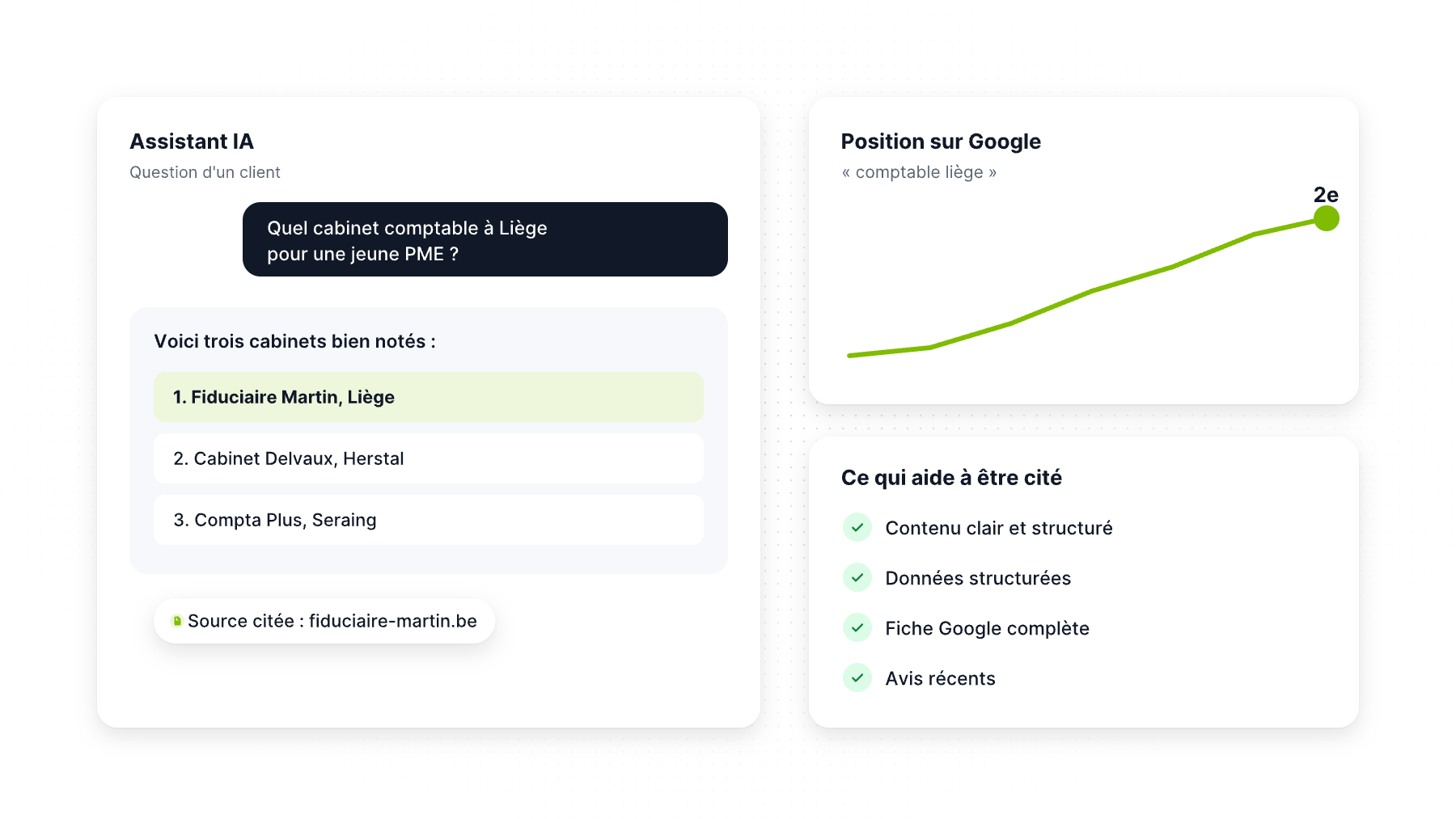
SEO in 2026 is still largely played out on Google: in the United States, it handles about 85% of searches across all devices and 94% on mobile (StatCounter, September 2026). At the same time, more and more of your customers also ask ChatGPT, Gemini or Google’s AI Mode before they pick a business. They still type their questions into Google, and a growing share of them also ask an AI assistant.
Search engine optimization hasn’t disappeared with AI: it has shifted. AI-generated answers are built on web pages that search engines consider trustworthy, crawlable and clear.
This guide brings together what a US small business, a solo practitioner or a professional firm needs to know, all the way to a concrete action plan. It’s useful even if you manage your website yourself; if you’d rather delegate, our SEO services page explains our approach.
SEO in 2026: what has changed and what hasn’t
SEO covers everything that helps a website show up, without paying, when someone searches for what you offer. Google says so itself: appearing in its organic results is free (Search Essentials, December 2025), and it doesn’t accept payment to rank a site higher. That’s what separates SEO from advertising, covered in our Google Ads guide for small businesses.
What stays the same: Google must be able to crawl your pages, it ranks helpful pages written for people first, and trust is earned (an identifiable author, verifiable contact details).
What has changed since 2024
- AI Overviews and AI Mode display an answer before the classic blue links; in the US, AI Overviews launched in May 2024 and AI Mode opened to all US users in May 2025.
- Core and spam updates come quickly and target content produced at scale.
- FAQ rich results no longer appear in Google since May 2026.
- Search Console now counts your appearances in Google’s AI answers, but not the clicks.
A solid website therefore serves Google, Bing and AI assistants at the same time.
What Google officially asks for: the three parts of Search Essentials
Google summarizes its expectations in a public document, Search Essentials (updated December 2025), in three parts:
- technical requirements: Google must be able to access the page, the page must return a proper response and contain indexable text; Google admits there is “very little” technical work required;
- spam policies: doorway pages, hidden text, keyword stuffing, buying links, scraped content, buying an expired domain to exploit its past reputation…;
- key best practices: content that’s helpful for people, the words your customers actually use when they search, and links Google can follow.
A properly installed WordPress site usually meets the technical requirements, as long as the “Discourage search engines from indexing this site” box, often checked during development, has been unchecked (Settings > Reading). The same goes for password protection or “noindex” settings left on after a Shopify, Wix or Squarespace launch. Any technique that sidesteps one of these three parts isn’t optimization: it’s a risk.
Helpful content and trust: the heart of SEO
Google asks for content created primarily for people, not to manipulate rankings (Google Search Central, updated October 5, 2026). It provides self-assessment questions: is your page original? Does it add more than the other results?
Google also lists warning signs: publishing on topics unrelated to your business, mass-automating content production, merely summarizing other sources, changing a page’s date without updating it. And it has no preferred word count: aiming for a number of words is pointless.
E-E-A-T: experience, expertise, authoritativeness and trustworthiness
Google puts trust above the other three criteria, and E-E-A-T is not a ranking factor in itself. It’s a framework that weighs more heavily on so-called YMYL (“Your Money or Your Life”) topics: health, finances, safety, civic life. A dentist, an attorney or a financial advisor has more to prove than a recipe blog.
Who, how and why
- Who wrote it? A real byline, an About page, a physical address and license numbers where your profession requires them. Fake profiles (an AI-generated headshot, an invented credential) are considered deception.
- How and why? If AI contributed to the text and readers might wonder, say so; the page should exist to help a customer, not to occupy a spot in the results.
AI isn’t banned for writing, as long as it isn’t used to mass-produce pages with no added value. The best content is often the easiest to write: your price ranges, your real turnaround times, the questions customers ask on the phone, the cities and neighborhoods you serve, your projects described in detail. See also our tips on how to write an SEO blog post.
Google core updates and spam policies in 2025-2026
Google announces its major changes on its public Google Search Status Dashboard. Core and spam updates as of November 6, 2026:
| Update | Rollout period |
|---|---|
| March 2025 core update | March 13 to 27, 2025 |
| June 2025 core update | June 30 to July 17, 2025 |
| August 2025 spam update | August 26 to September 22, 2025 |
| December 2025 core update | December 11 to 29, 2025 |
| March 2026 spam update | March 24 to 25, 2026 |
| March 2026 core update | March 27 to April 8, 2026 |
| May 2026 core update | May 21 to June 2, 2026 |
| June 2026 spam update | June 24 to 26, 2026 |
| August 2026 spam update | August 18 to 21, 2026 |
| September 2026 spam update | September 24 to October 8, 2026 |
That’s five core updates and five spam updates in eighteen months. A traffic drop during a core update isn’t a penalty: it often means other pages answer the same question better. During a spam update, however, a drop can signal that a practice on your site is being targeted, even without any message in Search Console. Either way, it’s better to improve than to rewrite everything in a panic; our breakdown of the March 2026 core update shows how to analyze a drop.
Three spam policies to know in 2026
- Scaled content abuse: producing many pages primarily to manipulate rankings, whatever the method. A hundred near-identical “plumber + city name” pages are the textbook example.
- Expired domain abuse: buying an old domain name to benefit from its past reputation.
- Site reputation abuse: publishing third-party content on a reputable site just to exploit its ranking signals. Google stopped applying manual actions under this policy to users in the European Economic Area in late summer 2026, but the policy still fully applies in the US.
Technical SEO: mobile, page speed, structured data and site migrations
Technical work alone won’t win you rankings, but a single flaw can cost you a lot.
Mobile-first indexing
Google crawls and ranks your pages based on their mobile version. Anything missing on smartphones (a pricing table, image alt text) risks being ignored; accordions and tabs are fine as long as the content is there.
Core Web Vitals
These three metrics measure your visitors’ real experience, at the 75th percentile of page loads:
| Metric | What it measures | “Good” threshold |
|---|---|---|
| LCP | Loading of the main element | 2.5 seconds or less |
| INP | Responsiveness to clicks and taps | Under 200 ms |
| CLS | Visual stability during loading | Under 0.1 |
They reflect what Google aims to reward, with no published weighting. Heavy images, a bloated theme and cheap hosting explain most poor scores; our web design team builds sites with these thresholds in mind.
Structured data that matters in 2026
This invisible markup describes your page to Google. For a small business, the most useful types are Organization, LocalBusiness, Product, Article, BreadcrumbList and VideoObject. Two recent rules to know:
- FAQ rich results disappeared from Google on May 7, 2026, for every site; the markup can stay, with no visual effect;
- marking up reviews of your own business (LocalBusiness or Organization) to get star ratings isn’t allowed: that markup is reserved for sites that collect reviews about other businesses. Product reviews shown on the product page of an online store remain eligible.
Our schema markup guide covers implementation.
Website redesign or new domain: protect your rankings
A poorly prepared redesign is one of the most common causes of a sudden traffic drop. Google describes the process (Google Search Central, August 2026):
- map every old URL to its new page, without redirecting everything to the homepage;
- set up permanent server-side redirects (301);
- submit the new sitemap in Search Console and, if you change domains, use the Change of Address tool;
- keep redirects in place for at least a year.
Google warns that rankings can fluctuate during a migration. Ask your developer for this plan before launch.
English and Spanish websites: multilingual SEO rules
If you serve Spanish-speaking customers in markets like Miami, Houston, Los Angeles or Phoenix, an English-only site misses part of the searches: a Spanish-speaking customer types “dentista cerca de mí,” not “dentist near me.” Google sets a few clear rules (Google Search Central, September 2026):
- one URL per language (for example /es/), rather than a single page whose language changes with a cookie;
- hreflang tags linking each version to its translations: each page must reference itself and every other version, or Google ignores the tags;
- no automatic redirects based on browser language: let visitors choose with a visible link;
- translate the main content, not just the menu.
Google doesn’t use hreflang or the lang attribute to detect a page’s language: it reads the text. Its spam policies also list machine translation used to mass-produce pages as scaled content abuse. Have a native speaker review, and adapt your keywords rather than translating them literally.
Links: internal links, backlinks and the ones to avoid
Google discovers pages by following links. Its rules (December 2025) are simple:
- A link must be a real link: an <a> tag with an href. A button with no URL, driven by a script, isn’t followed.
- Anchor text should describe the destination page, concisely. “Click here” tells Google nothing; anchor text stuffed with keywords doesn’t either.
- Every important page should get at least one internal link from another page on the site. There’s no ideal number of links per page.
- Paid links must carry the sponsored or nofollow attribute. Buying links to gain rankings is link spam.
Internal linking: an underrated lever
It’s often one of the simplest levers to pull: link each service to its case studies, each advice article to the matching service page, each location page to the main page.
Backlinks: reputation has to be earned
Links from other websites remain a reputation signal. For a US small business, the most natural ones come from real relationships: your chamber of commerce, trade associations, suppliers and manufacturers, local organizations or teams you sponsor, local news outlets.
SEO and AI search: AI Overviews, AI Mode, ChatGPT and Gemini
Google is clear: neither AI Overviews nor AI Mode require anything beyond the usual SEO best practices. It recommends presenting important content as text, using structured data that matches what’s visible, and keeping your Business Profile up to date (Google Search Central, December 2025). These features can run several related searches in parallel: our reading is that a page that also answers the questions surrounding the customer’s query has more chances to be picked.
Where things stand in the US
The US has been the first market for Google’s AI search features: AI Overviews launched there in May 2024 and AI Mode became available to all US users in May 2025. Your customers can already use both, and many also use ChatGPT, Copilot or Gemini.
How to increase your chances of being cited by AI
No one can guarantee a citation, but a few practices improve your odds:
- answer a specific question in the first lines of the page, then go deeper;
- give verifiable facts: service area, turnaround times, terms, price ranges, licenses and certifications;
- put your name on your content and show who’s behind the business;
- keep your information identical everywhere: website, Google Business Profile, directories, social media.
For the full method, see our AI search optimization guide. To delegate it, our AI search optimization (GEO) services handle it for you.
Stay in control of your content
The nosnippet, max-snippet and noindex directives also apply to AI features. Google-Extended limits how Google’s other AI products use your pages, without removing them from Search. A Search Console control, rolled out gradually from June and opened to all sites on August 31, 2026, also lets you exclude your content from AI features. For a small business looking for customers, that’s rarely a good idea. Instead, check that your robots.txt file, a security plugin or your host isn’t blocking Bingbot or AI crawlers without your knowledge.
Zero-click searches: what the studies really say
You read everywhere that “nobody clicks anymore.” Reality is more nuanced:
- United States (SparkToro and Datos, 2024): 58.5% of Google searches ended without a click, based on data collected before AI Overviews became widespread.
- United States (Pew Research Center, July 2025): among 900 adults tracked, 8% of visits to a results page with an AI summary led to a click on a traditional result, versus 15% without one. Google disputes the methodology.
- Ahrefs (February 2026): across 300,000 keywords, the presence of an AI Overview was associated with a desktop click-through rate for the top position about 58% lower.
Google says clicks from these pages are “higher quality,” without publishing figures.
What zero-click means for a small business
Informational searches (“how to bleed a radiator”) generate fewer visits; searches that lead to a decision (“emergency plumber Tampa Saturday,” “commercial lease attorney Chicago”) are still the ones where people want to contact someone. So you should:
- measure leads (calls, forms, quote requests) rather than traffic alone;
- treat an appearance in an AI answer as brand awareness, even without a click;
- strengthen the pages that convert: services, service areas, proof, contact details.
Local SEO: Google Business Profile, reviews and directories
For most small businesses, customers are local: a patient in Raleigh, a homeowner in Phoenix who needs a plumber, a table at a restaurant in Brooklyn. Three levers matter:
- your Google Business Profile: categories, hours, photos, reviews and replies. Google ranks local results on three official criteria: relevance, distance and prominence;
- your website: one page per service and, for the cities you actually serve, a dedicated page only if you can make it unique (projects completed, response times, local conditions), with the same contact details as your profile and, ideally, LocalBusiness markup;
- directories and review sites: Yelp, the Better Business Bureau, Apple Business Connect, Bing Places, and the platforms of your industry (Angi or Houzz for home services, Avvo for attorneys, Healthgrades for doctors).
Reviews matter, but collect them honestly: the FTC rule on fake reviews, in effect since October 2024, prohibits buying reviews and undisclosed insider reviews. The full method is in our local SEO guide for small businesses.
Measure your SEO in 2026 with Google Search Console
Free, Google Search Console shows what Google sees on your site: indexed pages, errors, the searches you appear for. Its Performance report gives clicks, impressions, click-through rate and average position, filterable by query, page, country, device and date. Our Google Search Console guide walks through it.
What’s new in 2025-2026
- Appearances in AI Overviews and AI Mode are counted in the Performance report, under the “Web” search type.
- Dedicated generative AI reports have been open to all sites since August 31, 2026: they count your pages’ appearances in Google Search and Discover AI answers, by page, country, device (Search only) and date, but provide neither clicks nor queries, and a small site may not have access for lack of volume.
- Annotations (November 2025) let you mark a redesign or a campaign on the chart.
What to track every month
Pages gaining or losing clicks, queries in positions 5 to 15 (often the easiest to improve), indexing errors. And above all, leads: Search Console can’t see them. Track them in Google Analytics 4 or by counting the calls and forms you receive.
A step-by-step SEO action plan for small businesses
Here’s the order we recommend, each step building on the previous one.
- Check the technical basics: HTTPS, a submitted sitemap, key pages indexed in Search Console and Bing Webmaster Tools, a complete mobile version, Core Web Vitals in the green on your main pages (a small site without enough traffic can test them in PageSpeed Insights).
- If you serve customers in person, complete your Google Business Profile and use exactly the same name, address and phone number on your site and in directories.
- List your customers’ searches (services, problems, cities, frequent questions), in Spanish too if you serve Spanish speakers, then build one strong page per service: what you do, for whom, where, how fast, with what guarantees, and proof.
- Polish titles and descriptions: an explicit title tag and a meta description that makes people want to click, page by page. Our on-page SEO guide covers these settings.
- Link your pages together: logical internal linking, descriptive anchors, no important page left isolated.
- Publish less, but better, rather than ten generic posts.
- Earn real links: partners, associations, local press, events.
- Measure and adjust every month, tracking leads as much as traffic.
You can handle steps 1 to 4 yourself and reply to your reviews. Redesign redirects, hreflang, page speed and structured data more often call for a professional: mistakes there are expensive.
SEO in your overall marketing strategy
SEO builds over several months; paid ads bring leads faster but stop with your budget; social media builds trust, as our social media marketing guide explains.
Short on time? Our team can take on all or part of this plan through our SEO services, starting with a free SEO & AI audit of your site.
Small business SEO: FAQ
Is SEO still worth it in 2026 with AI?
Yes. Answers generated by Google or ChatGPT rely on web pages that have been crawled and deemed trustworthy. Google sets no special requirements for its AI features: a site that follows the usual best practices also has the best chance of appearing in them. And Google still handles about 85% of US searches.
How long does SEO take to show results?
There’s no guaranteed timeline, and any promise of a specific ranking by a specific date should raise a red flag. Results are usually measured over several months, depending on competition in your industry and your market.
Can I write my content with ChatGPT?
Google doesn’t ban AI: it penalizes content mass-produced to manipulate rankings, whatever the method. A text you’ve reviewed and enriched with real experience (prices, timelines, projects, professional rules) can be perfectly helpful. Generic text published as-is, in bulk, is a risk.
Do I need to publish a blog post every week?
No. Google rewards neither frequency nor length: it has no preferred word count.
Was my site penalized if traffic dropped after an update?
Not necessarily. A core update reassesses all pages: if others answer better, they move ahead, with no penalty involved. A manual action shows up in the Manual Actions section of Search Console; automatic demotions from spam updates don’t. Check that section first, then the dates of the drop, and compare the pages and queries that lost ground.
Does Bing really matter in the US?
Bing accounts for about 10% of US searches across all devices (StatCounter, September 2026), but 18.8% on desktop (October 2026) and only about 2% on mobile: it’s mostly present on Windows work computers. Register your site in Bing Webmaster Tools; it’s free and also feeds Microsoft Copilot.
Does my website need a Spanish version?
Yes, if a meaningful share of your customers prefers Spanish. Customers search in their language, and an English page won’t rank for “dentista cerca de mí.” Plan one URL per language, hreflang tags and a real, reviewed translation, not raw machine translation. If your customers are almost all English-speaking, it isn’t a priority.
Want to know where your site stands and where to start? Request your free SEO audit: we analyze your organic rankings, local visibility and presence in AI answers, then propose a clear plan. Discover our SEO services for small businesses.