0498 70 98 60
Google Ads for Small Businesses: The Complete 2026 Guide
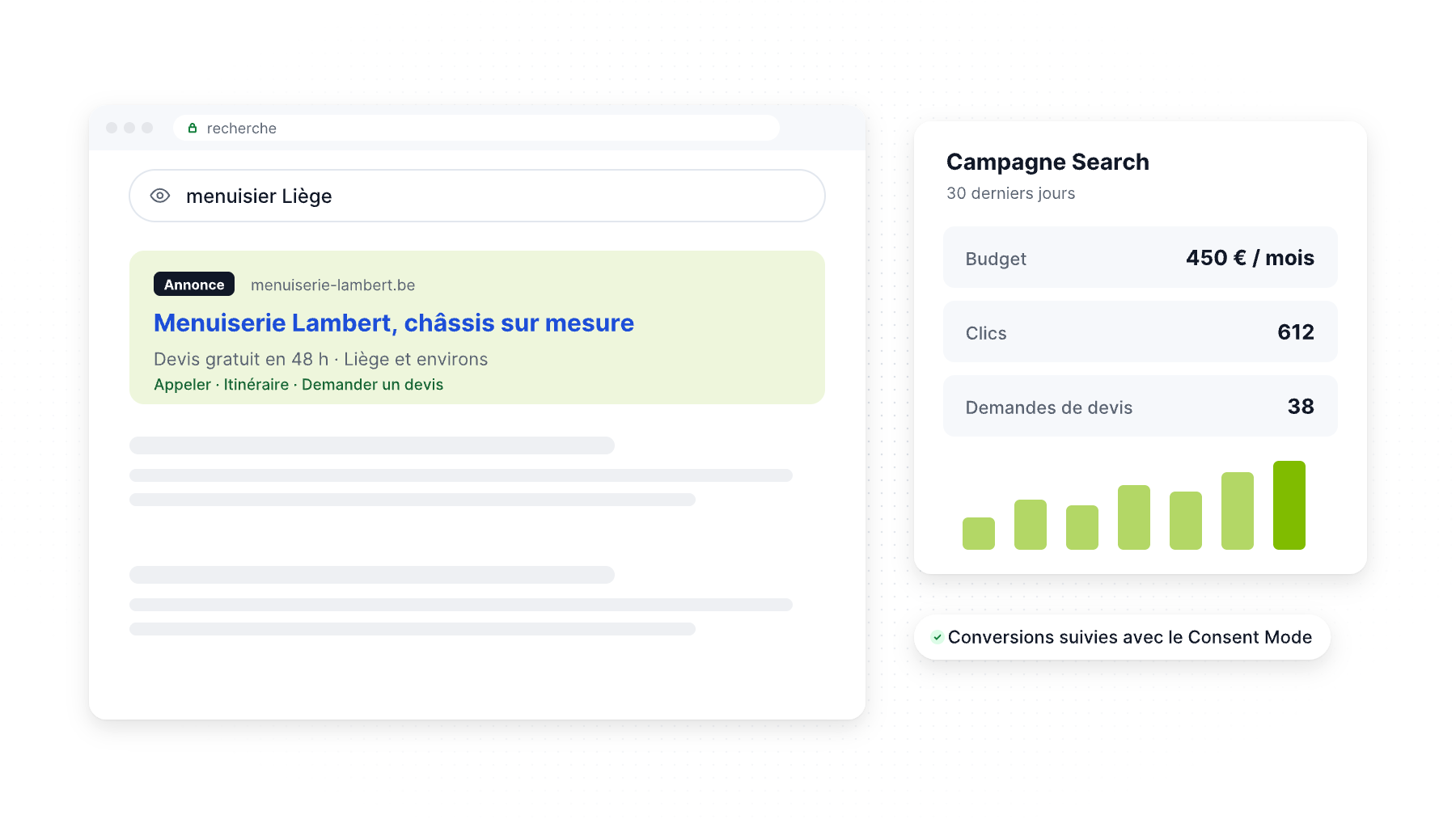
In the United States, Google handles about 85% of all searches across devices and 94% on mobile (StatCounter, September 2026). Whether you’re an electrician in Columbus or a CPA firm in Denver, your next customer almost always starts there. Google Ads lets you appear in those results without waiting for SEO to kick in, usually paying per click, but with no guaranteed position.
The platform has changed a lot, though: local campaigns are gone, campaign-level language targeting was removed from Search in September 2026, AI now sits at every step, and ads have moved into AI Overviews. With default settings, a campaign can burn through its budget without producing a single phone call.
This guide covers what you need to decide, launch and manage profitable campaigns in 2026. Use it on your own, or hand the work to our Google Ads management team.
Google Ads in the US in 2026: the landscape before you spend your first dollar
A Google-first market, except on the office desktop
On smartphones, Google is nearly alone. On desktop, Bing reaches 18.8% in the US (StatCounter, October 2026, based on page views, so treat it as an order of magnitude). For B2B companies, Microsoft Advertising deserves a test (more on that below).
Google Ads vs. Google Business Profile vs. SEO: three different levers
With Google Ads, you buy immediate visibility in search results and across Google’s other surfaces. It does not boost your Business Profile in local rankings: Google Business Profile help states that no payment can do that. Your Business Profile and organic SEO build visibility over time; ads stop the moment your budget does.
When Google Ads is worth the money
- you’re launching a business or a new service, and SEO will take months;
- demand is seasonal or urgent (no heat, a burst pipe, a move, storm damage);
- your margins let you pay for a click to get a quote request;
- your website already converts: a visible phone number, a short form, proof that you’re legit.
If your site loads slowly on mobile or doesn’t build trust, part of every paid click is wasted. Our local SEO guide for small businesses covers the foundations.
Which Google Ads campaign types should a small business choose?
Google Ads offers several campaign families:
| Campaign type | Best for | Watch out for |
|---|---|---|
| Search | Any business answering an expressed need | The most controllable option; requires good keyword choices |
| Search + AI Max | Accounts with reliable conversion tracking | Expands queries and rewrites your ad copy |
| Performance Max | Ecommerce with a product feed; lead gen if you import qualified leads | Runs across all of Google: without guardrails, expect low-quality leads and clicks on your own brand |
| Demand Gen | Awareness and interest on YouTube, Discover, Gmail | Doesn’t capture search intent |
| Shopping | Online stores with a Merchant Center feed | Product data quality drives results |
| Smart campaigns | Very small businesses just starting out | Little control, broad delivery |
Search campaigns: the foundation
For a plumber in Phoenix or an accountant in Tampa, the Search Network is still the starting point: you choose the searches and pay per click.
A simple account structure you can actually read
- one campaign per service with a different margin or urgency (emergency repair, installation, maintenance);
- one campaign per language if you advertise in English and Spanish;
- tight ad groups: about ten closely related keywords, ads that echo them, and a landing page that answers them.
Example for an HVAC contractor in Dallas: “Emergency AC Repair – EN – 25 mi” and “Heat Pump Install – EN – Metro”. When you create campaigns, choose Expert mode over Smart mode, make sure the Display Network is unchecked in your Search campaigns, and schedule ads for the hours when someone can pick up the phone.
AI Max for Search
Announced on May 6, 2025, this Search campaign option expands the queries you match, rewrites your text based on your landing page and can send people to other pages on your site. Google says it delivers an average of 14% more conversions at a similar cost (internal data, no published methodology). Turn it on once conversion tracking is solid, not before.
Performance Max
A single campaign gives you access to all of Google’s inventory: YouTube, Display, Search, Discover, Gmail and Maps. It’s driven by goals (sales, leads, traffic, store visits) and groups your images and copy into asset groups. Since 2025, you can add up to 10,000 negative keywords to it (Search Engine Land, March 2025). Our Performance Max guide goes deeper.
For a service business, before launching a lead-gen PMax: import your qualified leads, or it may optimize toward junk form fills; turn on brand exclusions and restrict final URL expansion to your sales pages (not careers or blog); keep the “Presence” location option. A Search campaign with an exact match keyword identical to the query still takes priority over PMax (Google Ads Help).
What’s gone
Local campaigns were converted to Performance Max in 2022: you can no longer create them, and store visit goals now run through PMax. For phone calls, a Search campaign with a call asset remains easier to control. The last Video action campaigns were due to be upgraded to Demand Gen by April 2026 (Google Ads Help).
Local Services Ads: pay per lead instead of per click
Local Services Ads appear at the very top of results with a Google Guaranteed or Google Screened badge, and you pay only for valid leads (calls, messages or booking requests), not clicks. In the US they cover a long list of home services (plumbers, electricians, HVAC, roofers, locksmiths, movers, house cleaners) as well as professional services such as lawyers, financial planners and real estate agents.
To get the badge, Google and its partners run background and license checks on the business, and on field workers for many home service categories, and verify insurance where required. You can dispute leads that weren’t genuine, such as spam or a request for a service you don’t offer.
For an eligible plumber or HVAC company, Local Services Ads complement Search campaigns rather than replace them: they capture “near me” emergencies, while Search covers the rest of your services.
Keywords and match types: pay for the right searches
Three match types
- broad match (the default, no symbol): your ad can show on searches related to the meaning of your keyword, sometimes loosely;
- phrase match, in quotes (“gas furnace”): the search must include the meaning of the phrase;
- exact match, in brackets ([gas furnace]): the most control, according to Google, but less volume.
Google is clear on one point: it calls pairing broad match with Smart Bidding “essential” (Google Ads Help). In other words, broad match only makes sense with Smart Bidding fed by reliable conversion data. Without it, an HVAC company can end up paying for clicks on “hvac technician training” or “hvac salary.”
Negative keywords: your safety net
Add terms that never bring customers from day one, then add more every week from the search terms report. Note that negative keywords don’t cover close variants the way positive keywords do: add plurals and common misspellings. Starter list to adapt: jobs, careers, hiring, salary, training, course, certification, free, DIY, how to, pdf, used; in Spanish: empleo, trabajo, curso, gratis. Add cities you don’t serve and, near a state line, the neighboring areas you can’t cover.
Writing Google Ads that make people call
Responsive search ads
A responsive search ad accepts up to 15 headlines of 30 characters and 4 descriptions of 90 characters; Google then assembles the combinations. Headline 2, headline 3 and the second description aren’t guaranteed to show, so every element must make sense on its own. Google recommends at least two responsive search ads rated “Good” or “Excellent” per ad group.
Practical principles:
- a headline that mirrors the search (“Electrician in Charlotte, NC”);
- a headline with proof (licensed and insured, years in business, a real warranty);
- a headline with a call to action (“Free Quote Within 24 Hours,” if it’s true);
- descriptions that answer the main objection: response time, service area, upfront pricing or not.
Pinning headlines to a position “isn’t recommended for most advertisers” and can lower ad strength, according to Google Ads Help. Save it for required disclaimers such as license numbers.
Assets (formerly ad extensions)
What used to be called “extensions” are now assets: call, location, sitelinks, callouts, price, lead form and more. Adding them is free; a click on an asset is charged like a regular click, with a maximum of two charged clicks per impression (Google Ads Help). For a contractor, the call asset and the location asset linked to your Google Business Profile are usually the most useful.
Quality Score is a diagnostic, not a price
Quality Score, rated 1 to 10, combines expected click-through rate, ad relevance and landing page experience. It isn’t an input in the ad auction but a diagnostic tool (Google Ads Help): what it measures matters, the number itself doesn’t. Put as much care into your landing page as into your ad.
Google Ads cost per click and budget: what we can honestly say
Average CPC by industry in the US
The WordStream/LocaliQ 2026 search advertising benchmarks cover 13,474 US campaigns that ran from April 2025 to March 2026. The overall average CPC was $5.42, but the gaps between industries are huge:
| Industry (US) | Average CPC, 2026 |
|---|---|
| Attorneys & legal services | $9.87 |
| Home & home improvement | $8.33 |
| Dentists & dental services | $8.00 |
| Health & fitness | $6.17 |
| Real estate | $3.22 |
| Restaurants & food | $2.05 |
These are national averages. Your actual cost depends on competition for your searches, in your area, at a given time: a personal injury keyword in Houston and a dentist keyword in a small Ohio town live in different worlds.
How to set a starting Google Ads budget
- Estimate CPCs for your searches in Keyword Planner, targeting your real service area.
- Work out what a lead is worth: average ticket, close rate, margin.
- Plan for enough conversions: Google recommends evaluating a Smart Bidding strategy on at least 30 conversions (50 for Target ROAS). Budget too tight? Narrow down (one service, one area, exact match keywords) instead of spreading thin.
- Adjust after the first few weeks, based on real numbers.
The math, with your own figures: cost per lead = CPC ÷ share of visitors who call or fill out a form; cost per customer = cost per lead ÷ close rate, compared with your margin. Cost per lead × the number of jobs you can handle per month = your media budget, before management fees. Keep in mind that Google can spend up to twice your daily budget on a given day, without exceeding 30.4 times that budget over the month (Google Ads Help).
Smart Bidding
Four strategies dominate: Maximize Conversions, Target CPA, Target ROAS and Maximize Conversion Value. They adjust each bid based on device, location, time of day or remarketing lists. The official prerequisite: conversion tracking must be set up before you choose one of these strategies.
Conversion tracking: calls, privacy laws and offline sales
Without reliable measurement, Smart Bidding optimizes blind. In the US, measurement comes down to four workstreams.
Decide what counts as a conversion
As primary conversions, keep only actions that look like a customer: calls longer than a minimum duration you set, form submissions, quote requests. Clicks on your phone number, page views and form opens stay secondary: Google uses them for observation, not bidding (Google Ads Help). Protect your forms against bots and avoid counting the same lead twice in Google Ads and GA4. Our Google Ads conversion tracking guide shows how to set this up.
US privacy laws and Google Ads
The US has no single federal consent requirement like Europe’s, but a growing number of states, starting with California (CCPA/CPRA), give consumers the right to opt out of the sale or sharing of their personal data, including for targeted advertising. Google Ads offers restricted data processing for these state laws, and your cookie banner or privacy tool should honor opt-out signals. If you’re in healthcare, be especially careful with tracking pixels on pages that could reveal health information: HHS has issued guidance on tracking technologies under HIPAA. Validate your setup with your attorney.
Enhanced conversions
Enhanced conversions send Google the contact details customers submit (email, phone), hashed with SHA-256 before sending, to better match conversions to ad clicks. The “for leads” version is built for deals closed offline, in your CRM or over the phone.
Phone calls: the blind spot for many contractors
For an HVAC company or a roofer, the phone is often the first point of contact. Google forwarding numbers let you count calls generated by your ads. One limitation: calls from the call asset are tracked only on mobile; calls made from your website require a code snippet that swaps in the forwarding number. Also import your qualified calls and closed sales so Google learns which leads actually make money.
Location and language targeting: settings that drain budgets
The “Presence or interest” trap
By default, Google targets people “in, or regularly in, or who’ve shown interest in” your area, even if they’re somewhere else. A plumber in Kansas City, Missouri, can end up paying for clicks from people who will never be in the service area. The “Presence” option limits delivery to people physically located in, or regularly in, your targeted area. On the other hand, a vacation rental in the Smoky Mountains should keep “interest” to reach travelers planning their trip.
No more language targeting in Search since September 2026
Since September 2026, the campaign-level language setting no longer applies to Search campaigns or to the Search portion of Performance Max. Google now relies on the language of your ad and landing page, the language of the search and the user’s settings. And Google has been explicit: it does not translate your ads (PPC Land, August 2026). If you want to reach Spanish-speaking customers, you need ads and landing pages in Spanish.
For businesses serving bilingual markets like Miami, Houston, Los Angeles or San Antonio, that means:
- separate ad groups or campaigns in English and Spanish (single-language campaigns still work, per the same source);
- landing pages in each language, not an English page with a machine-translation button;
- keywords researched in each language, not literally translated: people search “plomero cerca de mí,” not a word-for-word version of your English keyword.
Service areas across state lines
There’s no special setting for metro areas that straddle state lines: combine a radius around an address, location exclusions and the “Presence” option. If you’re licensed in only one state, exclude the areas across the line where you can’t legally work, for example, New Jersey for a contractor licensed only in New York.
Regulated industries: what Google and US rules allow
Some professions face both Google’s policies and their own regulators. Check both before you launch.
| Industry | Google Ads policy | US rules to check |
|---|---|---|
| Healthcare providers | Health is a sensitive category: no personalized ad targeting based on health conditions | HIPAA rules on tracking technologies; your state medical or dental board |
| Addiction treatment | Certification required (via LegitScript in the US) | State licensing of the facility |
| Online pharmacies | Certification required; prescription drug promotion is restricted | State pharmacy board licensing |
| Lawyers | General policies; Local Services Ads with Google Screened | State bar advertising rules, modeled on ABA Model Rule 7.1 (no false or misleading claims) |
| Housing, employment, credit | No targeting by age, gender, parental status, marital status or ZIP code | Fair housing, equal employment and fair lending laws |
| Personal loans | Required disclosures; high-APR and short-term personal loans prohibited | State lending licenses |
| Gambling | Google certification and a state license, only where legal | State gaming regulator rules |
| Alcohol | Allowed if you follow local laws; no targeting of minors | State alcohol beverage control rules |
Healthcare
Doctors, dentists and med spas can advertise on Google, but they can’t use personalized targeting based on health conditions, and ads for prescription drugs are restricted. The bigger risk is often tracking: HHS guidance warns HIPAA-covered entities about tracking pixels that send protected health information to third parties. Keep your conversion tags off patient portals and sensitive pages.
Lawyers
Every state bar sets its own advertising rules, most of them modeled on the ABA Model Rules of Professional Conduct, which prohibit false or misleading communications. Some states go further: Florida, for example, requires many lawyer ads to be filed with the bar, and New York requires a disclaimer when ads mention past results. Check your state’s rules before claiming “best,” “#1” or a win rate.
Finance and lending
In the US and Canada, Google prohibits targeting housing, employment and credit ads by age, gender, parental status, marital status or ZIP code. Personal loan advertisers must also meet Google’s disclosure requirements, and loans with very high APRs or very short repayment periods aren’t allowed.
Advertiser verification and account security
Google advertiser verification
Google is gradually verifying all advertisers; once verified, your name and location appear with your ads and in the Ads Transparency Center. If you don’t complete verification on time, your ads can be limited and your account paused. Note that changing the legal name on your payments profile triggers a new verification, and status updates can take up to five business days.
How to avoid a Google Ads suspension
In our experience, small business suspensions rarely come from fraud. They’re more often triggered by a website that looks untrustworthy or a questionable payment. Display your business address, phone number, terms and real prices; ban unverifiable claims (“#1 plumber in Atlanta”). Open the account in your company’s name, with your own payment method, then grant your agency access. Suspended? Appeal: creating a new account after a suspension is treated as circumventing Google’s policies.
Google Ads and AI in 2026: what’s live in the US
AI is everywhere in the platform, and in the US it’s now in the results your customers see, too.
Inside the platform
- AI Max, Performance Max and Smart Bidding, covered above;
- AI-generated text and image suggestions when you build campaigns and assets.
Ads in AI Overviews and AI Mode
In the US, text and Shopping ads from existing Search, Shopping and Performance Max campaigns are eligible to appear within AI Overviews, in English, on mobile and desktop. You can’t target these placements directly, and you can’t opt out (Google Ads Help, via Search Engine Roundtable, May 2025). Google has also been bringing ads into AI Mode, and in October 2026 announced “multiturn” ads in the US, which can show on follow-up questions. The best preparation: broad coverage through AI Max or PMax, strong landing pages and accurate product data.
Getting cited in AI answers through other channels
Paid placement isn’t the only way into AI answers. Whether ChatGPT, Gemini or Google’s AI Overviews cite your business depends on your website content, your Google Business Profile and your mentions elsewhere, not your ad budget. Our AI search optimization guide and our GEO services cover that side.
The most expensive Google Ads mistakes (and the Bing question)
Mistakes we see most often
- Launching Smart Bidding without reliable conversion tracking.
- Keeping “Presence or interest” for a purely local service.
- Using broad match without Smart Bidding or negative keywords.
- Advertising only in English in markets with a large Spanish-speaking customer base.
- Auto-applying recommendations, which can add broad match keywords on their own.
- Not tracking phone calls.
- Counting phone number clicks or page views as primary conversions.
- Launching a lead-gen PMax without importing qualified leads.
- Ignoring the rules of your industry (healthcare, legal, finance, housing).
- Confusing time frames: a bidding strategy is judged on about 30 conversions, but search terms need checking from week one.
Should you also advertise on Microsoft Advertising (Bing)?
With Bing at 18.8% of US desktop searches (StatCounter, October 2026), Microsoft Advertising reaches a lot of office workers on Windows PCs. For a B2B company, importing your Google campaigns into Microsoft Advertising is often worth a test; we evaluate it case by case in our Microsoft Advertising management.
A strategy, not just ads
Google Ads performs better when your website, Business Profile and SEO keep up. To go further, read our SEO guide for small businesses, our local SEO guide or, for Facebook and Instagram, our social media marketing guide.
Google Ads for small businesses: FAQ
What’s the minimum budget for Google Ads?
There’s no universal amount. Estimate click costs in Keyword Planner for your area, calculate your cost per lead, then plan enough budget to reach about 30 conversions so you can evaluate a bidding strategy. As a reference, the 2026 WordStream/LocaliQ benchmarks put the average US cost per click at $5.42, with legal and home services well above that.
Google Ads or SEO: where should I start?
Ads deliver immediate visibility that stops when your budget does; SEO and your Business Profile build lasting visibility, more slowly. Many small businesses combine both: ads to launch or cover peaks, SEO to gradually reduce dependence on paid clicks.
Should I run Google Ads in Spanish?
If a meaningful share of your customers searches in Spanish, yes. Since September 2026, Google no longer applies language targeting in Search and does not translate your ads: you need Spanish ads and Spanish landing pages.
Are Local Services Ads worth it?
For eligible home and professional services, often yes: you pay per lead rather than per click, and the Google Guaranteed or Google Screened badge builds trust. Expect a verification process (background, license and insurance checks) before your ads go live.
Can doctors, dentists or lawyers advertise on Google?
Yes, within limits. Healthcare advertisers can’t target based on health conditions and must be careful with tracking under HIPAA. Lawyers must follow their state bar’s advertising rules. Check with your licensing board or bar before launching.
How do I know if my ads bring in customers, especially by phone?
Set up conversion tracking, use Google forwarding numbers and import your qualified calls and closed deals. Without that, Google optimizes for clicks, not customers.
How long does it take to see results from Google Ads?
No timeline can be guaranteed. Ads can run as soon as they’re approved, and the first weeks are for checking search terms and tracking. A bidding strategy is then judged on about 30 conversions: depending on your lead volume, that takes a few weeks or several months.
Want to know whether your campaigns are spending in the right places, or whether Google Ads fits your business? Request your free Google Ads audit: we review your account or your project and show you how our PPC management works.