0498 70 98 60
Google Ads for Niche Markets: How to Perform When Data Is Scarce
Niche markets rarely generate enough volume for standard Google Ads playbooks to work as intended. Knowing how to make Google Ads perform when search volume is low becomes essential to getting results you can actually act on. In these markets, every click counts, and a single mistake in account structure or targeting can throw off the entire strategy.
Why Niche Markets “Break” the Standard Google Ads Playbook
Standard strategies such as Smart Bidding or Target ROAS rely on fairly high conversion volumes, typically 30 to 50 conversions a month as a rule of thumb, to work well. In a niche market, those thresholds are rarely met. Search volume is too thin to feed the algorithms properly, which leads either to chronic underdelivery or to targeting that sprawls out of control as the system hunts for data, usually at the expense of quality.
Two scenarios tend to dominate. In some cases, the advertiser “owns” its brand space, with highly specific terms that few people search for. In others, the offer gets buried in generic queries dominated by bigger players. Either way, optimization models built on large data sets lose their edge.
Signal Stacking
Google Ads learns from every conversion signal available, not just clicks. When volume is low, you need to make up for it by deliberately enriching the learning environment. Importing offline conversions, phone calls, CRM opportunities, and long-cycle sales through the Data Manager API reconnects the algorithm to real business value.
Even small Customer Match lists of a few hundred contacts can meaningfully improve how Google understands your converting profiles, provided they meet Google’s eligibility and minimum list-size requirements. Adding strategic audience signals, such as in-market segments, affinity audiences, or custom segments, helps the AI find the right people. At the same time, audience exclusions cut the noise generated by related but irrelevant interests.
Campaign Structure Built for Niche Markets
Search should be your primary entry point, because it captures explicit intent and produces the first usable data. Performance Max, on the other hand, already needs a meaningful base of conversions to perform well. When you use it in a niche, it must be paired with strong audience signals and reviewed through the Channel performance report so you can see where your ads are actually serving.
Awareness campaigns, especially Demand Gen, play a key role in educating prospects who do not yet know your solution exists. That upstream exposure often translates into more branded searches down the line. And even with strong organic search rankings, bidding on your brand terms remains a smart way to protect existing demand.
Keyword Strategy
Start with exact match and phrase match to keep maximum control over where your ads show. Rigorous negative keyword management is essential to limit wasted spend. Broad match only makes sense once you have built up enough conversion volume and stabilized your keyword universe. Before that, it tends to stretch the learning too far and pull in loosely related intent.
In very narrow markets, mining the search terms you can see becomes a valuable tactic, all the more so because Google often hides low-volume queries.
Ad Copy and Landing Pages
Your ads need to speak the exact language of your niche. Precise, industry-specific terminology increases perceived relevance and improves click quality. Using every asset slot available in responsive search ads, up to 15 headlines and four descriptions, increases the number of combinations Google can test and broadens your semantic coverage.
Landing pages should qualify the prospect immediately and make your differentiation crystal clear. In a niche, it is often better to filter out poor fits than to chase raw lead volume.
Conversion Tracking and Attribution
When sales cycles are long, the default 30-day click-through conversion window often falls short. Extending it (Google Ads allows up to 90 days) better reflects the real customer journey. Importing offline conversions and assigning value to each stage of the funnel (inquiry, demo, sale) gives Smart Bidding a more accurate picture of real value, not just the volume of intermediate actions.
Budget Strategy
The priority is to protect your brand campaigns and capture high-intent traffic first through tightly targeted keywords. Increasing budget only makes sense once that foundation is secure. Otherwise, the extra spend mostly pays for low-quality clicks, which inevitably erodes profitability.
Competitive Analysis
Auction insights reports show you which advertisers you are actually competing against. In extremely small markets, it can sometimes be the smarter move to let a competitor own certain terms rather than start a CPC bidding war that drives up costs for everyone without creating any additional value.
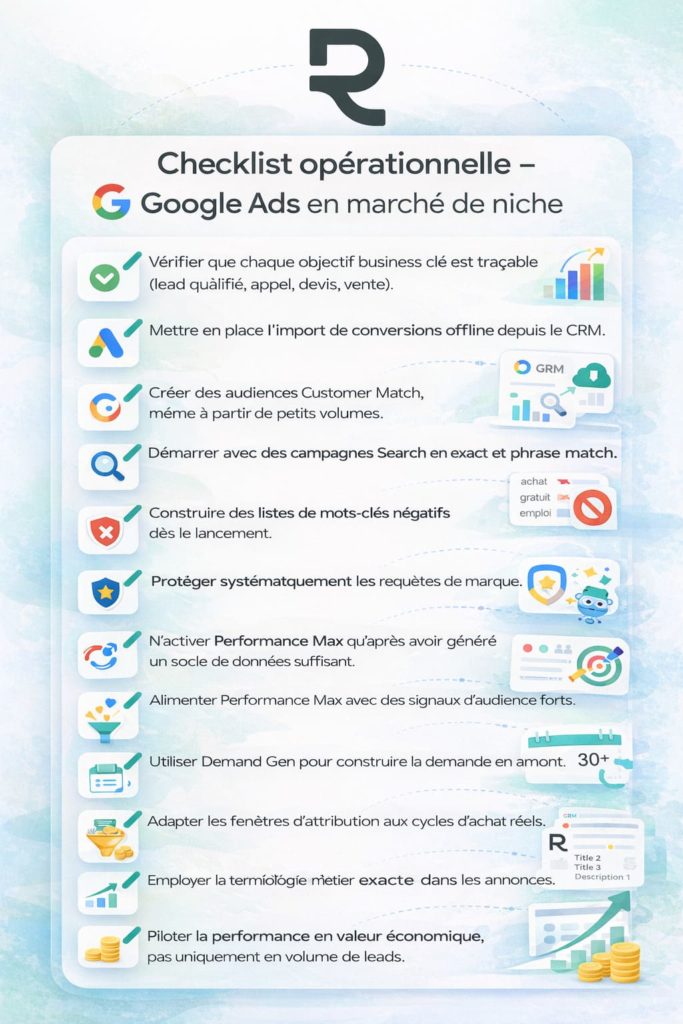
Checklist: Running Google Ads in a Niche Market
- Make sure every key business outcome is trackable (qualified lead, call, quote request, sale).
- Set up offline conversion imports from your CRM.
- Build Customer Match audiences, even from small lists.
- Launch with Search campaigns on exact and phrase match.
- Build negative keyword lists from day one.
- Always protect your branded queries.
- Only turn on Performance Max once you have a solid base of data.
- Feed Performance Max with strong audience signals.
- Use Demand Gen to build demand upstream.
- Match your conversion windows to your real sales cycles.
- Weight each funnel stage according to its business value.
- Use the exact industry terminology in your ads.
- Fill every responsive search ad asset slot.
- Design landing pages that qualify prospects immediately.
- Manage performance on business value, not just lead volume.
In a niche market, performance does not come from volume. It comes from precision.
Running Google Ads in a niche market and not sure your account is set up for it? Our Google Ads team, part of a certified Google Partner agency, works with U.S. businesses remotely: request a free assessment.