0498 70 98 60
NAP Consistency: Getting Your Business Listings Right on Yelp, BBB, Apple, Bing and Beyond
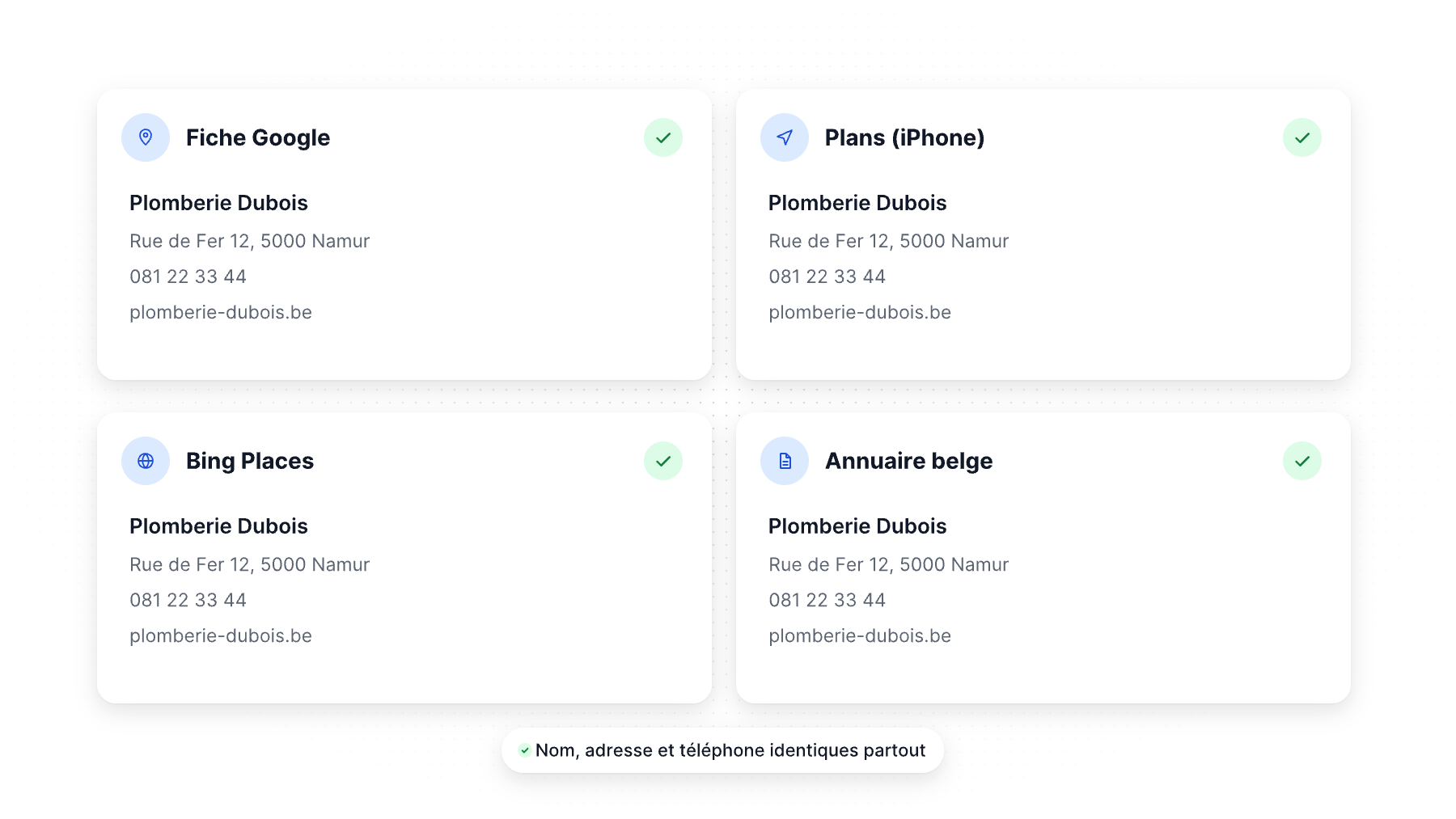
Your business name, address and phone number appear in dozens of places you’ve never visited: Yelp, the Better Business Bureau, Apple Maps, Bing, Angi, navigation apps, car dashboards and voice assistants. When those details disagree, customers call disconnected numbers, drive to your old address, or simply pick a competitor whose information looks reliable.
That’s what NAP consistency is about: making sure your Name, Address and Phone number (and ideally your website, hours and categories) are identical everywhere. This guide explains why it still matters in the age of AI search, which US listings to prioritize and how to clean them up without wasting money.
Why NAP consistency still matters
For customers
The first job of a listing is to get a customer to you. A wrong phone number or a pin in the wrong place costs you real calls and visits, whatever it does to rankings.
For Google and local rankings
Google says local ranking depends on relevance, distance and prominence, and that prominence reflects how well-known a business is, including information Google finds about it across the web. Citations (mentions of your business on other sites) are part of that picture. Consistent data makes it easier for Google to connect those mentions to your profile, and it helps when Google reviews your profile or an appeal (see our guide to suspended Google Business Profiles).
For AI search
AI assistants build answers from many sources at once. In Whitespark’s 2026 Local Search Ranking Factors, experts placed citation factors among the top signals for AI search visibility. If your listings contradict each other, AI tools are more likely to repeat the wrong details. We explore this in our guide to Google Business Profile and AI search.
Step 1: Define your “source of truth”
Before touching any listing, write down the exact version of your data:
- Business name: the name on your signage and state registration, without keywords or taglines
- Address: one format, used everywhere (“Suite 200” or “Ste 200,” pick one). Service-area businesses that hide their address on Google should apply the same logic elsewhere where possible (see our guide to service-area businesses).
- Main phone number: a local number you control
- Website URL: the exact version (https, with or without www)
- Hours, including holiday hours
- Primary category and short description
Keep this in a shared document. Every person and vendor who edits a listing should use it.
Step 2: Fix the listings that matter most in the US
Google Business Profile
Your most important listing. Start here and make sure it matches your source of truth exactly, including the primary category.
Apple Business (Apple Maps)
Apple Maps is the default maps app on iPhone. In 2026, Apple consolidated its business tools into a free platform called Apple Business, and the features of Apple Business Connect (place cards, logos, photos, “Showcases”) migrated into it, with free features rolling out from April 14, 2026. Claim your location, verify it and check the pin, hours and categories. Apple also announced ads in Apple Maps for summer 2026, so an accurate place card matters even more.
Bing Places for Business
Bing powers Microsoft’s search results and feeds other Microsoft experiences. In October 2025, Microsoft relaunched Bing Places for Business, moved the owner experience to bing.com/forbusiness and improved the import from Google. Importing is convenient, but double-check what came over. For example, a website URL with Google-specific UTM tags would credit Bing visits to Google in your analytics.
Yelp
Yelp remains a major review and discovery platform in the US, especially for restaurants, home services and personal care. Claim your free business page, correct your details and categories, and respond to reviews. Yelp goes further than Google: it asks businesses not to solicit reviews at all and bans incentives, so read its guidelines before you promote your Yelp page.
Better Business Bureau (BBB)
The BBB maintains business profiles whether or not a company is accredited. Accreditation is a paid program, but you can review and correct the basic information on your profile. For contractors, financial services and other trust-sensitive trades, a complete BBB profile reassures cautious customers.
Angi and other home-services platforms
For contractors and home-service pros, Angi (formerly Angie’s List), Thumbtack, Houzz and Nextdoor are often where customers compare providers. Make sure your free profiles carry the same NAP, license numbers and service areas as your Google profile, even if you don’t buy leads there.
Industry and local directories
Depending on your trade: Avvo or FindLaw for attorneys, Healthgrades or Zocdoc for physicians, state licensing board lookups, your local chamber of commerce. These citations are relevant and trusted, and often outweigh generic directories.
Step 3: Use data aggregators wisely
Data aggregators collect and distribute business information to a large network of apps, maps, GPS systems and directories. In the US, the networks commonly used for distribution include Data Axle, Neustar Localeze and Foursquare. BrightLocal, for example, distributes to these plus the Yellow Pages Network and GPS Network.
Submitting your correct data to aggregators fixes many downstream listings over time, but not all, and not instantly. Combine it with manual fixes on the platforms that matter most.
Step 4: Find and fix inconsistencies
- Search your old data: your old address, old phone number and old business names in Google, in quotes. Each result is a listing to correct.
- Use a citation audit tool (BrightLocal, Whitespark, Moz Local, Yext) to scan major sites at once.
- Prioritize: Google, Apple, Bing, Yelp, BBB, Facebook, your industry directories, then aggregators, then the rest.
- Merge or remove duplicates rather than leaving two listings for the same location.
- Keep a log of each listing, its login, its status and the date of the last check.
Step 5: Keep it consistent
NAP problems usually come back after a change: a move, a new phone system, a rebrand, a new location. Before any change:
- Update your source-of-truth document first.
- Update Google, Apple, Bing, Yelp and your website on the same day.
- Notify aggregators and industry directories.
- Run a new audit 30 and 90 days later.
Do you need a paid listings subscription?
Subscription tools that push your data to many sites can save time for multi-location brands. Before you sign, ask what happens to your listings if you cancel, which sites are actually covered and whether you keep ownership of the profiles. For a single-location small business, a one-time cleanup plus an annual check is often enough.
Let us clean up your listings
Référenceur audits your citations, fixes the listings that matter for your market and keeps your data consistent across Google, Apple, Bing and the directories your customers use, as part of our local SEO services. Want to be cited accurately by AI tools too? See our AI search optimization service, or contact us.
FAQ
What does NAP stand for?
Name, Address and Phone number. Many local SEOs add the website URL, hours and categories, since inconsistencies there cause the same problems.
Is NAP consistency still a ranking factor?
Google says prominence, which includes information it finds about your business across the web, affects local ranking. Consistent citations help Google and AI tools trust your data, and they prevent customers from calling or visiting the wrong place.
Which listings should a US small business fix first?
Start with Google Business Profile, Apple Business (Apple Maps), Bing Places, Yelp, the BBB, Facebook and the main directories in your industry. Then submit your data to the aggregators. Smaller directories can wait until the main listings are clean.
What are data aggregators?
They are companies that collect business data and distribute it to maps, apps, GPS systems and directories. In the US, Data Axle, Neustar Localeze and Foursquare are commonly used.
How long does it take to fix inconsistent citations?
Your main listings can be fixed in days. Aggregator updates and smaller directories can take weeks or months to update, which is why a follow-up audit is useful.
Not sure where your business data is wrong? Contact Référenceur for a citation audit.