 0498 70 98 60
An engineer needs a supplier for precision-machined aluminum housings. A procurement manager is looking for an ISO 13485-certified contract manufacturer. A plant director wants to compare industrial coating processes. Before any of them calls a sales rep, they search, read, download, and compare. Manufacturers that publish clear, technical, findable information get on the shortlist. Those that hide behind a brochure website usually don’t.
Référenceur provides SEO for manufacturers that sell to other businesses: contract manufacturers, machine shops, fabricators, component makers, and industrial equipment companies. Our French-speaking agency, based in Belgium and Luxembourg, has worked on SEO in Europe for more than 15 years, with a 4.7/5 rating from 107 Google reviews, and supports U.S. manufacturers remotely. Get a free assessment to find the capability searches your competitors are currently winning.
Why Manufacturing Websites Underperform in Search
According to the National Association of Manufacturers, there were 239,265 manufacturing firms in the U.S. in 2022, and about three-quarters of them had fewer than 20 employees. Many of those companies rely on trade shows, distributors, and word of mouth, and their websites reflect it: a homepage, an “about” page, a generic list of services, and a contact form.
That leaves a big gap, because industrial buyers do much of their research alone. Gartner estimates that B2B buyers devote only about 17% of their buying time to meetings with potential suppliers. Everything else happens without you, on Google, on supplier directories, in AI assistants, and on your competitors’ websites.
The most common SEO problems we see on manufacturing sites:
- Capabilities described in marketing language instead of the terms engineers search: process names, materials, tolerances, certifications, part sizes, and volumes.
- Key information locked in PDFs that search engines index poorly, or not at all.
- No pages for the industries served, even though buyers often search by application (“medical device contract manufacturing,” “aerospace sheet metal fabrication”).
- No measurement of RFQs. The site produces quote requests, but nobody knows which pages or searches generated them.
What Our Industrial SEO Work Includes
| Area | What we build | Why buyers care |
|---|---|---|
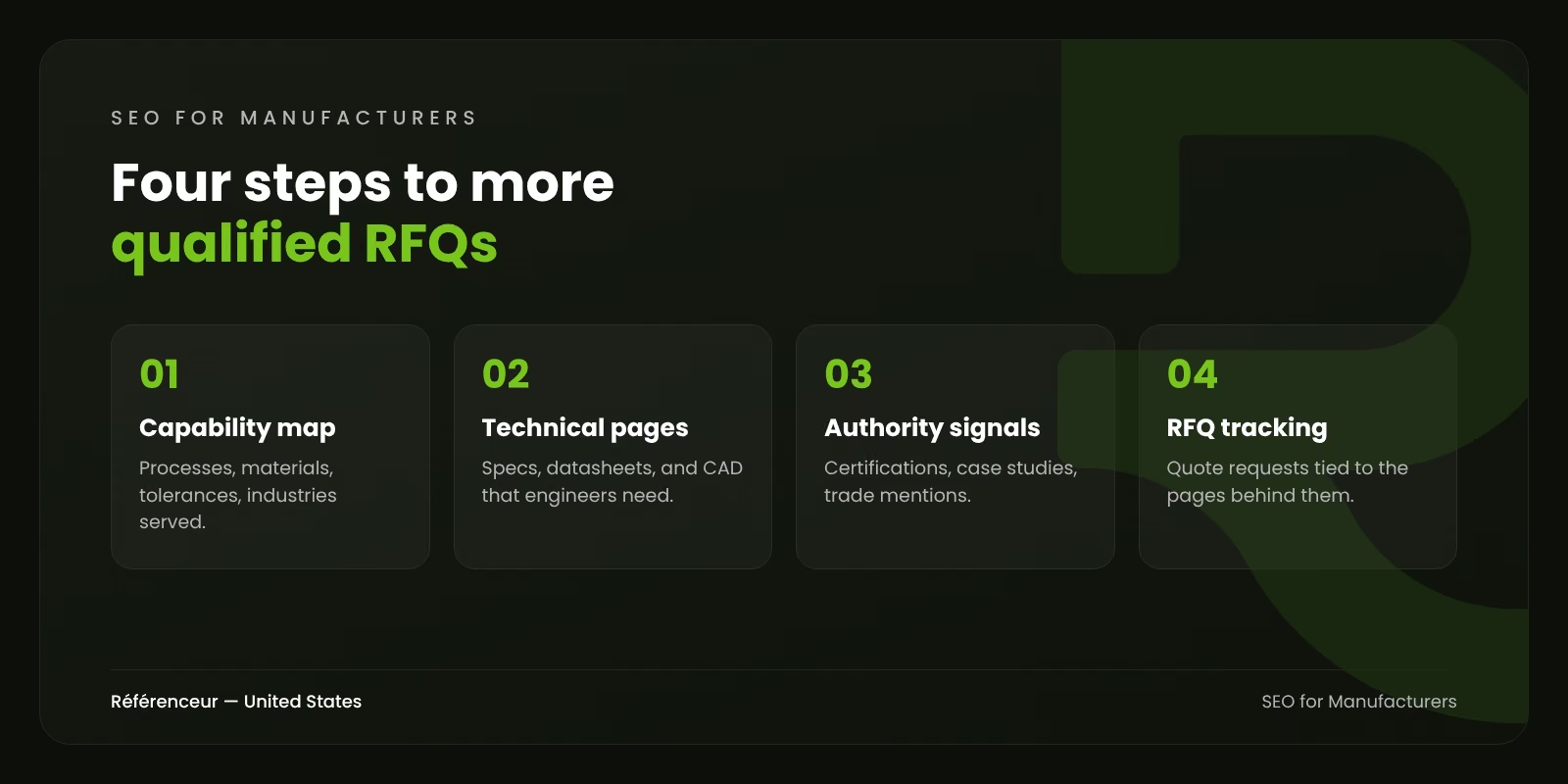
| Capability pages | One page per process: CNC machining, injection molding, laser cutting, powder coating, assembly | Matches how engineers search for suppliers |
| Material and spec content | Materials handled, tolerances, finishes, part size and volume ranges | Lets buyers qualify you in minutes |
| Industry pages | Applications for medical, aerospace, automotive, energy, food processing, and other sectors you serve | Captures application-led searches |
| Certifications and quality | ISO, AS9100, ITAR registration, or other credentials you hold, explained clearly | Reduces supplier risk in the buyer’s eyes |
| Technical resources | HTML versions of datasheets, design guides, CAD downloads where appropriate | Attracts engineers early in the project |
| RFQ optimization and tracking | Clear quote forms, file uploads, and source tracking in your CRM | Connects SEO to real sales opportunities |
B2B SEO for Manufacturing Is Slow-Burn, High-Value Work
Search volumes in industrial niches are small. A phrase like “titanium CNC machining services” may get only a modest number of searches per month in the U.S. But the people searching are often engineers or buyers with real projects, and one new account can be worth years of revenue. That’s why B2B SEO for manufacturing focuses on depth and precision rather than traffic for its own sake.
We prioritize by the business value of each capability: which processes have spare capacity, which industries pay best, and which customers you want more of. Then we build content that answers the questions those buyers ask, with the level of technical detail they expect.
Make Trade Shows and Distributors Work Harder Online
Trade shows, distributor relationships, and sales reps still matter in manufacturing. SEO doesn’t replace them; it supports them. After a show, prospects search for your company name and products, so your capability pages should be ready to back up what your booth promised. Distributors often reuse your descriptions, which creates duplicate content; giving them distinct copy, or keeping the most detailed technical pages on your own site, helps your website remain the primary source Google ranks.
Industrial Buyers Are Using AI Search, Too
Engineers and procurement teams increasingly ask AI assistants to compare processes or suggest suppliers. These tools tend to cite pages that state facts clearly: what you make, with which materials, to what tolerances, for which industries, under which certifications. Thin, vague pages give them nothing to quote. The same clear, structured technical content that ranks in Google also makes your company easier for AI systems to describe accurately. Our guide from SEO to GEO explains this shift.
A Manufacturing Marketing Agency That Understands Cross-Border Business
Manufacturing is where much international investment lands. Manufacturing represents 42.8% of all foreign direct investment held in the U.S., according to July 2026 figures from the Bureau of Economic Analysis. Many European manufacturers run American subsidiaries (see our marketing for European companies entering the U.S.), and many U.S. companies source or sell in Europe. Our bilingual team in Belgium and Luxembourg is comfortable with both sides: our copy for American buyers is written in native U.S. English, and we can coordinate with a European parent company’s marketing team in English or French.
Our European client references, such as the beverage producer Lupulus, are presented as exactly that; we don’t claim U.S. manufacturing clients. Partner status with Google, Microsoft Advertising, Semrush, and HubSpot helps when RFQ data needs to flow into your CRM.
How a Manufacturing SEO Engagement Works
With no office on U.S. soil, we run everything through video calls, shared files, and monthly reporting, from a time zone about six hours ahead of the East Coast.
- A video call with sales and engineering to understand capabilities, capacity, and target accounts.
- A technical SEO audit of your website, plus a review of search visibility and the suppliers outranking you.
- A capability and industry content plan ranked by business value.
- Content drafted from interviews with your engineers and reviewed by them for accuracy.
- Monthly reporting on rankings, qualified traffic, and RFQs.
See our general approach on our SEO agency page, or if you also want paid visibility for specific capabilities, our Google Ads agency team can help. Our team in Belgium and Luxembourg works natively in French and English, which is useful when a European parent company and a U.S. plant share one website. You can also view our U.S. locations. Get a free assessment and find out where your capabilities are invisible today.
Frequently Asked Questions About SEO for Manufacturers
Does SEO Work for Niche Industrial Products With Low Search Volume?
Yes, because the value of each search is high. A few dozen qualified visits a month from engineers with real projects can generate more business than thousands of casual visits. The key is matching the exact technical terms buyers use.
Should We Publish Our Capabilities in Detail If Competitors Can See Them?
Buyers need enough detail to qualify you, such as processes, materials, tolerances, and certifications. You don’t need to publish pricing or proprietary methods. We help you decide what to share and what to keep for sales conversations.
Can PDFs and Datasheets Rank in Google?
Google can index PDFs, but they rarely perform as well as HTML pages, and they’re harder to track. We usually create HTML versions of key information and keep the PDF as a download.
How Do You Measure SEO Results for a Manufacturer?
By RFQs and qualified leads, traced to the pages and searches that produced them, plus rankings for priority capability terms. Traffic alone isn’t a useful metric in industrial B2B.
Do You Work With Distributors as Well as Manufacturers?
Yes. Distributors face similar challenges with large catalogs and technical buyers, plus duplicate manufacturer content. Request a free assessment and walk us through your catalog.