 0498 70 98 60
European companies keep betting on the U.S. market. Figures released by the Bureau of Economic Analysis in July 2026 show foreign direct investment in the U.S. growing in 2025, with Europe leading the increase. The Netherlands, the United Kingdom, and Germany rank among the largest investors. What many of those companies discover quickly is that a translated European website and a copied ad strategy don’t win American buyers.
Référenceur specializes in digital marketing for European companies that are launching or growing in the U.S. We’re a French-speaking agency ourselves, based in Francorchamps, Belgium, and Wemperhardt, Luxembourg, with more than 15 years of experience in SEO, Google Ads, and web design, and a 4.7/5 average on 107 Google reviews. We understand how your headquarters works, and our copy for American buyers reads as native U.S. English. Get a free assessment of your U.S. go-to-market plan, wherever you are in the process.
What Changes When You Market in the U.S.
The U.S. isn’t one market with a different language. It’s a large, competitive, regionally diverse market with its own buying habits and rules. Some of the differences that trip up European companies most often:
- Language and tone. British English spellings, literal translations from French, German, or Dutch, and formal phrasing signal “foreign” immediately. American B2B copy is direct, benefit-led, and specific.
- Formats. Dates written month first (October 31, 2026), imperial units alongside metric where buyers expect them, U.S. phone numbers, letter-size documents, and prices in dollars if you publish them.
- Trust signals. U.S. buyers look for reviews, case studies, recognizable logos, certifications, and a clear way to reach a person during their business hours.
- Geography. The contiguous U.S. spans four time zones, and demand varies by state. Your first campaigns should target the regions where you can actually deliver, sell, and support.
- Taxes and legal language. Sales tax, not VAT. Privacy, email, and accessibility rules differ from the EU in structure, not just detail.
U.S. Market Entry Marketing: Our Core Services
| Stage | What we do | Outcome |
|---|---|---|
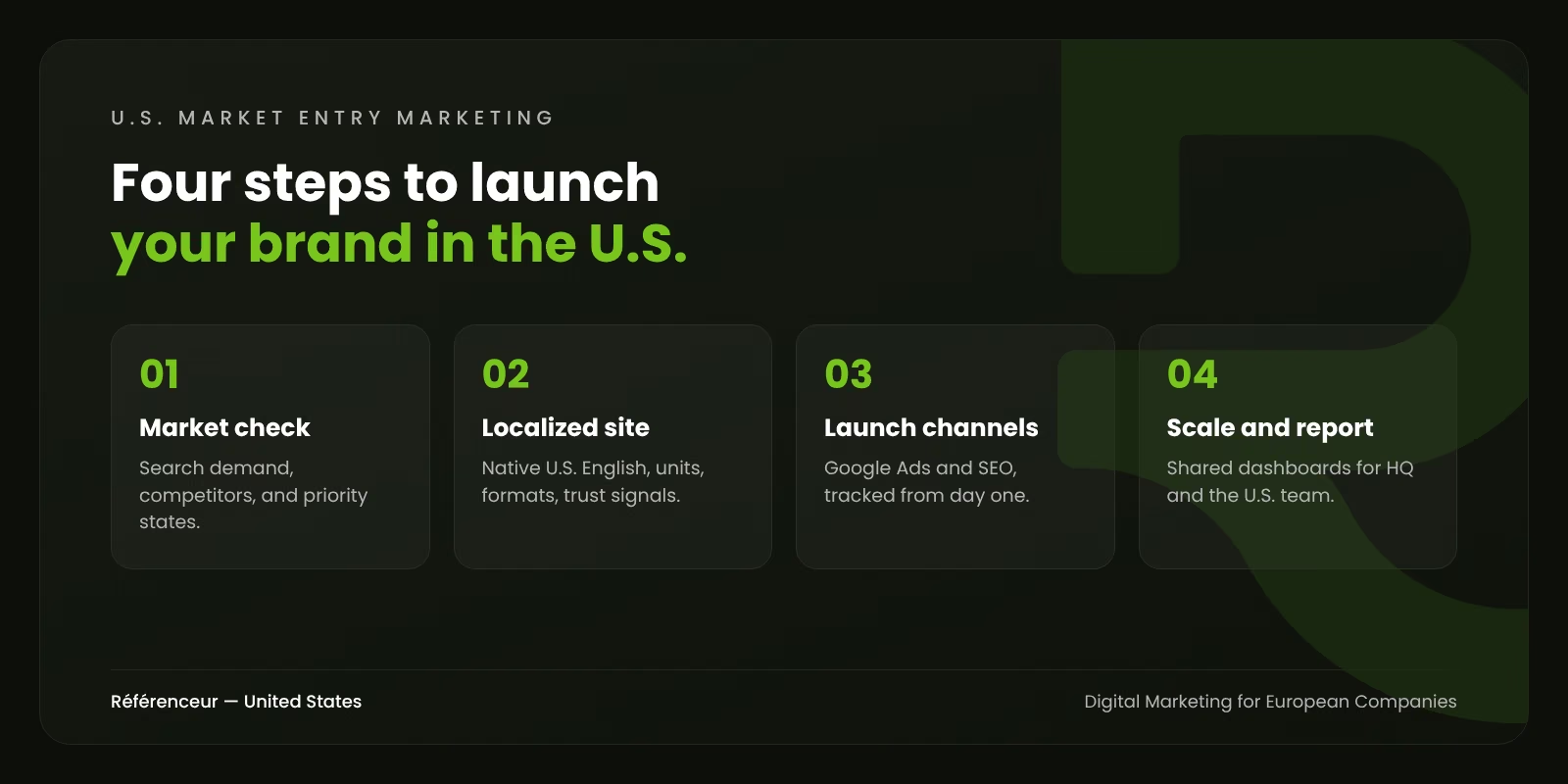
| Market and search research | U.S. keyword demand, competitor analysis, priority states or metros | A launch plan based on real search data |
| Website localization | Native U.S. English copy (not translation), U.S. formats, a dedicated /us/ section or separate site, hreflang setup | A site American buyers trust |
| SEO | Technical setup, landing pages by product and industry, local presence for U.S. offices or warehouses | Organic visibility that grows month after month |
| Google Ads and Microsoft Advertising | U.S.-only campaigns, time-zone-aware schedules, conversion tracking | Leads and sales from launch week |
| Tracking and reporting | GA4, Google Tag Manager, Looker Studio dashboards for HQ and the U.S. team | One shared view of performance |
| Bilingual coordination | Briefs, approvals, and reporting in English or French | Smooth collaboration with your head office |
Launching a European Brand in the U.S.: Common Mistakes
Assuming your EU compliance covers you. There’s no GDPR equivalent at the federal level in the U.S. Instead, more and more states are passing comprehensive privacy laws of their own, such as California’s CCPA as amended by the CPRA. They generally work on an opt-out model, with obligations like honoring “Do Not Sell or Share” requests. Commercial email falls under the federal CAN-SPAM Act, which requires, among other things, a valid physical postal address and a working opt-out. Text messages raise separate issues under federal and state law. This isn’t legal advice; your U.S. counsel should review your setup.
Ignoring accessibility. Accessibility litigation is a routine risk in the U.S.: the law firm Seyfarth Shaw tallied 3,117 website accessibility suits in federal courts in 2025, most of them filed in New York and Florida. Building to WCAG standards from the start is far cheaper than fixing a site after a demand letter.
Running ads from HQ’s time zone. Campaigns scheduled on European business hours burn budget while U.S. buyers sleep and go dark during their working day. We schedule and report in U.S. time.
Copying the European keyword strategy. Product categories often have different names in the U.S. The search terms that work in Germany or France rarely translate directly, which is why our international SEO guide starts with U.S. keyword research.
A U.S. Go-to-Market Digital Strategy That Fits Your Stage
Some companies come to us before incorporating a U.S. entity, to test demand with a landing page and a small paid search campaign. Others already have a U.S. subsidiary and sales team but a website that still reads like a translation. Others are scaling: new states, new verticals, new product lines. Our plan depends on where you are:
- Test: U.S. landing pages, a tightly targeted Google Ads campaign, and clean tracking to measure real demand.
- Launch: a fully localized U.S. website or section, SEO foundations, and paid search across priority regions.
- Scale: content programs, industry pages, additional channels, and reporting that ties marketing to pipeline.
Public resources can help with the non-marketing side. SelectUSA, part of the U.S. Department of Commerce, supports foreign companies investing in the U.S., and many states run their own economic development offices.
Why a European Agency Makes Sense for This
Having no U.S. office is often an advantage for this kind of work. Your marketing team in Europe gets a partner in its own time zone who understands European approval processes, while your U.S. team gets copy and campaigns built for American buyers. Calls with U.S. colleagues happen in their morning, our afternoon. Our partners include Google, Microsoft Advertising, Semrush, and HubSpot. References such as Lupulus, Isolpur, and Auto-école Georges are European clients, and we make no claim to U.S. client results.
Learn more about our SEO agency services, our Google Ads agency work, or our web design agency. If specific cities are your target, start with our U.S. locations hub. Get a free assessment to review your U.S. plan with a Belgian and Luxembourgish team that works natively in French and English and knows both sides of the Atlantic.
Frequently Asked Questions About Digital Marketing for European Companies
Should We Create a Separate U.S. Website or a U.S. Section?
Both can work. A /us/ subfolder on your main domain benefits from your existing authority and is easier to manage. A separate .com site gives more independence for a U.S. brand. We make a recommendation based on your brand structure, resources, and SEO history, and we set up hreflang either way.
Can’t We Just Translate Our Existing Content?
Translation is a starting point at best. U.S. buyers search with different terms, expect different proof points, and respond to a more direct tone. We rewrite content for the U.S. market in native American English, keeping your facts and positioning intact.
Do We Need a U.S. Address to Advertise on Google in the U.S.?
No, you can target U.S. users from a European Google Ads account. But a U.S. address, phone number, and support hours significantly increase trust and conversion rates. Some industries also have certification requirements; we check them before launch.
How Do GDPR and U.S. Privacy Laws Interact?
They’re separate regimes. If you handle data of people in both the EU and the U.S., you may need to comply with both. Your counsel should map the obligations; we configure tracking and consent tools according to their guidance.
How Long Before a U.S. Launch Produces Results?
Paid search can generate leads within days of launch. SEO typically needs several months to build meaningful U.S. visibility, longer in competitive sectors. We set expectations during the free assessment based on your market.