 0498 70 98 60
More than one in five people in the U.S. speak a language other than English at home, according to Census Bureau data for 2017 to 2021. French is part of that picture in specific places: it was the most common language other than English in Maine and Vermont, and it has deep roots in Louisiana. Add Haitian, West African, Canadian, and European French speakers in Miami, New York, Boston, and other metros, plus the many U.S. subsidiaries of French, Belgian, Swiss, and Canadian groups. For these businesses, a French English bilingual website isn’t a nice extra. It’s how they reach clients, partners, and head office in the language each one prefers.
Référenceur designs and builds bilingual websites where both versions read as if they were written natively, and where Google can index and serve the right language to the right person. We’re a European digital marketing agency based in Belgium and Luxembourg, with more than 15 years of web design and SEO experience. Our team works daily in English and French. Request a free assessment for your existing site or your new bilingual project.
Who Needs a Bilingual Website
We typically see four kinds of organizations:
- U.S. subsidiaries of French-speaking groups whose American buyers need native U.S. English, while headquarters in Paris, Brussels, Geneva, or Montreal wants to review content in French. Our page on digital marketing for European companies entering the U.S. covers that situation in more depth.
- Professional firms serving French-speaking clients: immigration lawyers, accountants, real estate agents, medical and dental practices, and financial advisers.
- Businesses in French-speaking communities, such as Haitian and West African neighborhoods in New York and Miami, Acadian and Cajun Louisiana, or northern New England close to Quebec.
- Companies selling into Canada, where Quebec buyers expect French, and where Quebec’s Charter of the French Language sets rules for commercial communication. If you sell into Quebec, check those requirements with counsel; this isn’t legal advice.
Translation Is Not Localization
Most bilingual sites fail because one version is an afterthought. A literal French website translation of American marketing copy sounds stiff; a literal English translation of French copy sounds foreign and loses U.S. buyers in the first paragraph. Machine translation has improved, but it still misses tone, industry terms, and search intent.
Our approach is to write both versions natively. The U.S. English version follows American conventions: direct headlines, month-first dates, U.S. spelling, and the terms Americans actually search. The French version uses natural, professional French adapted to your audience, which may lean European or Canadian depending on who you serve. Facts, offers, and legal content stay aligned between the two; phrasing doesn’t have to.
The Technical Side: Getting Google to Show the Right Language
| Element | Our standard | Why it matters |
|---|---|---|
| URL structure | Separate URLs per language, usually subfolders (/fr/) on one domain | Google recommends distinct URLs; it doesn’t rely on cookies or browser settings |
| Hreflang for English and French | Reciprocal hreflang annotations for en-US and fr (or fr-CA), plus x-default | Helps Google serve the right version in search results |
| Language detection | Visible content fully in one language per page | Google determines language from visible text, not from the lang attribute |
| No forced redirects | A visible language switcher, no automatic redirect by IP or browser | Users and Googlebot can reach both versions |
| Metadata and slugs | Translated titles, descriptions, URLs, image alt text, and schema | Each version can rank in its own language |
| Forms and tracking | Language-specific forms, thank-you pages, and GA4 segmentation | You see which audience converts and how |
Google’s documentation on multilingual sites is clear on these points, and getting them wrong is common. We regularly see sites where the French pages carry English titles, hreflang tags point to the wrong URLs, or a script redirects every visitor based on location, which can stop Google from crawling one of the versions.
Building a Multilingual WordPress Site
Most of our bilingual builds run on WordPress, using an established multilingual plugin to manage translations, URLs, and hreflang. A multilingual WordPress site needs extra care in three areas: plugin compatibility (your forms, SEO plugin, and page builder must all support both languages), performance (translation plugins can add database load), and security (more plugins mean more updates to apply, as our guide on updating WordPress plugins and themes safely explains). We configure, test, and document the setup so your team can add pages in either language without breaking anything.
We also design for both languages from the start. French text often runs noticeably longer than English, and French typography adds its own conventions, such as spacing before certain punctuation marks. Buttons, menus, and headlines need room for both, or the French version ends up with truncated labels and awkward line breaks.
SEO for Each Audience
A bilingual site is really two SEO projects sharing one technical foundation. English and French speakers search for different terms, and sometimes for different things. We research keywords separately for each language, decide which pages need both versions and which only need one, and track rankings and conversions for each. Learn more about our SEO agency work.
If your site also targets other countries, such as Canada or France, the same principles extend to multi-regional setups; our international SEO guide covers country targeting and domain choices. For most U.S. companies, though, a well-built French-English bilingual website on a single domain is the simplest and strongest option.
How We Work With U.S. Clients
Our designers and writers work from Francorchamps, Belgium, and Wemperhardt, Luxembourg, not from a U.S. office, using video calls, shared design files, and staging sites you can review at any hour.
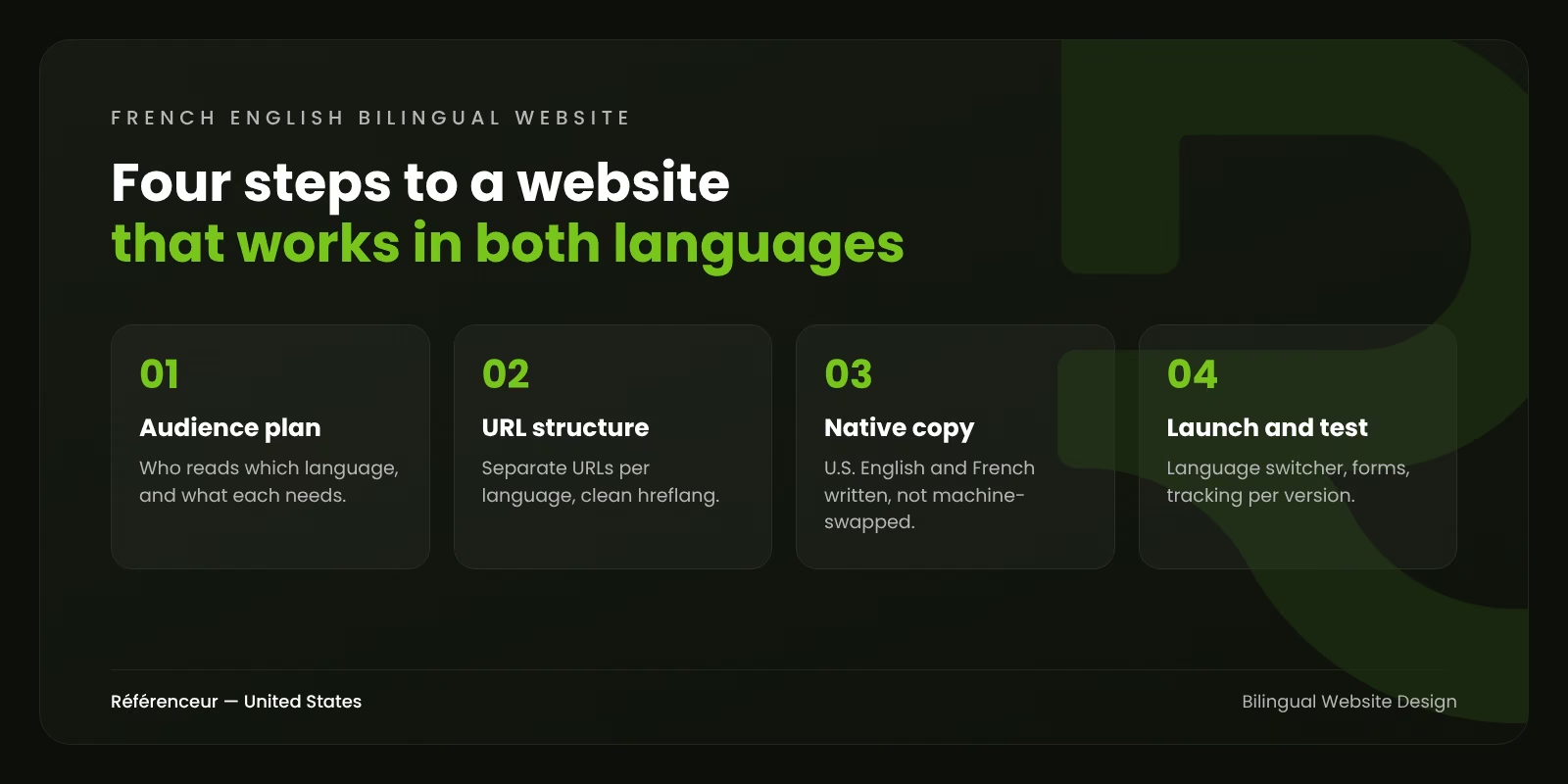
- Discovery call to understand both audiences and who approves each language.
- Site architecture and wireframes designed for English and French from the start.
- Copywriting in both languages, with your reviewers on each side.
- Development, hreflang setup, and testing across devices.
- Launch, Search Console monitoring for both versions, and a post-launch review.
Google, Microsoft Advertising, Semrush, and HubSpot list us as a partner, and our Google rating is 4.7/5 across 107 reviews. Menuiserie Rosen and Auto-école Georges, two of our references, are European clients; we don’t claim any U.S. projects. Our web design agency page describes the overall approach, and the U.S. locations hub covers specific cities. Request a free assessment, and we’ll review how your site performs in both languages.
Frequently Asked Questions About Bilingual Websites
Should the French Version Be on a Separate Domain?
Usually not. Subfolders on one domain (/fr/) are easier to manage and share the domain’s authority. Separate domains make sense mainly when you run distinct brands or target a separate country, such as a Canadian site.
Which French Should We Use: European or Canadian?
It depends on your audience. A U.S. subsidiary reporting to Paris may prefer European French, while a business serving Quebec clients should use Canadian conventions. We can tag the version as fr-CA or fr-FR in hreflang accordingly.
Can We Use Machine Translation and Edit It?
Machine translation can speed up drafts of technical or support content, but marketing pages, service pages, and anything legal should be written or fully edited by a native speaker. We tell you where automation is acceptable and where it isn’t.
Does Every Page Need Both Languages?
No. Some pages may only matter to one audience, such as U.S.-specific legal notices or French-only community content. We map which pages need both versions and set hreflang only where equivalents exist.
Can You Convert Our Existing English Site to a Bilingual One?
Yes. We audit the current site, choose the right multilingual setup, and add French versions without disrupting your English rankings. Request a free assessment to scope the project.