0498 70 98 60
Google Business Profile and AI Search: What Matters for AI Overviews, AI Mode and Ask Maps
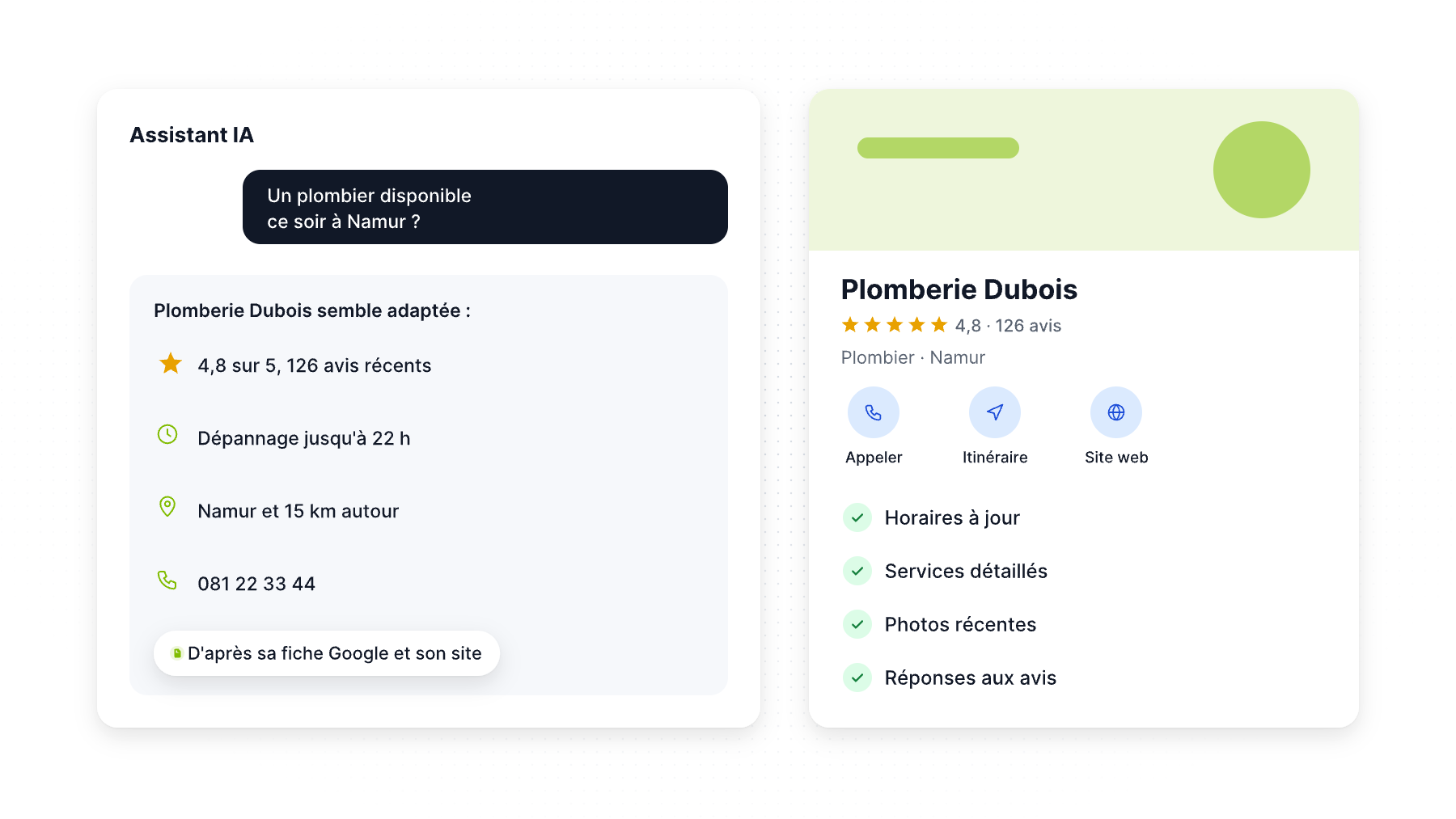
Your Google Business Profile and AI search are now closely linked. People no longer just type “plumber near me” and scan ten blue links. They ask Google’s AI Mode for “a plumber in Austin who can fix a tankless water heater this weekend,” or ask Google Maps which nearby restaurant has a quiet patio for a business lunch. The answer is a short list of businesses, with a sentence on why each one fits.
Where does that list come from? For local businesses, a large share of the answer comes from Google’s own place data: your Google Business Profile, its reviews, photos and attributes. This guide explains how the two fit together, with sourced launch dates, and what to change on your profile so AI tools describe you correctly.
Google’s AI search experiences: a short timeline
- May 14, 2024: AI Overviews. At Google I/O 2024, Google announced that AI Overviews were rolling out to everyone in the US. These AI summaries appear at the top of many search results.
- Early March 2025: AI Mode in Labs. Google began testing AI Mode, a conversational search mode, as a Labs experiment.
- May 20, 2025: AI Mode for everyone in the US. At I/O 2025, Google started rolling out AI Mode to all US Search users, running on a custom version of Gemini 2.5.
- October 17, 2025: Grounding with Google Maps. Google made Maps data available to developers building on the Gemini API, connecting Gemini to information on more than 250 million places, including reviews, hours and ratings.
- March 12, 2026: Ask Maps. Google introduced Ask Maps, a Gemini-powered conversational feature inside Google Maps, rolling out in the US and India on Android and iOS, with desktop announced as coming soon. MacRumors reported that it draws on information from more than 300 million places, including reviews from the Google community.
The Gemini app can also use public Google Maps information to find places and show their addresses, websites, ratings, opening hours and reviews.
How Google Business Profile and AI search work together
AI answers about local businesses need facts: what you do, where, when you’re open, what customers think and what makes you different. Your Business Profile provides most of those facts in a structured form:
| Profile element | What AI tools can do with it |
|---|---|
| Primary and additional categories | Decide whether you match the request at all |
| Services, products, menu | Match specific needs (“tankless water heater,” “gluten-free”) |
| Hours and special hours | Answer “open now,” “this weekend,” “on Thanksgiving” |
| Attributes (wheelchair accessible, outdoor seating, women-owned, etc.) | Filter by criteria people mention in a question |
| Reviews and owner replies | Summarize strengths and weaknesses in customers’ words |
| Photos | Support visual details (patio, parking, storefront) |
| Website link | Point to your own pages for more detail |
The practical consequence: every vague or missing field is a question an AI tool can’t answer about you. It may answer with a competitor that filled it in.
What to optimize for AI search
1. Categories that describe your core business precisely
Your primary category is still the foundation. Local SEO experts rank it as the top local pack factor in Whitespark’s 2026 survey, and it tells AI systems what kind of business you are. Our guide on the Google Business Profile primary category explains how to choose it.
2. Services described in plain language
Fill in the Services section with the terms customers actually use, then make sure your website has a page for each main service. AI answers often combine Maps data with web content, so the two should agree.
3. Attributes and accurate hours
Conversational queries often include a condition: “open late,” “accepts walk-ins,” “wheelchair accessible,” “free parking.” Set every attribute that truly applies, and update special hours before every holiday.
4. Reviews that mention specifics
When customers write “they replaced our water heater the same day” or “great for kids’ birthday parties,” those details become material for AI summaries. You can’t tell customers what to write, and you must not script or incentivize reviews (see our guide to Google reviews and US law). You can ask every customer for honest feedback and reply to reviews in a way that adds context.
5. Consistent data everywhere
AI assistants outside Google, such as ChatGPT, Perplexity and Copilot, rely on many sources. In Whitespark’s 2026 survey, experts placed citation factors among the most important signals for AI search visibility. Make sure your name, address, phone, hours and categories match on Apple Business, Bing Places, Yelp and industry directories (see our NAP consistency guide).
6. Fresh photos and posts
Recent photos and posts keep your profile current for customers and give AI tools up-to-date visual and factual details. A simple monthly routine is enough for most small businesses.
How to check how AI describes your business
Run the questions your customers would ask, and record the answers every month:
- In Google AI Mode: “best [service] in [city] for [specific need]”
- In Ask Maps (Google Maps app): “Which [business type] near me is open Sunday and has good reviews for [criterion]?”
- In Gemini, ChatGPT and Perplexity: “Who should I call for [problem] in [city]?”
Check whether you appear, how you’re described and whether any information is wrong. If an AI tool gives an outdated phone number or hours, the source is usually an inconsistent listing somewhere on the web.
Can you measure AI visibility in your Business Profile?
Not separately, yet. When Ask Maps launched, Search Engine Roundtable reported that, according to Google, standard Maps impressions apply. Interactions should therefore appear in your usual Business Profile reporting, not as a separate category, at least for now. Google also said ads weren’t part of Ask Maps at launch.
In practice, monitor:
- Profile views, calls, direction requests and website clicks in your Performance report
- The search terms report, where longer, conversational queries may appear
- UTM-tagged visits from your profile in Google Analytics 4
- Your monthly manual checks in AI tools
What doesn’t change
AI search doesn’t change the basics of a strong local presence. Google still says local results depend mainly on relevance, distance and prominence, and that there’s no way to pay for a better local ranking. AI tools reward the same things customers do: accurate information, a clear specialty, and a steady record of satisfied customers.
Get your business ready for AI search
Référenceur helps US businesses give AI tools accurate, consistent information to work with: Business Profile optimization, citation cleanup, service pages and monthly AI visibility checks. See our AI search optimization (GEO) and local SEO services, or contact us for a free assessment.
FAQ
Does my Google Business Profile affect AI Overviews and AI Mode?
Google’s AI experiences draw on Google’s place data for local requests, and your Business Profile is the main source of that data for your business. Accurate categories, hours, attributes and reviews make it easier to include and describe you correctly.
What is Ask Maps?
Ask Maps is a Gemini-powered conversational feature in Google Maps, announced on March 12, 2026. It started rolling out in the US and India on Android and iOS. It answers questions about places using Maps information, including community reviews.
When did AI Mode launch in the US?
Google began rolling out AI Mode to all US Search users on May 20, 2025. That followed a Labs test that started in early March 2025.
Can I see Ask Maps traffic in my Business Profile reports?
Not as a separate metric. At launch, Google indicated that standard Maps impressions apply. Activity therefore appears in your regular Business Profile Performance report.
How do I get recommended by ChatGPT for local searches?
Keep your business information consistent across the web, earn genuine reviews and publish clear service pages. Then check every month what AI tools say about you. No one can guarantee a recommendation, but accurate and consistent data improves your chances.
Want to know how AI tools describe your business today? Contact Référenceur for a free local AI visibility check.