0498 70 98 60
ChatGPT: OpenAI Launches the Business Hub
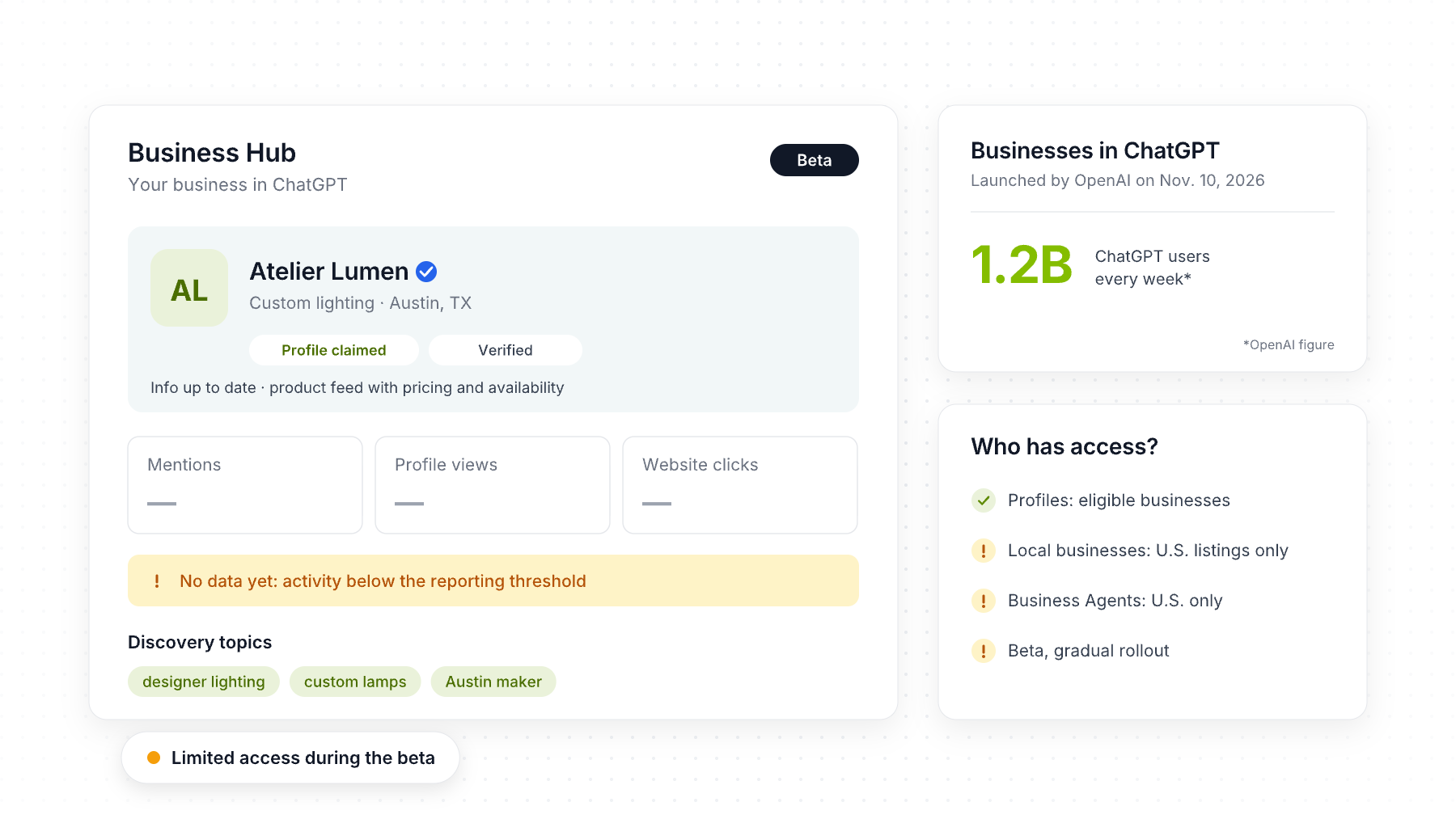
OpenAI has launched “Businesses in ChatGPT,” a space where companies can claim their profile, update their information, and see how ChatGPT talks about them. Think of it as a Google Business Profile for AI. One important caveat: it’s a beta, and not every business has access yet.
Before you dive in: access is rolling out gradually and depends on your industry, your location, and identity verification. Local stores and restaurants can currently claim only an existing U.S. listing, and Business Agents are limited to eligible U.S. ecommerce and online service businesses. If you can’t find your business or your claim is declined, it isn’t something you did wrong.
What OpenAI just launched
On November 10, 2026, OpenAI introduced Businesses in ChatGPT, a beta program for businesses. Its entry point is the Business Hub, available at chatgpt.com/business-hub or from the ChatGPT sidebar. OpenAI points to an audience of 1.2 billion people who use ChatGPT every week.
The idea is simple: ChatGPT already talks about your business when someone asks about your industry, whether you like it or not. The Business Hub lets you take back control of that information. It also follows the arrival of ads in ChatGPT: OpenAI is steadily building out a full offering for businesses.
What the Business Hub lets you do
- Claim your business and, once verification is approved, update your key details.
- Add a product feed with pricing and availability, so ChatGPT presents your offering with accurate data. Shopify merchants can connect their store directly.
- Track insights over the past 28 days: mentions, profile views, and clicks to your website.
- See your “discovery topics”: the conversation themes in which your website is cited. They help you spot information to add or clarify.
OpenAI is also launching Business Agents: an assistant that speaks for your business, which customers can chat with to explore your offering, compare products, or ask follow-up questions. The concept is close to the AI chatbots you can already add to your own website.

Who actually has access?
This is the point we want to be very clear about, because enthusiastic announcements often gloss over it.
- Profile claiming is open, in principle, to any eligible business located where ChatGPT is available and the required verification is supported. OpenAI doesn’t publish a detailed list of supported countries or excluded industries.
- Local stores and restaurants can currently claim only an existing U.S. listing. Being based in the U.S. helps, but eligibility checks, verification, and the gradual rollout still apply.
- Business Agents are initially limited to eligible ecommerce and online service businesses in the U.S. that have a website. OpenAI says it will expand to more markets and categories, with no timeline.
- OpenAI Enterprise customers and advertisers claim their business through their OpenAI representative.
In practice, even as a U.S. small business, you can try today, but be prepared for the process not to go through yet, or only partly.
How to claim your business
If you’re eligible, the process takes a few steps:
- Open the Business Hub and search for your business.
- Request the claim. You must own the business or be authorized to manage it.
- Prove the business is yours: by text message or phone call to the business’s main number, or through DNS verification on your domain.
- Verify your identity with Persona, the verification provider OpenAI uses.
Until your claim is approved and identity verification is complete, you can’t publish changes, add product feeds, or view insights.
Insights are still very limited
Don’t expect a rich dashboard on day one. Data is aggregated and only appears once activity passes OpenAI’s reporting thresholds, so an empty field doesn’t necessarily mean zero activity.
Barry Schwartz of Search Engine Roundtable claimed his site at launch. A week later, he still had no data, while other users were starting to see theirs. OpenAI also notes that the clicks shown don’t confirm actual visits or conversions, so cross-check these numbers with your own analytics.
On privacy, OpenAI says businesses can’t see individual users’ conversations or their chats with the Business Agent.
A risk to watch: profile hijacking
Just as with Google Business Profile in its early days, fraudulent claims are a concern. Search Engine Roundtable voiced worries about businesses being hijacked by third parties. That’s one more reason to keep an eye on how your business appears in ChatGPT, and to claim your profile as soon as you’re eligible.
What we recommend to our clients
1. Check your access, with realistic expectations
Go to the Business Hub and see whether your business shows up and whether you can claim it. If not, just make a note and check back regularly: access is opening in stages.
2. Get ready for verification
Make sure your business’s main phone number can be reached and that you have access to your domain’s DNS settings (or to your hosting provider). You’ll save time when access opens.
3. Work on what ChatGPT already knows about you
Even without the Business Hub, ChatGPT relies on public information: your website, your directory listings, your Google Business Profile, reviews, and articles about you. Consistent information everywhere, clear pages, and structured data remain the foundation of your SEO and your visibility in AI tools. That’s the core of AI search optimization (GEO).
4. Measure what actually reaches your website
Start tracking traffic from ChatGPT and other AI assistants in your analytics tool now. Today, it’s a far more reliable indicator than the Business Hub’s early insights.
Key takeaways
- OpenAI has launched Businesses in ChatGPT in beta, along with the Business Hub, a kind of business profile for ChatGPT.
- You can claim your business, update your information, add a product feed, and view insights.
- Access is still limited: local business claims and Business Agents are U.S.-only for now, and the rollout is gradual everywhere.
- Insights are still thin and subject to thresholds.
- The priority remains keeping the public information ChatGPT already relies on accurate and consistent.
Frequently asked questions about the ChatGPT Business Hub
Possibly. Claiming is open to eligible businesses in countries where ChatGPT and the required verification are available, but access is rolling out gradually. Local stores and restaurants can currently claim only an existing U.S. listing.
OpenAI presents profile claiming as free. No pricing has been announced for the Business Hub.
At launch, Business Agents are limited to eligible ecommerce and online service businesses in the U.S. that have a website. OpenAI plans to expand access to more markets and categories, with no date announced.
No. Your profile lets you provide accurate information and track your visibility, but ChatGPT still chooses its answers based on relevance and the sources available.
Data only appears once activity passes OpenAI’s reporting thresholds. An empty metric doesn’t necessarily mean no one is talking about you.
Want to know what ChatGPT says about your business?
With our SEO and AI audit, we analyze how your business appears in ChatGPT, Gemini, Copilot, and Google’s AI Overviews, and help you get your profile ready for the day the Business Hub opens up to you. Book a free initial consultation.