 0498 70 98 60
Marketing in Switzerland and Luxembourg: Two Small Markets With Outsized Buyers
Marketing in Switzerland and Luxembourg rewards U.S. companies that do their homework. Both countries are small, wealthy, and multilingual, and both are often lumped together on a European expansion slide. On the ground they work very differently: one sits outside the European Union and pays in Swiss francs, the other helped found what became the EU, and much of its daytime workforce crosses in each morning from three neighboring countries.
We know the second one from the inside. Référenceur runs an office in Wemperhardt, in the far north of Luxembourg, alongside our Belgian base in Francorchamps, and everyone on the team writes in native French as well as English. That French-speaking, Belgian, and Luxembourgish mix is why we can cover Romandy and the Grand Duchy in the same conversation. This page lays out what separates the two markets and where each one tends to pay off.
Same Slide, Different Markets: A Side-by-Side View
Before choosing channels, line up the basics. Many launch mistakes in these two countries come from treating them as one region.
| Topic | Switzerland | Luxembourg |
|---|---|---|
| EU membership | No | Yes, a founding member of the European Communities |
| Currency | Swiss franc (CHF) | Euro |
| Languages that matter for marketing | German, French, and Italian by region, with English rising | French, German, Luxembourgish, and English, often side by side |
| Privacy framework | The revised Federal Act on Data Protection (in force since September 1, 2023) | The EU’s GDPR |
| Who you’re really talking to | Regional audiences: Romandy behaves differently from Zurich | Residents, commuters, and a large international finance workforce |
| Typical first channel | Search and shopping ads by language region | LinkedIn and search for B2B, with geotargeting that reaches across the borders |
French-Speaking Switzerland Marketing: Romandy Is Its Own Market
According to the Federal Statistical Office, 23% of permanent residents named French as a main language in 2023, against 66% for German, 8% for Italian, and 0.5% for Romansh. English stood at 6%, up from 4% in 2010. Those French speakers live mainly in the west: Geneva, Vaud, Neuchâtel, Jura, and the French-speaking parts of Fribourg and Valais, which are both bilingual cantons.
Three practical points shape French-speaking Switzerland marketing:
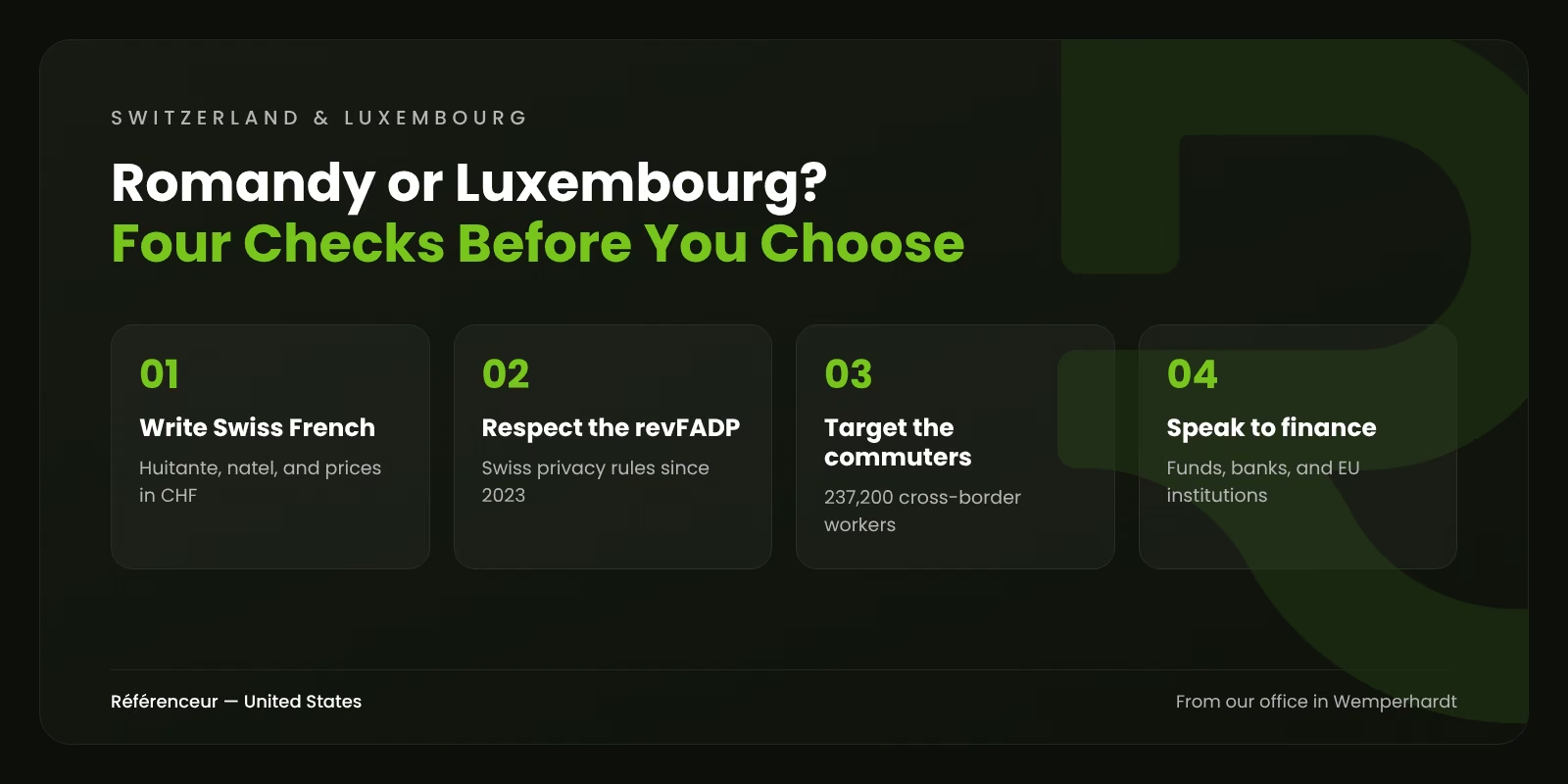
- Swiss French is not Parisian French. People in Vaud and Valais often say “huitante” for 80, Swiss speakers generally use “septante” and “nonante,” and a cell phone is commonly a “natel.” Copy written in Paris reads as imported.
- Prices belong in CHF. A euro price with a conversion note tells a Lausanne shopper the store wasn’t built for them. Swiss landing pages need their own currency, shipping terms, and returns address.
- Geneva has an international layer. The United Nations Office at Geneva, the World Health Organization, and the International Committee of the Red Cross are headquartered there, so B2B campaigns often need an English version next to the French one.
On the technical side, a fr-CH section with its own hreflang tags and a clean URL structure lets Google show Swiss pages to Swiss searchers. Our guide to SEO-friendly URLs covers how to name those folders. If French copy already exists for France, our French website localization team can adapt it for Romandy instead of starting over.
Swiss Privacy Rules Since September 2023
Switzerland is outside the EU, so it has its own data protection law. The revised Federal Act on Data Protection (often shortened to revFADP or nFADP) took effect on September 1, 2023. The Swiss government’s guidance for small and midsize companies highlights a few points that touch marketing directly:
- Privacy by design and by default. Products, services, and software should protect personal data in their structure and in their default settings, without the user having to act.
- Breach notification. A data security breach must be reported promptly to the Federal Data Protection and Information Commissioner (FDPIC) when the conditions apply.
- Records of processing activities. A register is required, with exemptions for some smaller companies.
What that means for a campaign: forms, tracking tags, and email sign-ups on your Swiss pages should be reviewed against the Swiss law, not only against U.S. habits or the GDPR. This summary is not legal advice; a Swiss lawyer should confirm what applies to your setup.
Luxembourg: 691,000 Residents, Many More Daily Buyers
STATEC, Luxembourg’s statistics office, put the population at about 691,000 on January 1, 2026, with foreign nationals making up 47% of residents. The figure that matters more for marketers is the workforce. In 2025, 237,200 people worked in Luxembourg while living abroad. Among salaried cross-border workers, 124,900 lived in France, 53,400 in Germany, and 51,900 in Belgium. Total employment came to about 522,200 jobs.
In plain terms, close to half of the people working in the country go home across a border every evening. For a U.S. brand, that changes three settings:
- Geotargeting. A campaign that stops at Luxembourg’s borders misses buyers who search from Thionville, Arlon, or Trier at night and shop in Luxembourg by day.
- Language. French is the everyday working language for a large share of commuters, German matters for those from Germany, and English dominates many finance offices.
- Timing. Weekday ads in Luxembourg reach office workers; evening and weekend ads reach many of the same people in another country.
Luxembourg Digital Marketing for US Companies in Finance and B2B
Luxembourg punches far above its size in finance. The CSSF, the financial regulator, reported total net assets of about 6.79 trillion euros in Luxembourg investment funds as of August 31, 2026, spread across 2,826 funds, plus 118 banks and 61,732 people working in the financial center. The country also hosts several EU institutions, including the Court of Justice of the European Union, the European Investment Bank, and the European Court of Auditors.
That profile shapes Luxembourg digital marketing for US companies selling software, data, compliance, or professional services:
- Decision-makers are concentrated, so paid search volumes are small. Our article on Google Ads in niche markets explains how to run campaigns when data is scarce.
- LinkedIn targeting by company and job title often matters more than broad keywords.
- Financial-sector content is reviewed by compliance teams. Plan approval time into the calendar, and check sector rules with your own advisers before publishing claims.
Who Reads What in Luxembourg
Luxembourg’s 1984 law on languages names Luxembourgish as the national language, French as the language of legislation, and French, German, and Luxembourgish as administrative languages. In marketing, the split looks roughly like this:
- French for most websites, retail, and B2B services
- German for parts of the press and for audiences from Germany
- English for finance, tech, and international teams
- Luxembourgish for a warm local touch in social posts or events, rarely for full sites
A French and English site covers most needs at launch. Adding German depends on your sector and on how many buyers you expect from Germany.
How We Work With U.S. Teams From Wemperhardt
Our Luxembourg office sits right by the Belgian border and a short drive from Germany, and our Belgian office is in Francorchamps. Being Belgian and Luxembourgish, with French as our first working language, we live the cross-border, multilingual reality this page describes every day. If Belgium is also on your list, read our page on marketing in Belgium; for the larger French market, see marketing in France. Our French SEO and broader French-language marketing services apply to all of them.
We don’t keep an office in the States. Instead, you get video meetings, live walkthroughs of your accounts, and an English-language report each month. Want to know whether Geneva or Luxembourg City is the better first step for your product? Get a Free Assessment and we’ll compare both markets for you.
Frequently Asked Questions About Marketing in Switzerland and Luxembourg
Can One French Website Serve France, Switzerland, and Luxembourg?
One French base text can, but each country needs its own adjustments. Switzerland needs CHF prices and Swiss usage, while Luxembourg usually needs euro pricing, delivery terms for a small cross-border market, and often an English or German version. Separate country sections with hreflang tags let search engines show the right one.
Does the GDPR Apply in Switzerland?
Switzerland is not an EU member and has its own law, the revised Federal Act on Data Protection, in force since September 1, 2023. The GDPR can still matter if you also target people in the EU. Which rules apply to your setup is a question for a lawyer, not a marketing agency.
Is Luxembourg Too Small for Paid Search?
Search volumes are small, but buyers are concentrated and often high value. Campaigns usually work best with tight keyword lists, cross-border geotargeting, and LinkedIn for B2B. We check real search volumes for your terms during the free assessment before suggesting a budget split.
Should We Write in German for Luxembourg?
Not always at launch. French and English reach most of Luxembourg’s business and retail audience. German becomes worthwhile when you target commuters from Germany, specific press titles, or sectors where German is the working language.
Which Should Come First, Romandy or Luxembourg?
It depends on what you sell. Consumer brands with Swiss pricing power often start in Romandy. B2B companies selling to funds, banks, or EU bodies often start in Luxembourg. If you’re unsure, request a free assessment and we’ll compare demand in both before you commit.