 0498 70 98 60
French Website Localization That Reads Like It Was Written in French
French website localization is the work that happens after the words are translated: prices that show in euros or Canadian dollars, dates a Parisian reads correctly, a cookie banner that meets French expectations, and a tone that sounds like a company, not a dictionary. Skip it, and French-speaking visitors notice within seconds. They may not say why the site feels off, but they leave.
We see this from the other side every day. Référenceur’s team is native French-speaking. We work from Francorchamps in Belgium and Wemperhardt in Luxembourg, and English is our second working language. When an American site lands in front of us in French, we read it the way your future customers in Brussels or Montreal will. We do the work remotely for U.S. companies, with video meetings, shared review files, and a monthly status note. To find out how your current French pages read to a native speaker, request a free assessment.
What Changes Beyond the Words
A localized page looks different even when the message is identical. Formats, legal habits, and expectations shift by country. This table shows the details we adjust most often on a U.S. site:
| Element | U.S. original | France | Quebec |
|---|---|---|---|
| Numeric date | 11/01/2026 | 01/11/2026 | 2026-11-01 |
| Price | $1,250.50 | 1 250,50 € | 1 250,50 $ |
| Taxes in displayed price | Usually added at checkout | Included for consumers | Usually added at checkout |
| Time | 2:30 p.m. | 14 h 30 or 14h30 | 14 h 30 |
| Postal address | City, state, ZIP | Postal code before the city | City, province, postal code |
| Measurements | Inches, pounds, °F | Metric, °C | Metric, °C |
| Printable PDFs | Letter size | A4 | Letter size |
Belgium and Luxembourg follow France on most of these points, with euro prices. French-speaking Switzerland uses Swiss francs and often an apostrophe as the thousands separator, as in CHF 1’250.50. None of this is hard, but each item needs a decision, and every decision has to be applied across templates, emails, invoices, and PDFs, not only on the pages a visitor reads first.
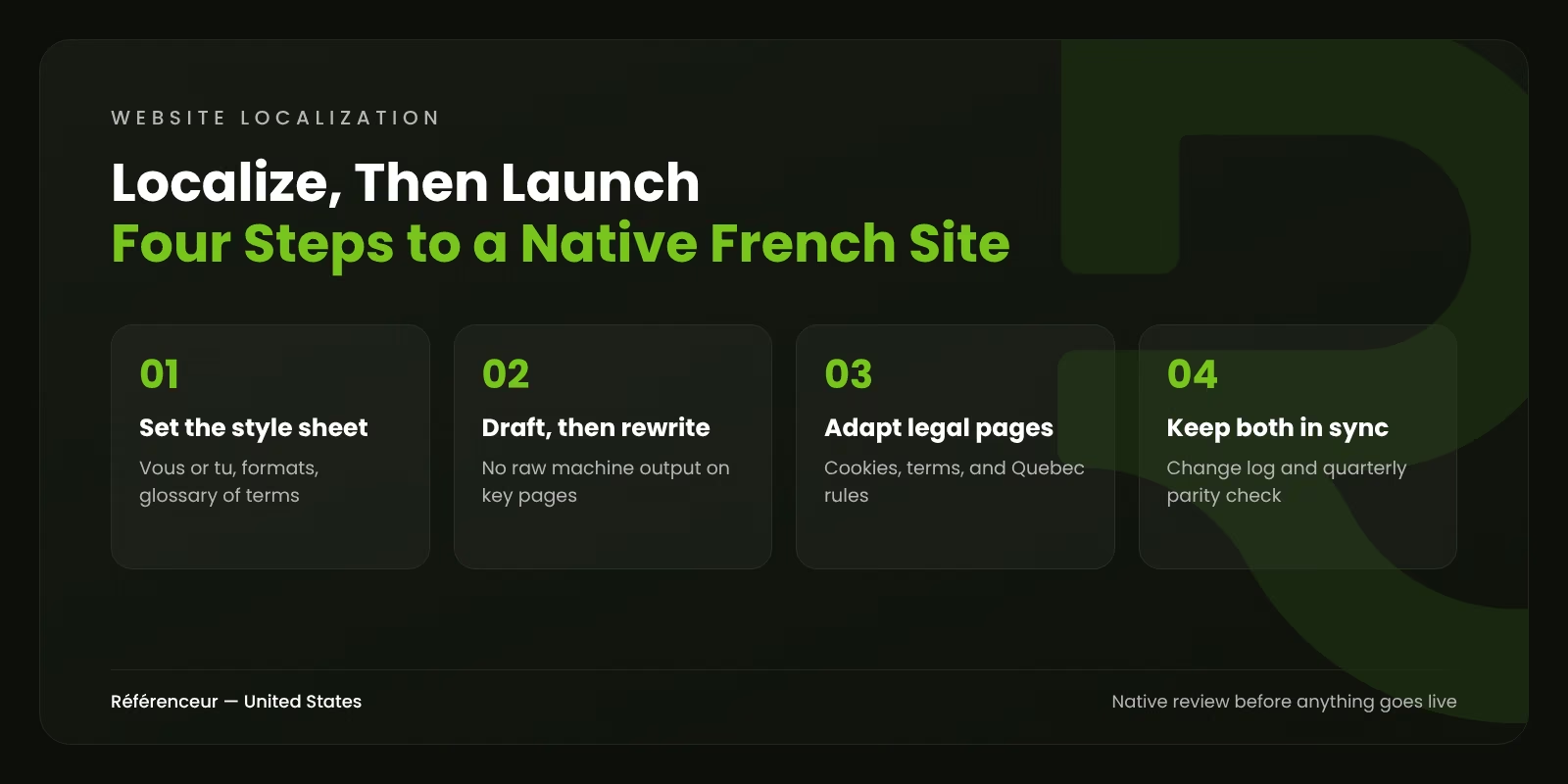
Tone is the other big shift. French copy addresses the reader as “vous” or “tu,” and the choice sets the whole relationship. Most B2B and professional sites in France and Belgium use vous. Some consumer brands use tu, and casual brand copy in Quebec leans that way more often. We decide this with you once, write it into a style sheet, and keep it consistent everywhere, including error messages and button labels.
Machine Translation: Useful Draft, Risky Final
Machine translation is fast and often grammatically correct. Its problem is that it is confidently wrong in places a buyer cares about. The usual culprits are false friends, words that look alike in English and French but mean different things:
- “Actually” can turn into “actuellement,” which means currently.
- “Eventually” can turn into “éventuellement,” which means possibly.
- “Library” can turn into “librairie,” which is a bookstore.
- “Locations” left untouched in a store finder reads as rentals in French.
- “To demand” rendered as “demander” softens a requirement into a polite request.
On a pricing page or a terms page, any of these can change a promise. That is why our workflow treats machine output as a draft at most. A native writer rewrites it against a glossary of your product terms, a second native speaker checks it in context on a staging site, and anything legal goes to your counsel. For short, high-stakes copy such as headlines, calls to action, and product names, we skip the machine entirely and write in French from the brief.
Legal Pages and Language Rules by Country
Some rules make localization mandatory rather than optional. We flag them so your counsel can decide what applies to you; none of this is legal advice.
France. Under the Toubon Law of August 4, 1994, French is mandatory in every form of advertising. The same law covers how goods and services are named, offered, presented, and explained, along with warranty terms and invoices. France’s Ministry of Culture notes that this covers products offered through online sales sites. On cookies, the French data-protection authority, the CNIL, adopted revised cookie guidelines in September 2020, published them on October 1, 2020, and has insisted since that refusing cookies must be as easy as accepting them. A U.S.-style banner with a single “OK” button does not meet that bar.
Quebec. Éducaloi, a Quebec legal-information organization, summarizes the Charter of the French Language this way: a business with an address in Quebec must have a French version of its website, and a store that sells online to Quebec customers must provide everything needed to complete a purchase in French, including product details, orders, invoices, and receipts. English can sit alongside French, as long as the French version exists.
Privacy and legal notices in general. Your privacy policy, terms of sale, return policy, and cookie notice should exist in French for each market you sell to, written for local rules rather than translated from a U.S. template. We localize the language and the structure; your lawyer validates the substance.
Which Pages to Localize First
Localizing everything at once is slow and expensive, and it delays the moment you learn whether French visitors convert. We usually work in this order:
- Pages that close business: the homepage, top product or service pages, pricing, and the contact or demo form, including confirmation emails.
- Everything in the purchase path: cart, checkout, account creation, transactional emails, and invoices.
- Legal and trust pages: privacy, cookies, terms, returns, shipping, and the “about” page.
- Support content that prevents tickets: FAQs, setup guides, and sizing or compatibility charts.
- Marketing content chosen with search data, which our French SEO agency team selects by country rather than by translating the whole blog.
Each localized page also needs a French URL slug, a French title tag, and French image alt text. Our guide to SEO-friendly URLs explains why the slug matters more than many teams assume.
Choosing the Technical Setup
How French content is stored determines how easy it is to maintain. On WordPress, the three setups we see most often each have a clear trade-off:
- A multilingual plugin such as WPML or Polylang stores each French page as its own post inside WordPress. You keep full control and own every word, but plugin updates, page builders, and forms all need testing in both languages.
- A translation proxy or cloud service (Weglot is a well-known example) captures your English content and serves a translated version from the provider’s system, usually priced by word count. Setup is quick; the risk is dependence on the subscription and less control over layout and URLs.
- A separate French site on its own installation suits companies whose French offer differs a lot, for instance a Canadian entity with its own catalog. It doubles maintenance.
Whatever the choice, we check that each French page has its own crawlable URL with server-rendered French text, and that switching languages never relies on a cookie or an automatic redirect. If you are rebuilding at the same time, our website redesign SEO article covers redirects so existing rankings survive. Our web design agency team handles the build itself.
Keeping English and French in Sync After Launch
The real cost of a French site appears six months later, when the English pricing page has changed twice and the French one still shows last year’s offer. Parity needs a process:
- One owner per language, named in writing, who approves every change.
- A change log: each English update creates a French task, with a deadline.
- A shared glossary and style sheet, updated whenever a new product term appears.
- A quarterly parity check comparing prices, features, legal text, and contact details across versions.
- Native review before anything goes live, including emails and pop-ups.
If your team writes English and wants French to follow automatically, we can set up a monthly retainer for updates. Not sure whether to update or rebuild? Talk to us before you commit to either. If you want a site designed for both languages from day one, see our bilingual French-English website design service.
A Localization Partner From Belgium and Luxembourg
We grew up in countries where a single street can switch languages, and where getting the French slightly wrong costs you the customer. That habit is what we bring to a U.S. company: Belgian and Luxembourgish marketers and writers, native French speakers who are fluent in American English, plus more than 15 years of building and ranking websites. On Google, 107 client reviews put us at 4.7/5.
Localization usually sits inside a larger plan for French-speaking buyers, from search to ads to social; our French-market marketing page shows how the pieces connect. When you are ready to see what your site needs, get a free assessment: a native speaker reviews a sample of your pages in French and tells you plainly what to fix.
Frequently Asked Questions About French Website Localization
Should Our French Site Use “Tu” or “Vous”?
For most B2B companies, professional services, and premium brands, vous is the safe and expected choice in France, Belgium, and Switzerland. Tu can work for youth-oriented or very casual consumer brands, and it appears more often in Quebec. The worst option is mixing both, which happens when several translators work without a style sheet.
Is Neutral International French Enough, or Do We Need Regional Versions?
Neutral international French can work if you avoid regional terms, prices, and legal details that only fit one country. Once you show prices, ship products, or publish terms of sale, separate versions for France and Canada are usually worth it. Belgium and Luxembourg can often share a European French version with small adjustments.
Do We Have to Translate Our Product Names and Trademarks?
Not always. A recognized trademark can usually stay in English. In Quebec, however, legal commentators note that under the rules in force since 2025, generic and descriptive words on products, such as “cleaner” or “hand cream,” must appear in French with the required prominence even when they sit next to an English trademark. Ask your counsel which of your product names and descriptors are affected.
What Do You Need From Us to Get Started?
Access to your website or a content export, your English style guide if you have one, a list of product terms you never want translated, and one person on your side who can answer questions about the offer. If you already have French pages, send them too; reviewing them often saves time.
Who Checks the French Before It Goes Live?
A native French speaker on our team who did not write the text reviews every page on a staging site, in context, on desktop and mobile. If you have French-speaking colleagues or distributors, we invite them to review as well. Their feedback goes into the glossary so the next batch needs fewer corrections.