 0498 70 98 60
French-Language Marketing Agency for U.S. Brands Selling Beyond English
A French-language marketing agency is worth hiring for one reason: “French” is not one market. It is France, Belgium, Switzerland, Luxembourg, Quebec, and a large part of Africa, each with its own currency, legal habits, vocabulary, and search results. A U.S. company that launches one translated site for all of them usually learns about those differences from its own budget.
Référenceur sees this from the other side of the Atlantic. We’re a digital marketing agency from French-speaking Belgium and from Luxembourg, with offices in Francorchamps and Wemperhardt and more than 15 years spent on search, ads, and websites. Everyone on the team writes native French as well as English, so one partner can draft a Geneva landing page, check a Quebec ad, and walk your VP of growth through both.
Six French-Speaking Markets, Sized and Compared
The Organisation internationale de la Francophonie (OIF) put the number of French speakers at 396 million in the 2026 edition of its report on the French language, which by its ranking makes French the fourth most spoken language in the world. The new count includes children aged 6 to 9 who are learning to read and write in French; the previous method gives 348 million. Close to 65% of French speakers live in Africa.
That geography matters more than the headline. Here is how we open the first conversation about marketing to French-speaking countries:
| Market | Currency and price format | Domain and hreflang | First thing a U.S. team should know |
|---|---|---|---|
| France | Euro, written “1 250,00 €” | .fr, fr-FR | The largest single market; written ads and product information must be in French |
| Belgium (Wallonia and Brussels) | Euro | .be, fr-BE | Brussels is officially bilingual, so plan for Dutch as well as French |
| Switzerland (Romandy) | Swiss franc, often “CHF 1’250” | .ch, fr-CH | French is the main language of about 23% of residents (2023 figures), alongside a German-speaking majority |
| Luxembourg | Euro | .lu, fr-LU | French is one of three administrative languages, and many workers commute in from France, Belgium, and Germany |
| Quebec | Canadian dollar, “1 250,00 $” | .ca, fr-CA | The Charter of the French Language reaches ads, websites, contracts, and software |
| Francophone Africa | CFA franc in much of West and Central Africa, plus national currencies | Country domains; a generic “fr” version is often the starting point | The fastest-growing share of French speakers; payment and delivery work differently |
If Quebec or France is your first target, our pages on marketing in Quebec and marketing in France go deeper into each one.
Localization vs. Translation: Where U.S. Copy Gives Itself Away
Translation converts sentences. Localization decides what a buyer in Lyon or Laval actually needs to read, and that’s the work a French localization agency for U.S. companies should be judged on. A translated page can be grammatically perfect and still feel imported. These are the details we change most often:
- Quotes and bids. A B2B buyer in France or Belgium requests a “devis”; in Quebec, a contractor or supplier is more often asked for a “soumission.”
- Marketing vocabulary. Quebec usage prefers “infolettre” to “newsletter” and “balado” to “podcast,” while French marketers in Paris tend to keep the English words.
- Sales periods. France regulates its “soldes” into two official sale periods a year, so “sale” campaigns copied from a U.S. calendar may need different wording.
- Student and housing terms. In Belgium, a student room is a “kot,” a word nobody in Paris uses.
- Prices. The symbol moves after the number, the comma becomes the decimal mark, and Swiss pages often use an apostrophe to separate thousands.
We start from one master French version written by a native writer, then add country variants only where vocabulary, currency, legal wording, or proof changes. Our French website localization service covers that workflow, and if your English site needs the same care, see our work on bilingual French-English website design.
The Rules Your Marketing Team Will Touch First
In French-speaking markets, ads, pages, and banners carry legal weight. This isn’t legal advice; check with counsel in each country before launch.
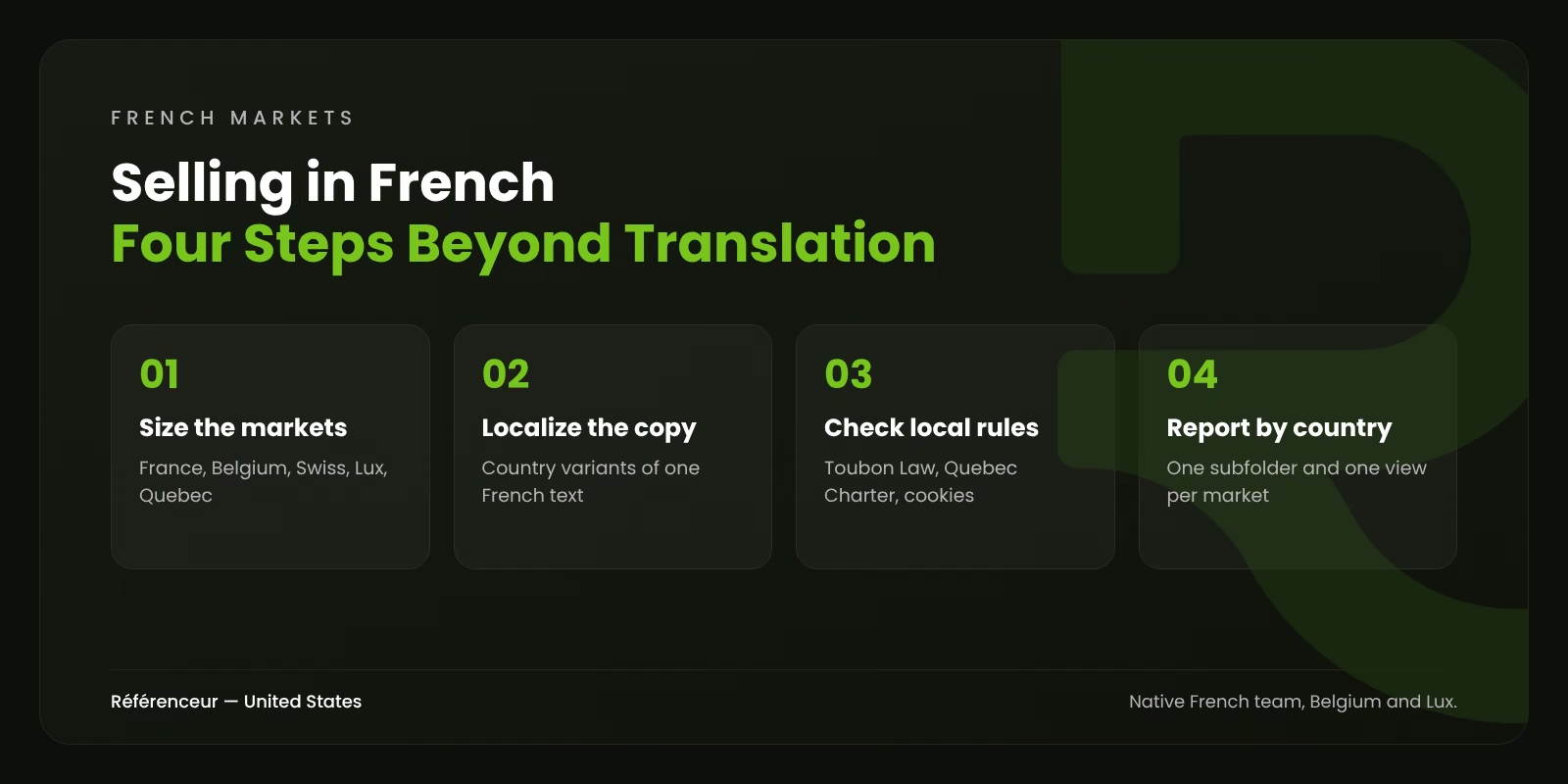
France’s Toubon Law. Under Law No. 94-665 of August 4, 1994, any ad shown or broadcast in France must use French, and so must the name, offer, and user instructions of goods and services sold there, online platforms included. A translation can sit next to the French text, and registered trademarks are exempt.
Quebec’s Charter of the French Language. As amended by Bill 96, it requires commercial advertising to be generally in French, with other languages allowed only if French is “markedly predominant.” A further set of rules took effect on June 1, 2025: a non-French trademark can appear on signs and ads only if no French version is registered, and generic product terms must be in French. According to the legal-information group Éducaloi, fines for businesses range from C$3,000 to C$30,000, double for a first repeat offense, and triple after that.
Consent in France and the EU. In September 2025, France’s data protection authority, the CNIL, fined Google €325 million for showing ads between emails in Gmail without users’ consent and for setting advertising cookies without valid consent when people created a Google account. The same day, it fined Shein €150 million over cookies, and it repeated that consent choices must be presented in a balanced way.
Quebec’s Law 25. Since September 22, 2023, businesses that use technology able to identify, locate, or profile a person must tell people about it first. At least one major Canadian law firm reads the wording as requiring those functions to stay off until the person switches them on.
French SEO and AI Answers, One Country at a Time
French-language SEO is not a translated keyword list. We research each country from its own results pages: buyers in Brussels, Geneva, and Quebec City name products differently and face different competitors.
The technical layer follows Google’s rules for localized versions: every country version gets its own URL and a language-plus-region hreflang value built from ISO 639-1 and ISO 3166-1 codes, and every page lists itself along with each alternate. Google reads a page’s language from what visitors actually see, so English menus or product names left on a French page work against you. Our international SEO guide compares subfolders, subdomains, and country domains.
AI answers have changed the picture in France this year. Google began rolling out AI Overviews and AI Mode there on July 22, 2026, about two years after the U.S. launch, once a compromise on publishers’ neighboring rights was in place. A French buyer’s AI summary is assembled from French-language pages, which gives a well-built French section a second way to be seen. Our notes on Google’s AI Overviews guidance apply in French too.
Paid Search and Social: Build by Country, Then by Language
A single “French” Google Ads campaign targeting five countries mixes currencies, landing pages, and buying hours. We build campaigns country by country, with French language targeting, local currency, and ad schedules set to each market’s business day. Paris and Brussels sit six hours ahead of New York for most of the year; Montreal shares Eastern Time with it. In Belgium and Canada, we also settle early whether Dutch or English speakers belong in the plan. Bidding and account structure are covered in detail on our French-language Google Ads page.
Social follows the same rule: LinkedIn posts for French buyers are written in French from the start, around each country’s trade press, events, and holidays.
Reporting Six Markets Without Blending Them
A French expansion fails quietly when every country is reported as “International.” Our setup keeps each one visible:
- One subfolder per market (for example /fr-fr/, /fr-be/, /fr-ca/) and a Search Console property for each.
- GA4 comparisons by country and language, with conversions mapped to the right currency.
- Consent-aware tracking, with a note in every report on how much traffic consent refusals hide in Europe and Quebec.
- Revenue converted to U.S. dollars at a fixed monthly rate, so your CFO compares like with like.
- A monthly report in English for your U.S. team, with French notes for any local partner or distributor.
Why a Belgian and Luxembourgish Team for Your French Markets
We don’t have an office in the U.S., and we don’t claim American clients. U.S. teams work with us remotely: video calls booked around both time zones, shared dashboards, and a written monthly report. What we bring is the part a U.S. agency usually has to outsource: a native French-speaking team that lives in Belgium and Luxembourg, shops on French-language websites every day, and can tell at a glance when copy was written in Ohio. HubSpot, Semrush, Microsoft Advertising, and Google all count us as a partner, and 107 people have reviewed us on Google, for an average of 4.7/5.
Two U.S. hubs have their own pages: software firms in the Bay Area planning a European launch can read about our Silicon Valley marketing work, and hotels and venues that host French-speaking guests can read about our Las Vegas digital marketing. Wherever you’re based, ask for a free assessment: we’ll point to the French-speaking market worth opening first, and the one to leave for later.
Frequently Asked Questions About Working With a French-Language Marketing Agency
Which French-Speaking Market Should a U.S. Company Enter First?
Start where you can deliver and support customers. Quebec is often the easiest first step for companies already selling in Canada, since the time zone and many buying habits feel familiar. France is the largest prize and the most competitive. Belgium and Luxembourg work well as smaller tests.
Can One French Version Serve France, Belgium, Switzerland, and Quebec?
One master French text can, with country variants on top of it. Prices, currencies, legal pages, contact details, and a handful of vocabulary choices should change per market, and each variant needs its own URL and hreflang annotation. We usually recommend separate fr-CA and fr-FR versions at minimum.
Does Our U.S. Privacy Setup Cover French-Speaking Markets?
Usually not. U.S. state privacy laws mostly work on an opt-out model, while France, Belgium, and Luxembourg follow the GDPR and EU consent rules for cookies, Switzerland has its own federal data protection law, and Quebec has Law 25. Your banner, tags, and email consent should be reviewed per market. This isn’t legal advice; check with your counsel.
How Do We Approve French Copy We Can’t Read?
Our native reviewers check the French first, and each page ships with a short English note on key terms, claims, and country differences, so you approve the substance, not the grammar. If you have a distributor or local sales rep, we invite them to review the final version too.
What Should We Prepare Before Our First Call?
The countries you’re considering, the products you want to sell there, any existing French content, and access to Search Console and GA4. A few months of data often reveals French-speaking visitors you didn’t know about, and the plan starts there. You can send us those details in advance.