 0498 70 98 60
Google Ads in French-Speaking Markets: Campaigns Built for Each Country
Running Google Ads in French-speaking markets looks easy from a U.S. account: duplicate a campaign, switch the language to French, add five countries, and launch. A week later, the search terms report shows Flemish queries from Antwerp, clicks from Zurich on a page priced in dollars, and a French invoice line nobody can explain. This page is for U.S. tech companies that want paid search in France, Belgium, Switzerland, Luxembourg, and Quebec to produce pipeline, not just impressions.
Référenceur manages these campaigns from inside the francophone world. We are a Google Partner agency founded in Belgium and Luxembourg; our account managers speak French as a first language and report in English. We have bid on French keywords for European clients for more than 15 years, and we offer the same work to U.S. companies, remotely, with shared dashboards and a monthly review call.
Start With Geography, Then Language
French speakers don’t live in one block, so a single French campaign can’t target them. Three examples show why:
- Belgium is split by language. Flanders searches in Dutch, Wallonia in French, and Brussels in both. A campaign aimed at “Belgium” with French ads still pays for Flemish clicks unless you target regions and add Dutch negative keywords as they show up in your search terms.
- Switzerland’s French speakers live mostly in the west, around Geneva and Lausanne. Zurich and Basel search in German, so a nationwide Swiss campaign with French ads wastes most of its reach.
- Quebec is French-speaking, but Montreal also has a large English-speaking market. Language targeting and copy need to reflect both.
Then check the location option itself. The default rarely suits B2B lead gen; our Google Ads page for Silicon Valley companies explains why we switch French campaigns to “Presence” targeting.
The Account Structure We Use
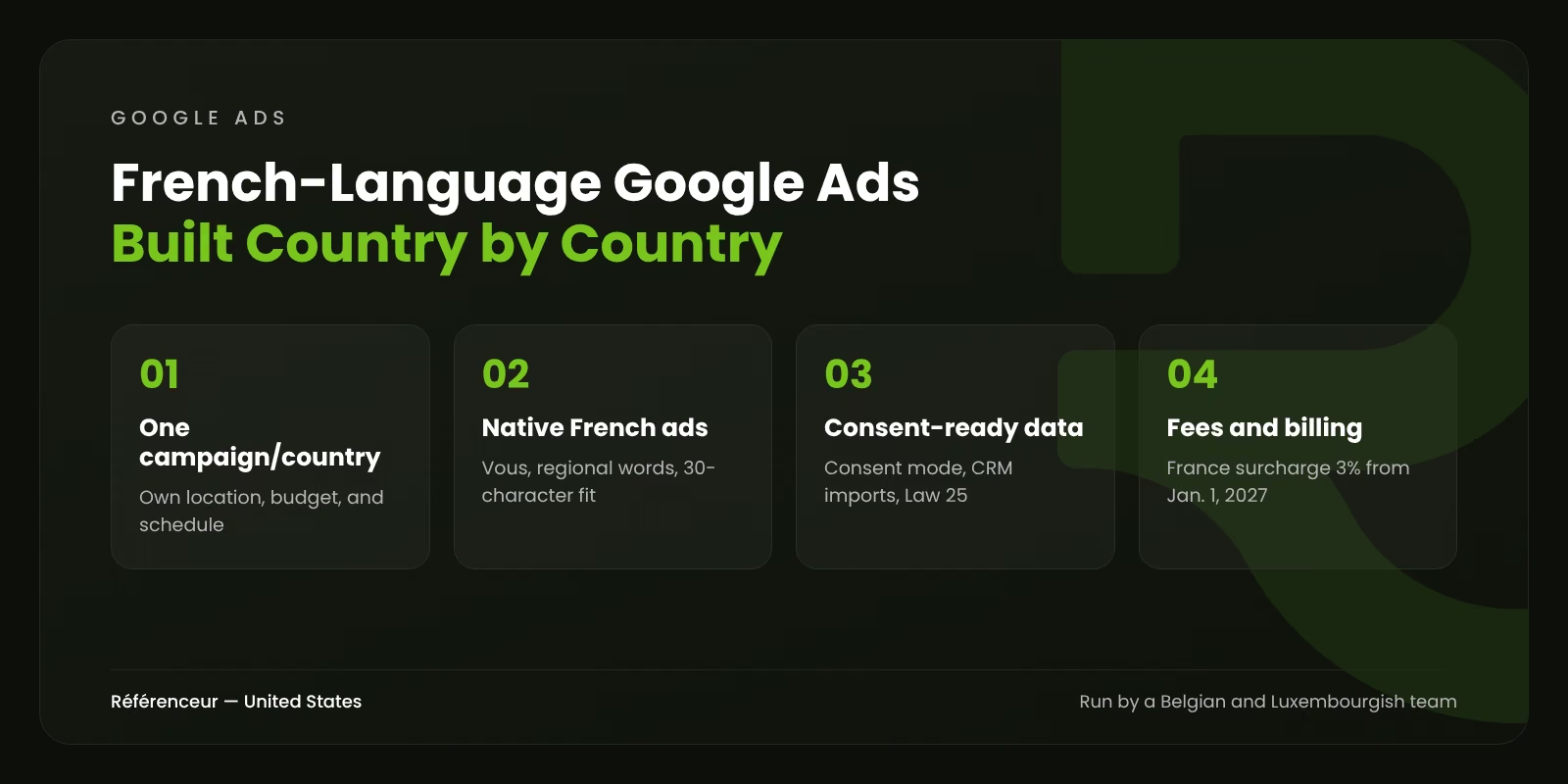
We build one campaign per country, so budgets, bids, and reports stay separate. Here is the starting structure we propose for a U.S. software company:
| Market | Location targeting | Ad language and copy | Landing page | Local 9-to-6 in Pacific Time |
|---|---|---|---|---|
| France | Whole country, Presence | French, France vocabulary | French page, prices in euros | Midnight to 9 a.m. |
| Belgium (French) | Wallonia and Brussels regions | French, Belgian terms checked | French page, euros | Midnight to 9 a.m. |
| Switzerland (Romandy) | French-speaking cantons | French, Swiss terms checked | French page, Swiss francs | Midnight to 9 a.m. |
| Luxembourg | Whole country | French, sometimes English or German | French page, euros | Midnight to 9 a.m. |
| Quebec | Province or Montreal and Quebec City areas | French, Quebec vocabulary | French page, Canadian dollars | 6 a.m. to 3 p.m. |
The last column matters more than it looks. A buyer in Lyon or Liège has usually left the office before most of your SDRs log in, so an ad schedule set in Pacific Time switches French ads off at the wrong moment. We set each campaign’s schedule in its own local time zone.
French Ads Written to Fit 30 Characters
Responsive search ads give you headlines of up to 30 characters. French usually needs more words than English to say the same thing, so a translated headline is often cut or forced into awkward abbreviations. Our writers start from the search term and the offer, then write in French directly.
They also handle choices that a translation tool gets wrong:
- “Vous,” not “tu,” for almost every B2B software ad. “Tu” can work for a consumer app aimed at younger users, but it reads as presumptuous to a procurement manager.
- Regional vocabulary. A Quebec buyer reads “cellulaire,” “fin de semaine,” and “magasiner,” while a French buyer expects “portable,” “week-end,” and “faire du shopping.” In Belgium, a mobile phone is often a “GSM.”
- Accents and capitals. French headlines keep their accents and use sentence case. “Logiciel De Paie Pour PME,” capitalized the American way, looks like a machine translation; “Logiciel de paie pour PME” looks local.
France and Quebec also regulate the language of advertising; our European expansion guide, linked below, summarizes both sets of rules. We don’t give legal advice, so have your attorney review any English-only ad before it runs there.
Consent Rules That Shrink Your Audiences
Remarketing works differently in Europe. Under Google’s EU user consent policy, personalized ads and measurement for EEA visitors depend on consent you obtain and share with Google. Google also warned that Customer Match audiences built from offline data would degrade from March 2024 for advertisers who did not update their integrations. Consent mode carries each visitor’s choice from your cookie banner to Google’s tags.
Quebec adds its own layer: under Law 25, Quebec law firms read tracking that can profile visitors as off by default until the visitor turns it on, so plan Quebec audiences as if they were European.
What this means for your campaigns:
- Remarketing lists in Europe will be smaller than your U.S. lists, so grow first-party audiences that users agreed to share.
- Conversion counts will rely partly on modeling, so import qualified leads and opportunities from your CRM to give bidding a trustworthy signal.
- Reports should separate observed and modeled conversions, so nobody compares Paris to Phoenix on the wrong numbers.
Our conversion tracking guide walks through the setup, including enhanced conversions.
The Fees and Billing Details Your Finance Team Will Ask About
Google adds surcharges to ads served in certain jurisdictions, and France is one of them. Google’s help page on jurisdiction-specific surcharges lists a France regulatory operating cost, added to cover part of the cost of France’s digital services tax. Google charged 2% and announced that the rate would rise to 3% from January 1, 2027, so check the current rate on that page before you budget. The surcharge depends on where the ad is served, not on where your company is based, and Google does not refund it for valid clicks. Canada works the other way: Google says ads served there are no longer subject to its former 2.5% digital services tax fee.
Two consequences for Google Ads France for U.S. companies:
- Add the surcharge to your French cost per lead before you compare markets, or France will look cheaper than it is.
- Check where ads were served with the location report each month. Loose location settings can create charges in countries you never meant to target.
Billing is the other question. Google invoices your account in the currency chosen when the account was created, and taxes depend on the billing entity and country. If you later move French campaigns to a European entity, ask your accountant how VAT applies before you switch.
Bidding and Budget Split for a First Launch
PPC in Quebec and France rarely needs the same budget or the same bid strategy. We usually recommend this sequence:
- Start with exact and phrase match on French terms with clear buying intent, plus your brand. Some French IT buyers search in English for technical terms, so test English keywords with French ads only where your counsel is comfortable with the language rules.
- Run manual or target-based bidding until each country records enough qualified conversions to train automation. A new market with a handful of leads per month is not ready for fully automated campaigns.
- Split budget by expected deal value, not by population. A Luxembourg campaign can be small and still justify itself with one enterprise lead.
- Add Performance Max or Demand Gen only after search proves the offer and the landing page. Our Google Ads for SaaS page explains how we tie spend to pipeline, and our Quality Score guide covers why French landing pages must match French ads.
If your U.S. account is already in good shape, our Google Ads management service can take over the francophone campaigns without touching what already works at home.
How Our Belgian and Luxembourgish Team Runs Your Account
Someone who works in French every day reads a search terms report differently. They spot the Flemish query that slipped into a Belgian campaign, the Quebec slang that signals a consumer rather than a buyer, and the Swiss term that means your price page needs francs. That’s the advantage of a francophone agency based in Belgium and Luxembourg: the market knowledge sits in the same heads that write your ads.
You keep ownership of the ad account and the budget. We build and run the French-language campaigns, report monthly in English, and join a call at a time that suits both California and Central Europe. If you’re planning a wider launch, see our guide to European expansion for Silicon Valley startups, our French-market marketing overview, and our Silicon Valley page.
Get a Free Assessment: share your account and target countries with us, and we’ll show you where the first francophone budget should go.
Frequently Asked Questions About Google Ads in French-Speaking Markets
Can We Run French Campaigns From Our Existing U.S. Google Ads Account?
Yes, and it’s often the simplest start. New campaigns with their own location, language, and budget settings keep reporting separate. The trade-off: currency and billing entity stay those of your U.S. account.
Should Belgian Campaigns Include Dutch-Language Ads?
If you sell to the whole country, yes, but as a separate campaign with Dutch copy written by a Dutch speaker. Mixing French and Dutch ads in one campaign makes budgets and search terms hard to manage. A common start is Wallonia and Brussels in French, with Flanders added later.
Do English-Language Ads Work in France?
Some French tech buyers do click English ads, especially for developer tools. But French rules on the language of advertising, and simple buyer preference, favor French. We test English only as a limited experiment and only after you have checked the language rules with your counsel.
Why Did Our Remarketing Lists Shrink After Launching in Europe?
Usually because EEA visitors declined consent, so Google can’t add them to personalized audiences. That’s expected. Confirm your banner passes consent states correctly, then lean on search intent, permission-based customer lists, and content offers.
Can We Advertise in Francophone Africa With the Same Campaigns?
We recommend separate campaigns. Africa is home to most of the world’s French speakers, but payment methods, buying power, and sales coverage differ widely from Europe. Start with one or two countries where your team can actually close and serve customers, and send them to pages that show the right currency. If you want a second opinion on whether that test is worth it, ask us for a free assessment or set up a free video call.