 0498 70 98 60
Digital Marketing Agency Silicon Valley Teams Can Take to Europe and Quebec

A digital marketing agency Silicon Valley founders hire is usually judged on one number: U.S. pipeline. We start there too. Then we add something a San Jose, Santa Clara, or Mountain View team rarely finds nearby: marketers who write native French and can open France, Belgium, Switzerland, Luxembourg, and Quebec once the American engine is running.
Référenceur’s team is split between Francorchamps, in French-speaking Belgium, and Wemperhardt, in northern Luxembourg. Search, paid media, and websites have been our trade for over 15 years. English and French are both working languages for everyone on the team. We have no office in California; we run engagements remotely, with scheduled video calls, shared dashboards, and a written report every month.
The South Bay Market in Numbers
Joint Venture Silicon Valley’s 2026 Silicon Valley Index, presented on February 27, 2026, counts roughly 2.7 million people in Santa Clara and San Mateo counties, about the same as in mid-2020. AI companies alone attracted nearly $80 billion in venture capital in Silicon Valley and San Francisco in 2025, about 83% of all venture funding there, and the total stayed below the 2021 peak of nearly $100 billion. Yet total employment slipped 0.8% between mid-2024 and mid-2025.
For marketing, those three figures add up to a familiar squeeze. Well-funded competitors bid on the same category keywords, hiring is careful, and a lean growth team has to prove every channel. That’s why we don’t sell a fixed package here. We set priorities from your sales cycle, deal size, and runway, and we measure them on qualified opportunities rather than traffic.
Teams looking for a San Jose digital marketing agency often expect the same playbook as San Francisco, but the Valley differs from the city to its north. Semiconductor suppliers, enterprise software vendors, and hardware companies along the 101 sell to engineers and procurement teams, often over long cycles. If your company is in the city itself and selling to startups, our San Francisco digital marketing page is the better fit.
Two Tracks on One Roadmap: U.S. Growth Now, French Markets Next
Most of our Silicon Valley conversations follow the same arc. The U.S. engine has to work first. French-speaking markets come next, built on the same site, the same tracking, and the same lessons. We plan both tracks from day one so the second doesn’t force a rebuild; our international SEO guide explains the site structure choices behind that.
| Channel | U.S. track (months 1–6) | French-speaking track (when the signals appear) |
|---|---|---|
| Website | Use-case and integration pages in American English, demo flow tied to your CRM | A /fr-fr/ or /fr-ca/ section on the same domain, written natively, with local pricing |
| SEO | Category, comparison, and problem-led pages for U.S. buyers | Country-specific keyword research, built from French results pages |
| Google Ads | Brand, category, and competitor campaigns judged on opportunities | Separate campaigns per country, scheduled on European or Eastern hours |
| AI search | Clear, citable product facts for English-language answers | French pages that AI summaries in France and Quebec can quote |
| Founder and product content for U.S. decision-makers | Native French posts tied to each country’s events and trade press | |
| Reporting | Pipeline by channel, in English | The same report, split by country, with French notes for local partners |
Each U.S. channel has its own page: SEO in Silicon Valley, Google Ads in Silicon Valley, and web design in Silicon Valley.
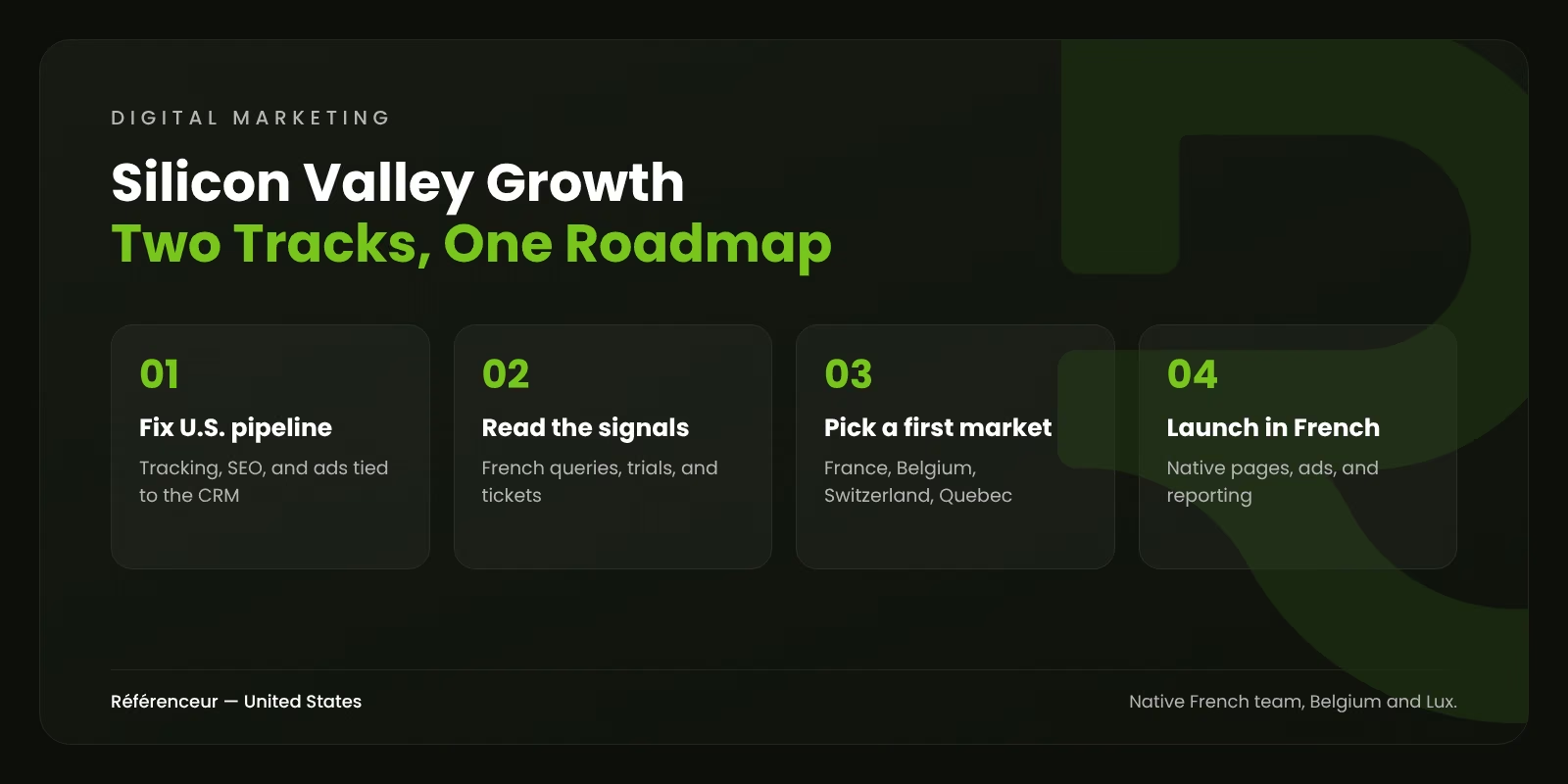
Five Signals in Your Own Data That French Is Worth It
Expansion decisions often start with a board slide. We prefer to start with evidence already sitting in your accounts. These five signals tell us a French-speaking market deserves budget:
- French queries in Search Console. Impressions from France, Belgium, Switzerland, or Canada for your category terms, even when you have no French pages.
- Trials and sign-ups by country. GA4 or product analytics showing steady activity from francophone countries, with weaker conversion than U.S. users.
- Inbound demo requests from European or Quebec domains. Sales reps answering in English to prospects who wrote their first message in French.
- Partner and reseller requests. A distributor in Montreal or Brussels asking for French collateral before they’ll present you to customers.
- Support tickets in French. Customers already using the product and translating your help center in their browser.
Two or three of these together usually justify a first French test. For software companies, our page on French SEO for SaaS explains how to localize product, pricing, and documentation pages in the right order.
What Changes the Day You Market in French
The two French-speaking regions closest to a U.S. company are bigger than most plans assume: in its 2026 report, the Organisation internationale de la Francophonie (OIF) counts about 80 million people in Europe and 17 million in the Americas who are born into French and live in it day to day. Reaching them changes more than the copy. This isn’t legal advice; your counsel should review each market before you launch.
- Consent comes before tracking. France’s data regulator, the CNIL, has fined major platforms heavily over cookie consent. A U.S. tag setup that fires on page load is the first thing we change.
- Quebec puts French first. Under the Charter of the French Language, commercial advertising in Quebec must be in French; another language can appear alongside it only if French is “markedly predominant,” which Quebec’s regulation defines as French text with a much greater visual impact.
- AI answers now reach French searchers. AI Overviews and AI Mode are now rolling out in France, which gives a vendor with no French pages one more place to be absent. Our article on SEO vs. GEO covers how AI visibility differs from rankings.
Our page on European expansion for Silicon Valley startups turns these points into a pilot-country choice and a launch calendar.
Bay Area Doors to Luxembourg and Belgium
Several European trade offices are within driving distance of your office, and part of their job is attracting U.S. companies to their home markets. Few growth teams treat them as part of the marketing plan.
The Luxembourg Trade and Investment Office in San Francisco, at 1 Sansome Street, helps American companies expand into Luxembourg and reach the wider European market. Its services include briefings on the business environment, visit programs, help with company setup, introductions to officials, and guidance on visas. Belgium’s regions are present too: AWEX for Wallonia and hub.brussels for the Brussels region both have representatives in San Francisco, and Flanders Investment & Trade has a science and technology attaché in Menlo Park.
When one of those offices introduces you to a prospect or a partner in Europe, the first thing that person does is look you up. A Silicon Valley marketing agency for European expansion should have that moment covered before the meeting happens. We make sure they find a French page that explains what you sell, who already uses it, and how to reach a human in their time zone.
A Belgian and Luxembourgish Team on Pacific Time Mornings
We don’t claim any American clients, and our case studies describe work for companies in Europe. What we offer a Valley team is a bilingual bench: the same people write your U.S. landing pages and your French ones, so claims, numbers, and positioning stay consistent across languages. HubSpot, Semrush, Microsoft Advertising, and Google list us among their partners, and 107 Google reviewers give our work an average of 4.7/5.
Our clocks are usually nine hours ahead of yours. We use your early morning for live calls, then build, publish, and test during our day, which is your night. Your team starts each day with finished work instead of a queue.
If French-speaking markets are already on your roadmap, read how our French-language marketing agency work covers them country by country. To see where your U.S. pipeline and your first French market stand today, request a free assessment from a native French-speaking team in Belgium and Luxembourg that already reports in American English.
Frequently Asked Questions About Our Digital Marketing Agency in Silicon Valley
Should We Wait for Product-Market Fit in the U.S. Before Adding French?
In most cases, yes. A French launch multiplies whatever your funnel already does, good or bad. We use the first months to fix U.S. conversion and tracking, and we plan site structure so that a French section can be added later without a migration.
Can the Same Team Run Our U.S. and French Campaigns?
Yes, and that’s the core of what we offer. The people who write your American English pages also write the French ones, which keeps product claims, pricing logic, and naming consistent. A translation vendor working from finished English copy can’t make those calls.
Do We Need a Separate Budget for French-Speaking Markets?
We recommend it. When several countries share one campaign budget, the cheapest clicks win, and one market quietly absorbs spend meant for another. Separate budgets per country make it clear whether each market is paying back.
How Does a Team in Europe Handle Urgent Issues?
We agree on an escalation path at kickoff: who to message, how, and what counts as urgent, such as a broken form or an ad account suspension. Routine requests follow the daily rhythm, and replies typically reach you by the start of your next working day.
What Happens in the First Month?
We review your tracking, site, Search Console data, and ad accounts, then agree on two or three U.S. priorities and the signals that would trigger a French test. You get a written plan in English and a first monthly report at the end of the month. If you have data ready, send it ahead of the call.