 0498 70 98 60
Marketing in Belgium for US Companies: One Small Country, Three Languages
Marketing in Belgium for US companies can look like a quick win. The country is about the size of Maryland, and Brussels is a short train ride from Paris, Amsterdam, and Cologne. Then you notice that a campaign written for Liège won’t land in Antwerp, that Brussels expects two languages on the same billboard, and that a French ad imported from Paris can sound slightly foreign to a Belgian reader.
This is our home market. Our agency, Référenceur, has offices in Belgium and in Luxembourg, plus a team raised in French; the Belgian office sits in Francorchamps, in the Walloon hills near Spa. We grew up with the language border this page describes, we write natively in French and English, and we have more than 15 years of experience running search, ads, and websites for businesses on our side of the Atlantic. Our job here is to help an American team see Belgium the way Belgians do, then decide where to start.
A Language Border Runs Through the Middle of the Market
Belgium has three official languages: Dutch, French, and German. They don’t overlap much in daily life. Each region runs its schools, media, and local politics in its own language, so the audience you reach depends on which side of the line your ad appears on.
Statbel, the Belgian statistics office, counted 11,867,634 residents at the start of 2026. Here is how they split:
| Region | Residents (January 2026) | Main language of daily life | What it means for your campaign |
|---|---|---|---|
| Flanders (north) | 6,898,350 | Dutch | Largest audience; needs its own Dutch site, ads, and keywords |
| Wallonia (south) | 3,713,450 | French, plus German in the small eastern cantons | Native French copy with Belgian usage |
| Brussels-Capital Region | 1,255,834 | Officially French and Dutch; English widely used | Bilingual by default, international audience |
Two takeaways for a U.S. marketer. First, Flanders holds more than half the population, so a French-only launch covers well under half of Belgium. Second, Wallonia and Brussels together still hold about 5 million residents, and French copy written for them also opens the door to a much larger French-speaking world.
Brussels: Two Official Languages and a Third One in the Meeting Room
Brussels is officially bilingual, and public signage, street names, and many brand campaigns appear in both French and Dutch. It also hosts the headquarters of the European Commission, the Council of the European Union, and NATO, which brings diplomats, lobbyists, consultants, and their families from across Europe.
For a U.S. company, that creates an unusual audience mix:
- Residents who search and shop in French or Dutch, depending on the household
- International professionals who often work in English and switch to French for daily errands
- B2B buyers in policy, consulting, legal, and associations, who expect polished English and respect a French or Dutch version
A good Brussels campaign doesn’t pick one language and hope. It runs separate ad groups by language, sends each one to the matching page, and tracks which version actually converts.
French and Dutch Marketing in Belgium Is Not Copy-and-Paste
The most common mistake we see is reusing French copy written for France and Dutch copy written for the Netherlands. Both are understandable in Belgium. Neither feels local.
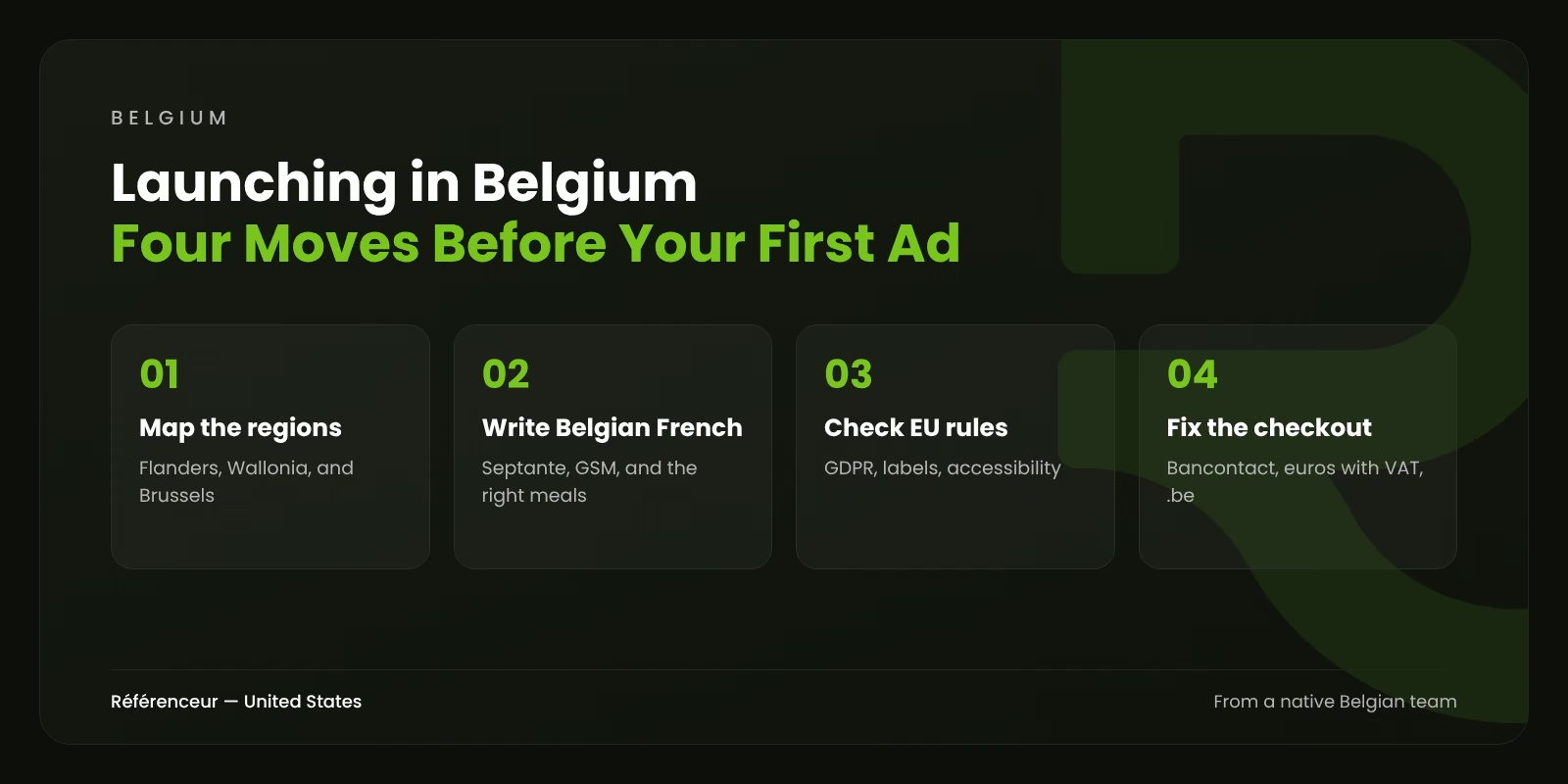
On the French side, Belgians name meals differently and use their own everyday words. “Déjeuner” usually means breakfast in Belgium, “dîner” means lunch, and “souper” means the evening meal. A cell phone is a “GSM,” and the numbers 70 and 90 are “septante” and “nonante.” None of this blocks understanding, but a meal-kit ad that offers “le dîner” at 7 p.m. reads as written by someone who has never set foot in Namur.
On the Dutch side, Flemish readers notice phrasing and tone from the Netherlands just as quickly. We’re native in French and English, not Dutch, so we’ll tell you plainly when a native Flemish writer should own that copy.
Good French and Dutch marketing in Belgium starts with separate keyword research per language. The same product can carry different search terms in Liège and Ghent, and both can differ from what people type in Paris. On the technical side, Google supports language-and-region codes such as fr-BE and nl-BE in hreflang, so a site can serve Belgian French and Belgian Dutch pages to the right people. Our international SEO guide explains how that setup works, and our French website localization team handles the French side end to end.
Rules a U.S. Seller Meets Early in Belgium
Belgium is an EU member, so the EU’s main consumer and data rules apply, along with some Belgian specifics. None of what follows is legal advice, so run it past your own lawyer before launch. Three points come up early:
- The GDPR applies when you target people in Belgium, even from the United States. Belgium’s Data Protection Authority oversees it locally. Cookie banners, consent for marketing email, and clear privacy notices in the reader’s language are the visible parts.
- Food labels follow a language rule. Article 8 of Belgium’s law of January 24, 1977, as amended by a law of July 12, 2022, requires mandatory label information, including information required by EU rules, to appear at least in the language or languages of the linguistic region where the product is placed on the market. A U.S. snack brand selling nationwide should plan for French, Dutch, and, in the German-speaking area, German.
- Accessibility is now an EU obligation. Since June 28, 2025, the European Accessibility Act has applied to ecommerce services offered to consumers in the EU, among other services, including providers based outside the EU. A U.S. site built to WCAG standards starts with an advantage.
Checkout, Domains, and the Details Belgian Buyers Notice
Belgian shoppers spot a foreign store fast. These details make the difference between “imported” and “at home”:
- Bancontact at checkout. Belgium’s domestic payment brand handled more than 2.5 billion card and mobile payments in 2024, including 382 million online, according to the company. A store that only offers international credit cards leaves out the option many Belgian shoppers look for first.
- Prices in euros, with VAT included for consumers. Showing a U.S.-style pre-tax price creates a surprise at checkout.
- A .be domain or a clear /be/ folder. Either works for SEO when it’s set up cleanly. Our guide on how to choose a domain name walks through the trade-offs.
- Local proof. A Belgian phone number, a European returns address, and reviews from Belgian buyers do more than a translated “About Us” page.
Belgium also sits next to the bigger markets. Many U.S. companies treat it as a test bed before rolling out to France, Switzerland, or Luxembourg. If that’s your plan, compare this page with our notes on marketing in France and on Switzerland and Luxembourg.
A 60-Day Plan for a First Belgian Launch
Here is a typical sequence for a U.S. company testing Belgium. We adjust it to your product and budget during the assessment.
| Weeks | Focus | Output |
|---|---|---|
| 1–2 | Market check | Search demand in French and Dutch, competitor landscape, language priority |
| 3–4 | Pages and tracking | Belgian French landing pages, hreflang, GA4 events, consent banner |
| 5–6 | First campaigns | Google Ads by language, Brussels split by ad group, Bancontact-ready checkout |
| 7–8 | Read and adjust | Report in English, cost per lead by region, decision on Dutch rollout |
Starting in French and adding Flanders once the numbers make sense is a common route. Starting with both languages is better when your product is national from day one, such as consumer goods sold through Belgian retail chains.
Why a Belgian Team Makes Sense for a Belgian Launch
A Belgian digital marketing agency for American companies may sound like an odd pairing. For a Belgian launch, it’s the shortest path. We work from Francorchamps, in Belgium, and from Wemperhardt, in northern Luxembourg, a short drive across the border. That means we know Belgian French from the inside, we know how the Brussels market behaves, and we can explain all of it to an American team in clear American English. That native view shapes every French SEO agency project and our wider French-language marketing services. We have no office on American soil. Your project runs on video calls, shared screens during campaign reviews, and a monthly written report, with meetings booked when both calendars overlap (Brussels usually runs six hours ahead of New York).
Have a product that might sell in Brussels, Liège, or Antwerp? Get a Free Assessment and we’ll give you a straight answer on whether Belgium deserves to be your first European test.
Frequently Asked Questions About Marketing in Belgium
Can We Launch in Belgium With English Only?
For some B2B niches in Brussels, English can carry a first test, because many professionals there work in English. For consumer products, it rarely works. Belgian shoppers expect to read product details, checkout steps, and support pages in French or Dutch, and many simply leave a store that doesn’t offer either.
Should We Start With French or Dutch?
It depends on where your buyers are and on the competition in each language. Flanders is the larger audience, but competition in Dutch search results can be stiffer. Wallonia and Brussels together give you a French-speaking test market, and that copy can later feed France, Switzerland, or Luxembourg. We compare search demand in both languages during the free assessment before recommending a starting point.
Will Our French Copy From France Work in Belgium?
It will be understood, but it won’t feel local. Numbers, meal names, and everyday words differ, and Belgian readers notice. A light Belgian adaptation of key pages, ads, and emails usually costs far less than a full rewrite and removes the “foreign site” feeling.
Do We Need a Belgian Company to Sell to Belgian Consumers?
Not necessarily for marketing, but tax, VAT registration, and consumer obligations depend on how and from where you sell. That’s a question for your accountant and counsel, not for a marketing agency. What we can do is make sure your site shows the information European consumers expect, such as prices with VAT, delivery terms, and a returns process.
How Do You Work With a U.S. Team From Belgium?
Our afternoon overlaps with your morning, so that’s when we hold calls and walk through campaigns on a shared screen. A written report in English follows every month. Your team gets one point of contact, and nothing depends on finding a translator. If you’d like to see how that would work for your launch, request a free assessment.