 0498 70 98 60
Marketing for European Companies Expanding to Los Angeles
Marketing for European companies expanding to Los Angeles comes with two conditions that an East Coast launch doesn’t impose as sharply: a nine-hour gap with headquarters, and privacy rules enforced by a dedicated state agency. Brands that plan around both from the start launch faster. Brands that discover them later usually rebuild their tracking and lose a quarter.
Référenceur’s French-speaking team sits in eastern Belgium and northern Luxembourg. For a West Coast launch, that location is part of the method rather than a handicap: our working day ends about when Los Angeles starts, so your U.S. team wakes up to finished work instead of waiting on it. We write natively in French and English, which lets headquarters approve the plan in its own language while Southern California buyers read copy that sounds local. The national playbook is on our page about European brands entering the U.S. market; this page deals with California.
Nine Hours Apart: Running a Launch Asynchronously
Belgium and Luxembourg are normally nine hours ahead of Los Angeles. For a few weeks each year the gap drops to eight, because Europe and the U.S. change clocks on different dates: between the second Sunday in March, when the U.S. springs forward, and the last Sunday in March, when Europe does, and again between the last Sunday in October and the first Sunday in November. Live meetings are possible, but only in a narrow window: 8 a.m. in Los Angeles is 5 p.m. in Belgium and Luxembourg for most of the year.
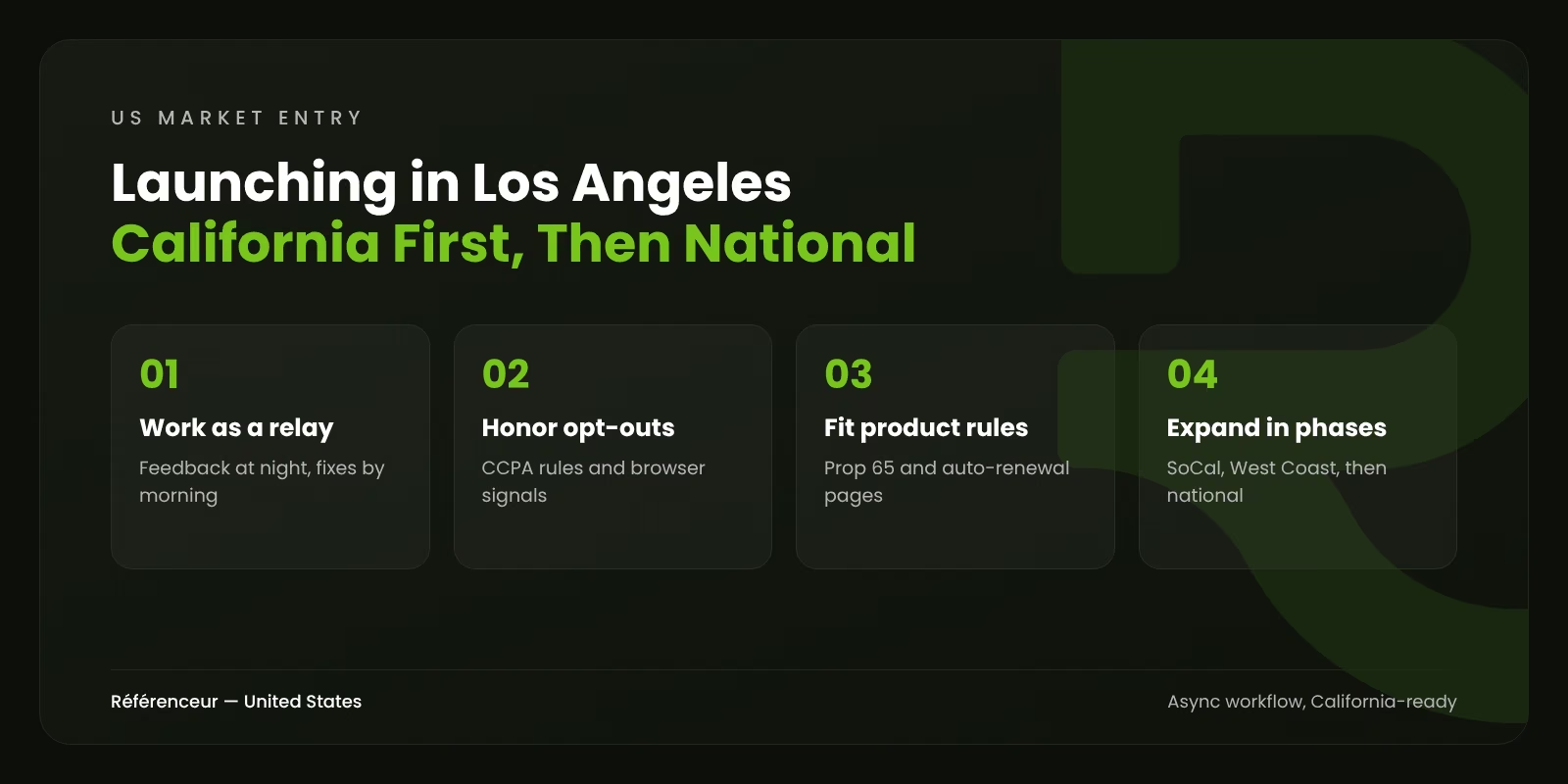
Projects stall when every decision has to fit into that window. We work as a relay instead:
- Your Los Angeles team sends comments before the end of its day, in writing or as a recorded screen walkthrough.
- We pick them up at the start of our morning and work through them while California sleeps.
- Revised pages, ads, or reports are waiting when your team logs in, with a short note on what changed and what still needs a decision.
- One live call a week, early Pacific Time, settles anything that can’t be handled in writing.
- Every ad schedule, report, and deadline is set on Pacific Time, so nobody converts time zones in their head.
A shared decision log keeps headquarters informed without adding a third time zone to every thread.
California Privacy Rules Reach Your Tracking Before Your First Sale
European marketers know the GDPR’s consent-first model. California works differently: its privacy law, the CCPA as amended by the CPRA, is largely built on opt-outs, but it treats sharing data for cross-context behavioral advertising as something consumers can refuse. That hits remarketing, ad pixels, and audience lists directly. This isn’t legal advice; your California counsel should confirm what applies to you.
Two recent changes matter for a launch planned now:
- New regulations. California’s Office of Administrative Law approved updated CCPA regulations on September 23, 2025. They took effect on January 1, 2026, with risk assessment duties starting that day, rules on automated decision-making technology from January 1, 2027, and cybersecurity audit certifications phased in from April 1, 2028, depending on company revenue.
- Browser opt-out signals. The California Opt Me Out Act (AB 566), signed on October 8, 2025, requires browsers to offer a built-in opt-out preference signal starting in January 2027. Expect a growing share of visitors to arrive with that signal switched on.
In practice, we configure consent tools to honor those signals, rely more on first-party data such as newsletter sign-ups and CRM records, and set up conversion measurement that still works when some visitors opt out. Building this for California first means fewer surprises when you expand to other states with their own privacy laws.
Food, Wine, and Beauty: Product Rules That Show Up on Your Pages
Southern California is a natural first market for European consumer brands, and that’s where product rules meet marketing pages.
Proposition 65 warnings. California requires warnings for products that expose consumers to listed chemicals. Updated rules for the short-form warning took effect on January 1, 2025, with a transition until January 1, 2028. For online sales, the warning can appear on the product page, behind a clearly marked “WARNING” link, or in another prominent way before checkout. Some imported foods, drinks, and cosmetics can be affected, so we design product templates with a place for it.
Subscriptions. Amendments to California’s automatic renewal law that took effect on July 1, 2025, require express consent to the renewal itself, a cancellation path as easy as the sign-up, and the same treatment for free trials that convert to paid plans. A European coffee, chocolate, or wine club needs its checkout and account pages built that way before launch.
Trade shows. Natural Products Expo West, held each spring at the Anaheim Convention Center, brings natural food, beverage, and personal care brands together with retail buyers. For a food or beauty brand, a show like that is worth a dedicated landing page, retailer-focused sales sheets, and paid social aimed at buyers before and after the event.
California First, Then the Rest of the Country
Launching everywhere at once spreads a small ad budget across four time zones. We usually sequence it.
| Phase | Geography | Focus | Why this order |
|---|---|---|---|
| Months 1–3 | Los Angeles and Southern California | Google Ads by area, a U.S. site section, privacy setup built to California standards | Proves demand where your team is based |
| Months 4–6 | San Diego, the Bay Area, and the West Coast | Content for each target segment, retailer or partner pages, organic search | Uses what the first ads taught you about search terms |
| Months 7–12 | National | Campaigns scheduled for each time zone, East Coast landing pages, broader SEO | Tracking and consent already follow California’s rules, so other states need fewer changes |
When the East Coast comes into play, read how European companies expanding to New York adjust their plan. For the local channels themselves, see our digital marketing agency in Los Angeles.
Belgian, Luxembourgish, and French Networks on the West Coast
Los Angeles has its own support network for Benelux and French companies, and it’s organized differently from the East Coast’s.
- The Consulate General of Belgium in Los Angeles covers 13 western states, from Alaska to New Mexico, and hosts the local office of Flanders Investment & Trade.
- Belwest, the Belgian-Luxembourg American Chamber of Commerce, is listed at the same Wilshire Boulevard address and runs events for both communities.
- Wallonia’s AWEX and hub.brussels have their West Coast representatives in San Francisco, which is worth knowing before you book a trip.
- French Tech Los Angeles brings together French founders and investors, with committees on PropTech, FinTech, and AdTech and a scale-up program: an immersive week in Los Angeles for three to five French scale-ups at a time. For French companies in Los Angeles, it’s often the first network to join.
These groups make introductions. Your website, your LinkedIn presence, and your ads decide what happens after the introduction, so we prepare them before the first event rather than after it.
Why a Francophone Team From Belgium and Luxembourg Fits a West Coast Launch
We have no U.S. office, in Los Angeles or anywhere else. Your account is handled from Francorchamps, Belgium, and Wemperhardt, Luxembourg, by people who speak French with your headquarters and write English for your American buyers. We know how European approval chains work, and we’ve organized our process so the nine-hour gap moves your project forward overnight. As a California market entry agency based abroad, we’d rather state that plainly.
Our partnerships span Google, Microsoft Advertising, Semrush, and HubSpot, and our 107 Google reviews average 4.7/5. The clients in our case studies, including Lupulus and Isolpur, are European. If headquarters wants French pages alongside the U.S. site, our French and English bilingual websites are built for that. Send us your launch plan and request a free assessment; we’ll point out what California will require of it.
Frequently Asked Questions About Los Angeles Market Entry for European Brands
Do We Need a Separate Privacy Notice for California?
Many companies use one U.S. privacy policy with a California section, since the CCPA requires specific disclosures and rights descriptions. Whether the law applies to you depends on thresholds such as revenue and data volume, so ask your counsel before you assume either way.
Should Our Website Show Pacific or Eastern Business Hours?
Show the hours your team can actually answer. If your only U.S. staff are in Los Angeles, state Pacific Time clearly, because East Coast buyers will otherwise expect a reply at 9 a.m. their time. Once you sell nationally, list both, or route East Coast inquiries to whoever starts earliest.
Is Los Angeles a Good Test Market for a European Consumer Brand?
Often, yes. Southern California has dense retail, a strong food and beauty scene, and buyers used to imported products. The catch is cost: competition for ads is intense, so start with a narrow geography and a clear offer.
How Do We Measure Ads When Visitors Send Opt-Out Signals?
Accept that some conversions won’t be tracked individually. We combine consent-aware tags, server-side tagging and first-party data where appropriate, and the modeled conversions offered by ad platforms, then compare results against real sales in your CRM.
Can We Launch in California Without Anyone Based There?
You can start without staff in California, using a U.S. phone line, clear support hours on Pacific Time, and a partner who handles day-to-day marketing. Most companies hire locally once demand is proven. If you want to test that path, request a free assessment or ask us a question in French or English.