 0498 70 98 60
A Digital Marketing Agency Brooklyn Makers and Neighborhood Businesses Can Hold to Account
Choosing a digital marketing agency Brooklyn business owners can hold to account starts with one admission: Brooklyn is not a cheaper annex of Manhattan. It is an economy of its own, with factories on the waterfront, studios under the bridges, a busy shopping district downtown, and thousands of neighborhood businesses whose customers live a short walk away. A plan written for “New York” in general misses most of that.
We come from two small, crowded, multilingual countries. Référenceur’s French-speaking team, based in Belgium and Luxembourg, uses English every day and comes from places where the language on a shop sign can change within a few miles. That habit helps in a borough where a pharmacy counter may switch between English, French, and Haitian Creole in the same hour. We have no office in Brooklyn or anywhere in the U.S.: we meet you on video, walk through the numbers on a shared screen, and send a written report every month, at hours that suit both time zones. For an outside opinion first, request a free assessment of your current setup.
Brooklyn’s Business Clusters Each Need a Different Message
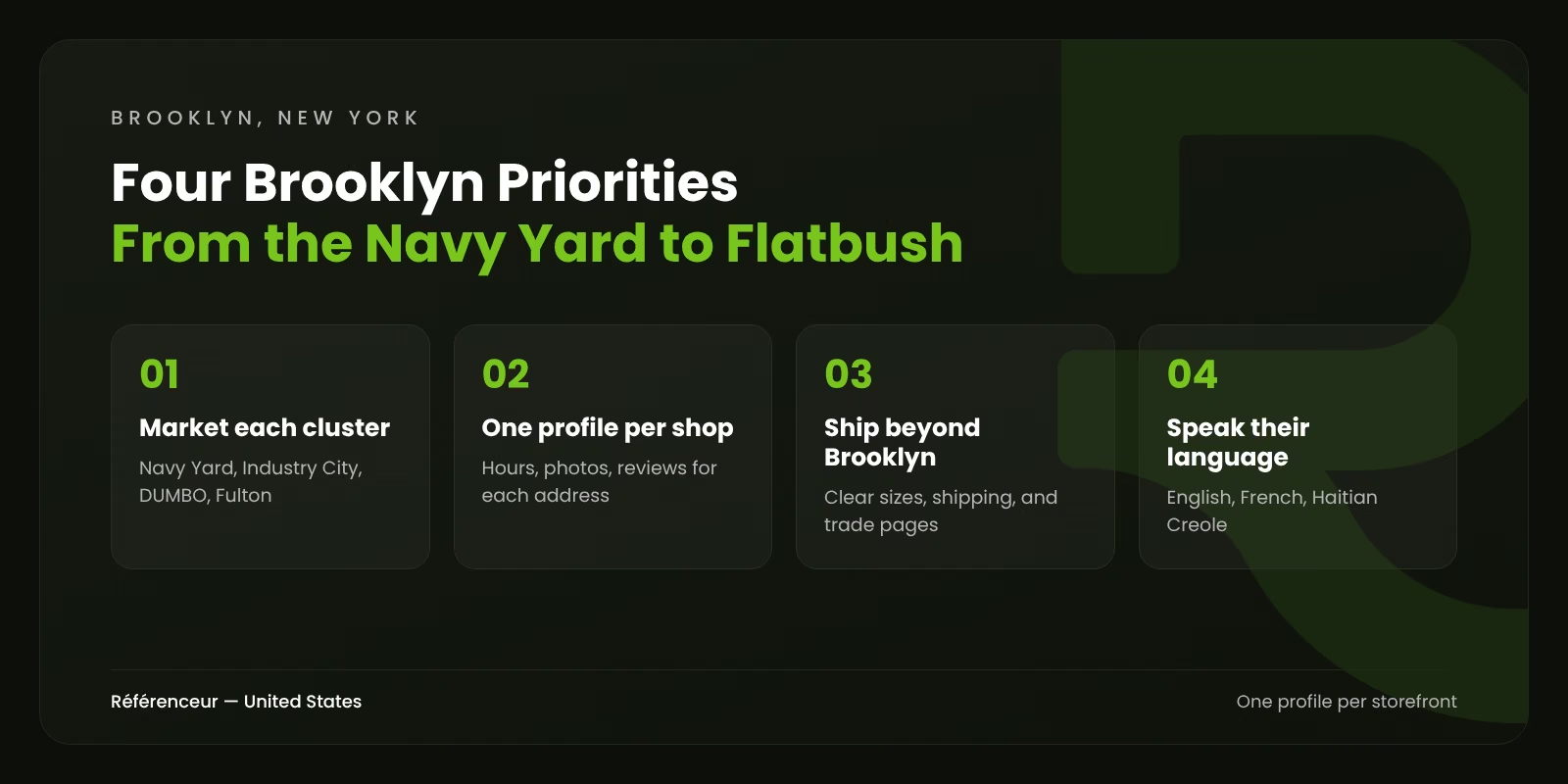
Treating Brooklyn as one audience is the most common flaw in borough-wide plans. Its main clusters behave very differently online.
The Brooklyn Navy Yard is an industrial campus first. The first impact report from its development corporation, published in January 2026 for fiscal year 2025, counts more than 550 businesses in 17 industries on over 300 acres, supporting more than 13,000 jobs. Roughly 45% of those businesses are led by women or members of minority groups. A Yard tenant usually sells to other companies, such as architects, developers, retailers, and film productions. Its website needs spec sheets, lead times, and minimum orders, not lifestyle copy.
Industry City in Sunset Park passed 650 businesses in April 2025, spread across 16 buildings on a 35-acre campus. When the current owners took over in 2013, there were about 100. Tenants range from robotics and woodworking to food halls, so one tenant may need two funnels: one for wholesale buyers and one for weekend visitors looking for lunch.
DUMBO concentrates design, media, and software firms in converted warehouses. Their buyers are rarely local, so their marketing looks more like national B2B lead gen than neighborhood search.
Downtown Brooklyn and Fulton Street run on foot traffic and transit. Here, a store’s hours, photos, and reviews on Google matter more than its blog.
Then come the businesses everywhere else: dentists in Bay Ridge, bakeries in Bed-Stuy, tax preparers on Flatbush Avenue. For them, the relevant market is a handful of ZIP codes, and the plan should say so in writing.
Google Business Profile Rules That Trip Up Multi-Location Brooklyn Businesses
Local visibility here is won block by block (our Google local SEO guide covers the basics), and Google’s eligibility guidelines for Business Profiles set the limits. Four rules cause most of the trouble:
- One profile per location. A bakery with shops in Park Slope and Williamsburg gets two profiles, each with its own hours, photos, and reviews. Extra profiles created to cover more neighborhoods break the guidelines and put listings at risk.
- No virtual offices. A rented mailing address you don’t operate from is not eligible. Shared workspace counts only when it carries your signage, is staffed by your own people during opening hours, and actually receives customers.
- Practitioners versus the practice. A doctor or lawyer who serves the public can have an individual profile, but support staff cannot. When several practitioners share an office, the organization gets its own profile for that address, separate from theirs.
- Departments. A public-facing department that operates as a distinct entity, such as a vision center inside a large store, can have its own profile with a distinct name and category. A product section inside a shop cannot.
To appear in “near me” searches from Greenpoint to Sheepshead Bay, each profile needs the right primary category, real photos of that storefront, and steady reviews that mention what people bought. On your website, each location deserves its own page with staff names and directions from the nearest subway stop, not the same paragraph with a new address pasted in, which Google can treat as doorway pages built for search. The wider organic work is described on our SEO agency in New York page. When a business hires us as its Brooklyn SEO company, we usually start with the profiles, because changes show up there fastest.
Selling a Brooklyn-Made Product Beyond the Borough
“Made in Brooklyn” can sell nationwide, but only if the online store does the selling. Many small brands outgrow a starter storefront long before they outgrow their workshop. The warning signs: product pages with no size or material details, shipping costs revealed only at checkout, and no way to tell which post produced which order, a gap our web analytics services are designed to close.
Good Brooklyn web design for a maker brand is less about visual flourish and more about removing friction:
| Problem | What a better store does |
|---|---|
| Shoppers can’t tell if the product suits them | Dimensions, materials, care instructions, and photos at real scale |
| Shipping costs surprise people at checkout | Delivery zones and costs shown on the product page |
| Wholesale buyers email asking for a price list | A trade page with minimums, lead times, and a request form |
| Market and pop-up sales vanish from the data | A simple tag on in-person orders so channels can be compared |
Put your workshop story next to the product, where it helps the sale. If the store has to be rebuilt from scratch, see how our web design agency in New York runs projects from scoping to launch. If the catalog is the growth engine, our ecommerce SEO work focuses on category and product pages, as detailed in our ecommerce SEO guide for online stores.
Haitian Creole, French, and English: Deciding Which Languages to Publish
Census Bureau survey data for 2019 to 2023 show that 47.5% of New York City residents age 5 and older use a language other than English at home, and 36.5% of residents were born abroad. Brooklyn has its own concentration: the city’s Department of City Planning counts 49,634 Haitian-born residents in the borough, its fourth-largest immigrant group, and Haiti is the leading country of birth among Flatbush’s immigrants (The Newest New Yorkers, 2026 edition, 2019 to 2023 data). That can mean a pharmacy on Church Avenue or an accountant in East Flatbush serving parents who prefer Haitian Creole, neighbors who read French more easily, and grown children who search in English.
Three practical points before you translate anything:
- Haitian Creole is not French. It has its own spelling and grammar, and machine translation into Creole is often unreliable. If Creole speakers are a core audience, have a fluent reviewer approve every page.
- Start with what people act on. Hours, services, insurance accepted, and how to book. A short, accurate page in each language beats a whole site translated badly.
- Show the language before the click. Write “Nou pale kreyòl” or “On parle français” on the storefront, in your profile description, and in your site header. People searching in those languages look for that cue.
French speakers from West Africa form a smaller audience in Brooklyn, often fluent in several languages. We write and review the French ourselves, and we bring in a Creole specialist rather than guess. For a full two-language build, see our page on bilingual French-English website design.
What a Digital Marketing Agency Brooklyn Owners Hire Should Deliver in 90 Days
Here is what the first three months look like with us:
| Weeks | Work | What you can check |
|---|---|---|
| 1 to 3 | A free assessment, then an audit of profiles, site, ads, and tracking | A written list of problems, ranked by what they cost you |
| 4 to 6 | Profile cleanup for each location, plus tracking for calls, forms, and orders | Every location verified, every lead source counted |
| 7 to 9 | Location and product pages rewritten, language pages where demand justifies them | New pages live and indexed in Google Search Console |
| 10 to 13 | First paid tests if useful, a monthly report, and the next quarter’s plan | One report showing what produced calls, visits, and sales |
Some businesses won’t need ads at this stage. A Bay Ridge clinic with strong reviews may gain more from fixing its profile and booking page than from any campaign. How we coordinate channels across all five boroughs is explained on our New York digital marketing hub. If many of your customers live across the river, see our page for Jersey City and Hoboken.
Why a Belgian and Luxembourgish Team Fits a Brooklyn Brief
Brooklyn rewards businesses that feel rooted, and so do the small markets we come from. Our French-speaking team, split between Francorchamps in Belgium and Wemperhardt in Luxembourg, has spent more than 15 years helping small companies hold their own next to much larger competitors, and everything we write for your American customers reads as native U.S. English. Google lists us as a Partner, as do Microsoft Advertising, Semrush, and HubSpot, and our 4.7/5 rating comes from 107 Google reviews. We won’t pretend to have a Brooklyn client list. What we offer is a clear method, plain reporting, and French whenever your customers or your head office need it.
Tell us which neighborhoods you serve and what you sell, and we’ll come back with the three changes we would make first.
We typically reply within one business day, Central European Time.
Frequently Asked Questions About Digital Marketing in Brooklyn
Can You Manage Business Profiles for Several Brooklyn Locations at Once?
Yes. Each location keeps its own profile, reviews, and page on your website. Every profile stays in your company’s Google account, we are added as managers, and results are reported location by location, so you can see that the Williamsburg shop is growing while the Park Slope one needs attention.
Do You Work With Brands That Sell Mostly at Markets and Pop-Ups?
Yes, and those sales belong in the data. We set up a simple way to record in-person orders next to online ones, then use your best market weekends to grow your email list. The goal is a store that keeps selling between events.
Should a Small Shop in Flatbush Publish in Haitian Creole, French, or Both?
Start from the people who actually walk in or call. If staff already answer in Creole every day, a short Creole page with hours and services is worth more than a long French one. If your customers include West African or Caribbean French speakers, add French. We help you test demand before paying for a full translation.
Is Search Visibility in Brooklyn Different From Manhattan?
The tools are the same, but the targets are smaller. A Manhattan firm often competes citywide, while a Brooklyn business usually wins or loses within a few neighborhoods. That shifts effort toward profiles, location pages, and reviews, and away from broad keywords that bring visitors who will never make the trip.
How Do Meetings Work for an Owner Who Is Behind the Counter All Day?
We keep them short: a monthly video call of about half an hour, booked early in the morning or after closing on your side, plus a written summary you can read on your phone. Between calls, questions go by email, and you never need to log in to a dashboard to follow progress.