 0498 70 98 60
Online shopping keeps taking share. According to U.S. Census Bureau data for the second quarter of 2026, ecommerce accounted for 17.1% of total retail sales, with online sales up 12.2% from a year earlier. More of that spending starts with a Google search, and every sale that comes through organic results is a sale you didn’t pay a marketplace or an ad platform to make.
Référenceur is an ecommerce SEO agency for brands and retailers that sell online, especially on Shopify and WooCommerce. We focus on what moves revenue: category pages, product data, crawl efficiency, and Google’s shopping surfaces. Référenceur, whose French-speaking team is based in Belgium and Luxembourg, has practiced SEO in Europe for more than 15 years, carries a 4.7/5 rating from 107 Google reviews, and works with U.S. retailers remotely. Get a free assessment to pinpoint the categories where your store leaves organic revenue on the table.
Where Ecommerce SEO Wins and Loses
On an online store, the pages that matter most for SEO are usually not the product pages. Category pages target the broader, high-volume searches (“women’s trail running shoes,” “standing desks with drawers”), and they’re where most stores underinvest. Product pages capture specific, high-intent searches by model or attribute, but they’re often thin, duplicated across variants, or based on manufacturer descriptions copied by dozens of competitors.
The other big issue is crawl waste. Filters for size, color, price, and brand can generate thousands or even millions of URL combinations. Google’s own documentation on faceted navigation warns that these URLs can consume crawling resources and slow down discovery of the pages you actually care about. Fixing that is often the fastest technical win on a large catalog, and it’s a core item in our technical SEO audit checklist.
What Our Ecommerce SEO Services Include
| Area | What we do | Revenue impact |
|---|---|---|
| Keyword-to-category mapping | Match search demand to categories and subcategories, create new ones where demand exists | New entry points for high-volume searches |
| Category page optimization | Useful intro and buying-guide copy, internal links, product sorting, FAQs | Category pages that can rank and convert |
| Product page optimization | Unique descriptions for priority products, specs, images, reviews, shipping and returns details | Better rankings and higher conversion rates |
| Faceted navigation | Decide which filters deserve indexable pages and block or canonicalize the rest | Crawl budget goes to pages that sell |
| Structured data | Product, offer, review, and organization markup, return policy where relevant | Eligibility for rich results and better data in Google |
| Merchant Center | Feed quality checks and free listings in the Shopping tab | Extra organic visibility without paying per click |
| Migrations | Platform changes or redesigns with full redirect mapping | Protects rankings and revenue during change |
Shopify SEO and WooCommerce SEO: Platform Details Matter
Each platform has its own strengths and quirks, and our work adapts accordingly.
Shopify SEO usually means working around fixed URL structures (/collections/ and /products/), duplicate product URLs created by collection paths, theme bloat from apps, and limited control over some technical elements. We clean up internal linking so the canonical product URL is the one that gets linked, trim apps that slow the store, and use metafields to add the structured content that categories need.
WooCommerce SEO offers more freedom but also more ways to go wrong: plugin conflicts, slow hosting, bloated databases, and uncontrolled filter URLs. Since WooCommerce runs on WordPress, security and updates matter for SEO too. A hacked store can be flagged as dangerous by Google, which wipes out organic traffic until it’s cleaned. We keep performance, plugins, and indexing under control.
Google Shopping Without Paying for Every Click
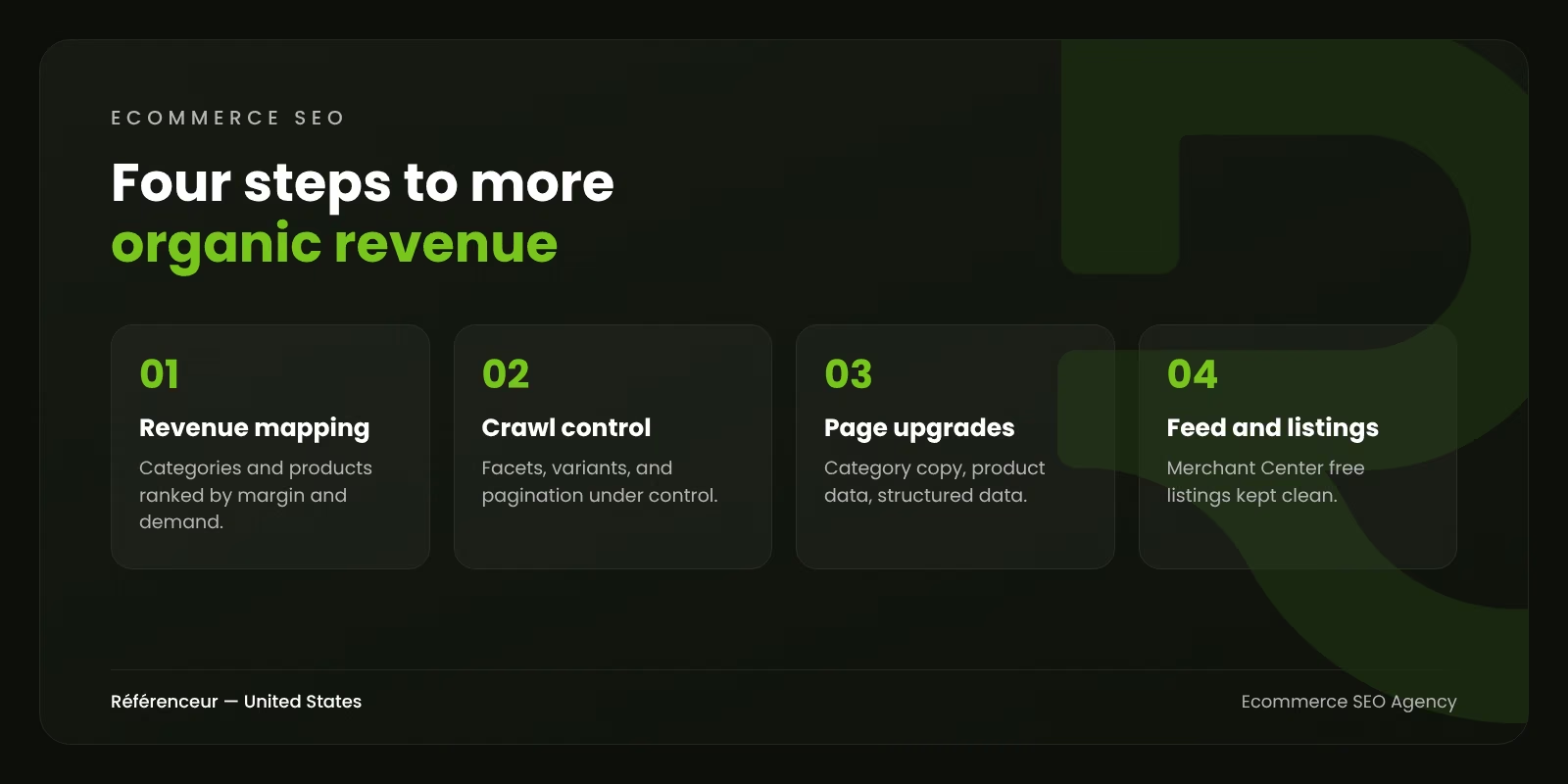
Many store owners don’t realize that products can appear in Google’s Shopping tab and other surfaces through free listings from Merchant Center. A clean product feed, with accurate titles, prices, availability, GTINs, and images, supports both free listings and paid Shopping campaigns. We audit and improve the feed as part of SEO, and if you also run paid Shopping or Performance Max, our Google Ads agency team can manage it with the same data.
AI Shopping Assistants and Product Discovery
Shoppers increasingly ask AI tools for recommendations: “best carry-on suitcase for international flights,” “quiet blender for a small kitchen.” These answers draw on product data, reviews, comparison content, and brand mentions across the web. Stores with structured, complete, consistent product information, including product schema markup, are easier for these systems to understand. We treat that as part of ecommerce SEO, not a separate trend to chase.
Measuring Ecommerce SEO by Revenue, Not Rankings
Rankings are a means, not the goal. We report organic revenue, transactions, and conversion rate by landing page type, so you can see whether category work, product work, or technical fixes are paying off. We also separate branded searches, which mostly reflect existing awareness, from non-branded searches, which show whether new customers are finding you. If you want to understand the fundamentals before talking to an agency, our ecommerce SEO guide covers category pages, product pages, and site structure in detail.
How We Work With Ecommerce Brands
Our team sits in Belgium and Luxembourg rather than in a U.S. office, typically six hours ahead of U.S. Eastern Time, and collaborates with your team through video calls, shared dashboards, and project tools. The engagement usually follows this path:
- Kickoff call covering your catalog, margins, seasonality, and platform.
- Technical and content audit, including crawl analysis and a review of Search Console data.
- A prioritized roadmap ranked by expected revenue impact and effort.
- Implementation with your developers, or directly on the platform when you prefer.
- Monthly reporting on organic sessions, revenue, and category rankings.
We’re a partner of Google, Microsoft Advertising, Semrush, and HubSpot, and we cite only European references, such as Lupulus, and never U.S. results we can’t show. European brands launching a U.S. store get an extra benefit: our Belgian and Luxembourgish team works natively in French and English, so we understand both markets and write product content in native U.S. English. Read about our SEO agency services, browse our U.S. locations, or get a free assessment to see where your catalog can grow.
Frequently Asked Questions About Ecommerce SEO
What Should an Ecommerce SEO Agency Focus on First?
Usually category pages and crawl efficiency. Categories target the searches with the most volume, and fixing faceted navigation helps Google reach your important pages faster. Product page work follows, starting with your best sellers and highest-margin items.
Do I Need to Rewrite Every Product Description?
No. Start with priority products: best sellers, high-margin items, and products where manufacturer copy is duplicated everywhere. For long-tail products, structured specs and reviews often matter more than long descriptions.
Is Shopify Good for SEO?
Shopify can rank very well. It has some fixed structures and duplicate URL patterns to manage, but with good internal linking, clean themes, and strong category content, Shopify stores compete effectively.
How Do You Handle Out-of-Stock Products?
It depends. Temporarily unavailable items usually keep their page with clear availability information. Permanently discontinued products may redirect to a close alternative or the parent category. We decide case by case based on traffic and links.
Can SEO Reduce Our Dependence on Paid Ads?
Over time, yes. Organic traffic builds without a per-click cost, though most stores keep paid campaigns for launches and competitive terms. Request a free assessment to estimate your organic potential.