 0498 70 98 60
Digital Marketing Agency Santa Monica: Growth Plans Sized to Your Funding Round
Choosing a digital marketing agency Santa Monica founders can trust usually comes down to one question: will this team spend the money as if it were their own? On the Westside, most marketing budgets come from a funding round, and each month of runway has a cost. You need a plan that ties every channel to trials, demos, or paid accounts, and that tells you early when something isn’t working.
Référenceur comes from Belgium and Luxembourg: a French-speaking team that is just as much at home in American English. We have spent more than 15 years helping companies sell to buyers in more than one market and more than one language. That background suits software and app companies that want to grow in the U.S. without hiring a full marketing department before Series A. Request a free assessment: we’ll look at your funnel, your tracking, and the next three moves worth funding.
Silicon Beach Is Small on the Map and Loud in the Feed
Santa Monica had 93,076 residents in the 2020 census, and Census Bureau survey data for 2019 to 2023 puts the share of residents 25 and older with a bachelor’s degree or higher at 68.9%. Yet the area competes for attention with some of the biggest names in tech. Snap Inc. lists its principal executive offices at 3000 31st Street in Santa Monica in its annual report for 2025, and Snapchat averaged 474 million daily active users in the fourth quarter of that year. A few miles south in Playa Vista, Google turned the 1943 hangar Howard Hughes built for the Spruce Goose into a 450,000-square-foot office.
KCRW was already describing Silicon Beach in 2012 as the stretch of Santa Monica, Venice, Culver City, and the South Bay where new media companies cluster. For a young company, that density has two effects. Your buyers are used to polished onboarding and sharp product pages, so a rough site costs more here. And well-funded teams target the same audiences, which pushes up the price of every paid click and every sponsored post.
Match the Marketing to Your Funding Stage
A Silicon Beach marketing agency that sells the same retainer to a pre-seed team and a Series C company is selling hours, not outcomes. The work changes with the stage. These profiles are illustrative, not client stories.
| Stage | What buyers need to see | Channels worth the money | What we measure |
|---|---|---|---|
| Pre-seed and seed | A clear problem, a clear user, a way to try it | Founder-led content, a fast landing page, small search tests | Waitlist or trial quality, activation rate |
| Series A | Proof that the product works for a defined segment | Santa Monica SEO for use-case pages, Google Ads on high-intent terms, remarketing | Trial-to-paid rate, payback period by channel |
| Series B and later | Category leadership, comparisons, security answers | Content at scale, paid search across regions, review platforms | Pipeline by channel, blended acquisition cost |
| Consumer app at any stage | A reason to install today | App store pages, app campaigns, creator content | Day-7 retention by source, cost per retained user |
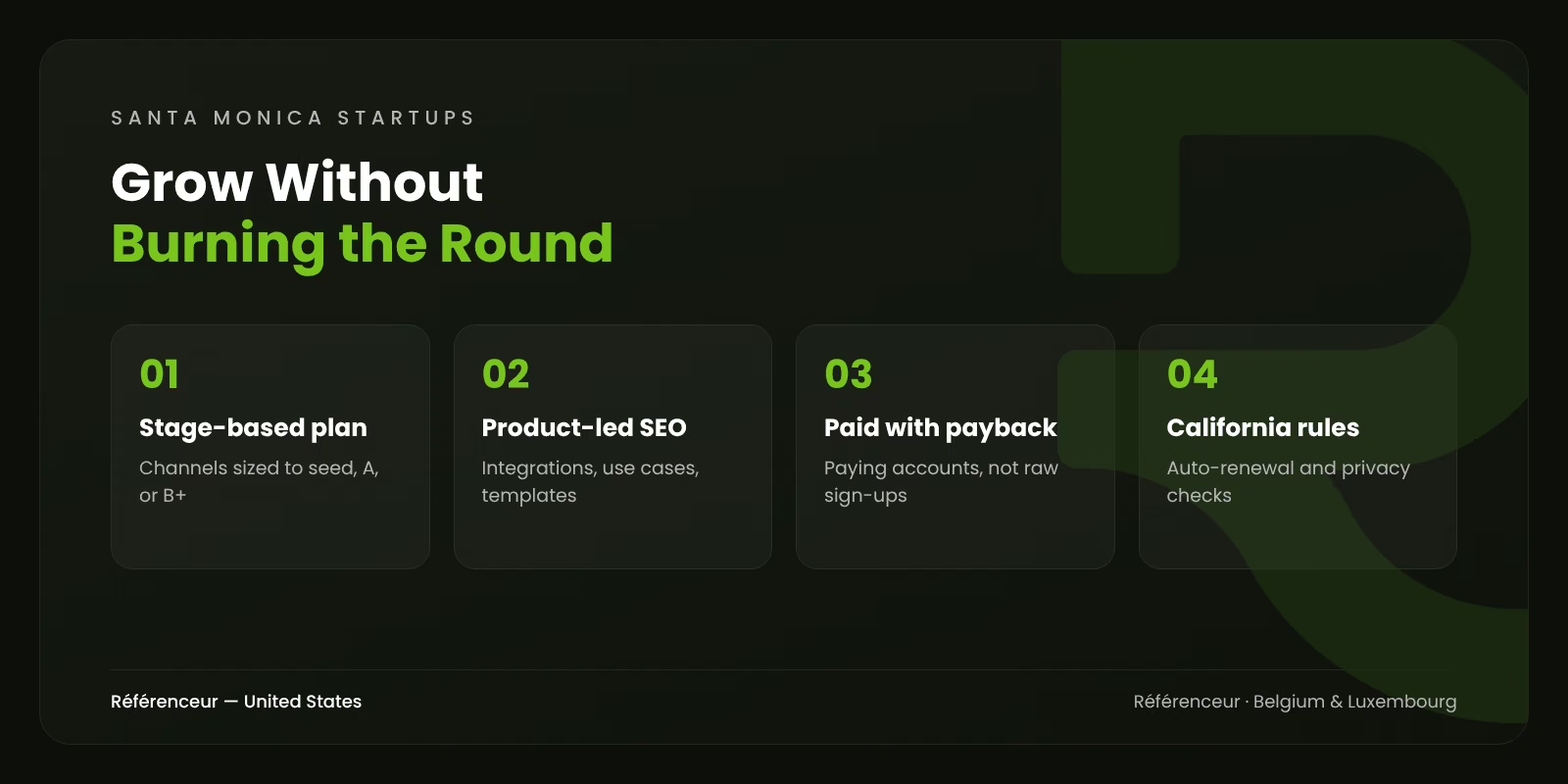
The table drives the budget conversation. Before Series A, we usually advise against large SEO programs: the positioning will move, and pages written for last quarter’s pitch age fast. After Series A, organic search becomes the channel that lowers your blended cost as paid spend grows, which is where our SEO services for growing companies come in.
Product-Led Content That Ranks and Converts
Product-led companies have content most marketing teams would envy: templates, integrations, changelogs, help docs, and real usage patterns. Most of it sits behind a login or in a help center that search engines barely see. We start by finding the pages that already answer buyer questions and making them indexable, fast, and linked from the main site.
From there, we build pages around jobs to be done rather than features, following our tips for content that ranks:
- One page per integration, explaining what the connection does and who sets it up.
- Use-case pages for each role that signs the contract, written in that role’s vocabulary.
- Template or calculator pages that let a visitor get value before creating an account.
- Honest comparison pages that explain when your product is not the right fit.
That last point matters. Buyers in this market read comparison pages skeptically, and AI assistants that summarize your category tend to favor sources that sound balanced. A page that admits a limitation earns more trust than one that claims to win every row.
Paid Acquisition Without Burning the Round
Paid search works best for startups when it answers a narrow question: which searches turn into customers who stay? We set up campaigns to learn that quickly, with modest budgets and strict exclusions, then scale what pays back. For B2B software, our page on Google Ads for SaaS companies covers campaign structure in detail, and our Google Ads management in Los Angeles page covers local targeting across the county.
For product-led funnels, two habits make the biggest difference. First, report on accounts that reach a usage milestone, not raw sign-ups (our Google Ads conversion tracking guide shows the setup), because free plans attract curious visitors who never return. Second, set a payback target with your finance lead before spending, so a good month doesn’t hide a channel that only works with an ever-larger budget. If your current accounts report sign-ups only, ask us for a free assessment of your conversion setup.
California Rules That Touch Your Funnel
Growth teams in California work under some of the most detailed consumer rules in the country. Two affect startups directly.
Automatic renewals and free trials. AB 2863, signed on September 24, 2024, amended California’s Automatic Renewal Law as of July 1, 2025. The changes reach free trials that convert to paid plans. Businesses need the consumer’s express affirmative consent to the renewal terms and must keep a record of that consent for three years or one year after the contract ends, whichever is longer. Online subscribers must be able to cancel online, a business that shows a retention offer during cancellation must also display a prominent “click to cancel” link, and price changes need notice between 7 and 30 days before they take effect. An annual reminder is also required. Your pricing page, checkout, and lifecycle emails all touch these rules.
Privacy and automated decisions. The California Privacy Protection Agency announced on September 23, 2025, that new regulations on risk assessments, cybersecurity audits, and automated decisionmaking technology had been approved. They took effect on January 1, 2026, and businesses that use automated decisionmaking technology to make significant decisions about consumers must comply with those specific requirements starting January 1, 2027. If your product scores, ranks, or approves people, your marketing claims and your privacy notice should describe that accurately.
We build consent banners, tag setups, and checkout flows that make compliance easier to document. None of this is legal advice; talk to your counsel before launching a new pricing model or data use.
A Partner Who Works While Your Team Sleeps
Belgium and Luxembourg are usually nine hours ahead of Pacific Time. For a startup, that gap is useful: we review the previous day’s campaign data, publish fixes, and leave notes before your standup. We schedule calls in the overlap, typically late afternoon in Europe and morning in California. Every month, you get one report that a board member could read in five minutes.
We have no office in California and don’t claim U.S. clients; our published case studies come from European companies. What we bring is a Belgian and Luxembourgish team that works in French and English every day, which helps founders who sell to Europe too or report to European investors. If your company also runs a team in Irvine or Newport Beach, see our page on digital marketing in Orange County. For the full list of services across the region, start with our Los Angeles digital marketing agency page.
Have a launch, a raise, or a stalled funnel on your mind? Tell us where growth is stuck, and we’ll show you what we would test first.
Frequently Asked Questions About Santa Monica Growth Marketing
Should a Seed-Stage Startup Pay for SEO Before Product-Market Fit?
Usually not at scale. Before product-market fit, your positioning, pricing, and target user may change every quarter, and SEO pages take months to mature. We recommend a solid technical foundation, a handful of pages for the problems you’re sure about, and founder-written content. Larger SEO investment makes sense once you can describe your best customer in one sentence.
Can You Work Inside Our Existing Tools?
Yes. Most startups already use a CRM, a product analytics tool, and a website builder or headless CMS. We work in your accounts rather than moving you to ours, so you keep ownership of the data, the campaigns, and the history if we stop working together.
How Do You Report on Trial-to-Paid Conversions Instead of Sign-Ups?
We connect your ad platforms and analytics to an event that reflects real value, such as a paid upgrade or a usage milestone you define. Reports then show which channels produce paying accounts and how long each one takes to pay back its acquisition cost. Sign-ups still appear, but as an early signal rather than the goal.
Does California’s Auto-Renewal Law Affect Our Free Trial Page?
It can. Since July 1, 2025, the amended law covers free trials that turn into paid subscriptions, with rules on consent, online cancellation, reminders, and price-change notices. We review the marketing side of your trial flow, such as disclosures and email timing, and flag open questions for your counsel. This isn’t legal advice, so have your lawyer confirm how it applies to you.
What Happens to the Work if We Hire an In-House Marketing Team?
That’s a common and healthy outcome. Everything we build stays in your accounts, documented, so a new head of growth can take over without starting from zero. Some teams keep us for specific channels, such as paid search or technical SEO, while their own hires focus on brand and community.