 0498 70 98 60
French SEO Agency for U.S. Companies: Rank in France, Quebec, Belgium, and Beyond
A French SEO agency should open every project with one blunt question: which French-speaking market are you trying to win? A buyer in Lyon, a procurement manager in Montreal, and a homeowner in Liège may all type in French, yet they use different words, see different results pages, and trust different websites. Treating them as one audience is the fastest way to publish French pages that nobody finds.
Référenceur was born in Belgium and Luxembourg, so French is our working language by birth, not by translation. Our team writes and researches natively in French and English, and we live in two of the markets your French pages would target. We have no U.S. office: U.S. companies meet us on video, review work on a shared screen, and receive a written summary each month, scheduled at hours that suit both time zones. If you want a second opinion on your current French pages before anything else, ask us for a free assessment.
One Language, at Least Five Search Markets
French is not a niche. The Organisation internationale de la Francophonie (OIF) ranks it fourth among languages present online and counts hundreds of millions of French speakers, most of them in Africa, according to its 2026 report on the French language. France alone had about 69.1 million residents on January 1, 2026, according to its national statistics office, Insee.
For SEO, those people split into markets that behave differently:
- France, the largest single market, with its own vocabulary, its own media, and its own consumer rules.
- Quebec and the rest of French Canada, where North American habits meet a distinct vocabulary and strong language requirements for businesses.
- Belgium, specifically Brussels and Wallonia, where many searches mix French with local terms.
- French-speaking Switzerland and Luxembourg, small but wealthy markets where French shares the stage with German and other languages.
- Francophone Africa, a fast-growing audience that is often mobile-first and served by pages written for France.
Most U.S. companies should not attack all five at once. We usually recommend picking one or two markets where you can actually sell, ship, or support customers, and building from there. Our French-market marketing services cover how that choice fits with ads, social, and sales.
French Keyword Research Is Country-by-Country Work
Good French keyword research starts from what people type in each country, not from a translated English list. Search volumes, competitors, and even the meaning of common words shift at the border. A few examples our team runs into all the time:
| What you mean | France | Quebec | Belgium or Switzerland |
|---|---|---|---|
| e-mail, mail | courriel | e-mail, mail | |
| Cell phone | portable | cellulaire | GSM (Belgium), natel (Switzerland) |
| Weekend | week-end | fin de semaine | week-end |
| Lunch | déjeuner | dîner | dîner |
| Go shopping | faire du shopping | magasiner | faire du shopping |
| Ninety | quatre-vingt-dix | quatre-vingt-dix | nonante |
A restaurant group that writes “déjeuner” for its lunch menu is right in Paris and wrong in Montreal, where déjeuner means breakfast. A telecom page optimized for “portable” misses the Belgian searcher who types “GSM.” Small gaps like these add up to a page that ranks for nothing.
Our process for SEO in French for U.S. companies runs in this order: we pull keyword data from the database for each target country, cluster terms by intent, check who ranks today on that country’s results page, and only then decide which English pages deserve a French counterpart. We also flag terms where French searchers simply use English, which is common in software, finance, and marketing. Sometimes the best French page targets an English keyword with French copy around it.
Domains and Hreflang: What a U.S. Company Can Actually Register
Domain choice is often settled by eligibility before strategy enters the picture. Two rules surprise many American teams:
- A .fr domain is limited to people and organizations based in the European Union or in Iceland, Liechtenstein, Norway, or Switzerland. A U.S. company without a European entity cannot register a new one in its own name.
- A .ca domain follows CIRA’s Canadian Presence Requirements. Canadian citizens, residents, and corporations qualify. A foreign company can qualify mainly through a trademark registered in Canada, and then only for a domain built on that trademark.
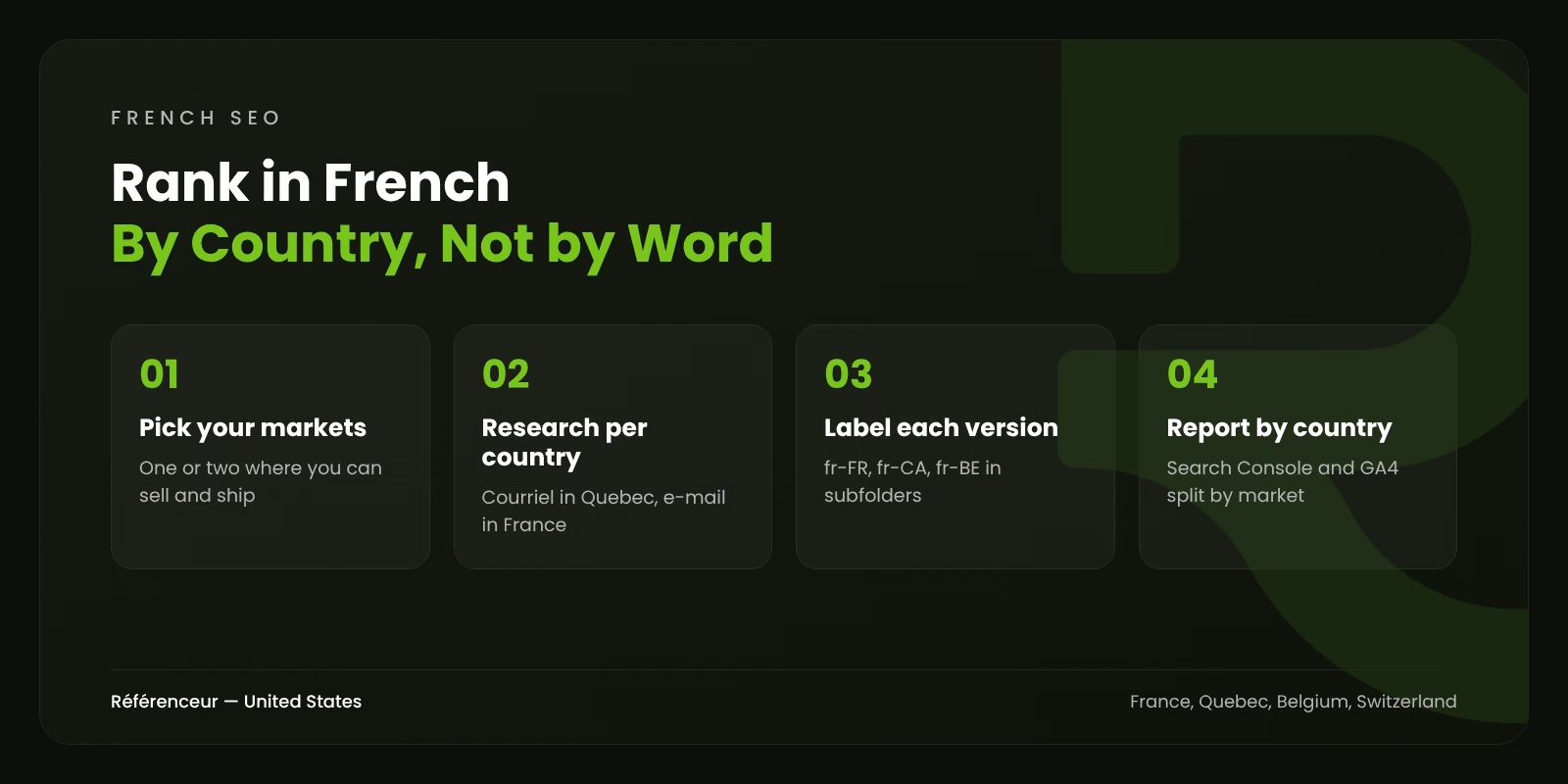
That is why many U.S. companies run French sections in subfolders on their existing .com, such as /fr-fr/ and /fr-ca/. Our international SEO guide compares the structures in detail. What matters here is the labeling. Google’s documentation says an hreflang value must start with a language code, with an optional region: fr-FR, fr-CA, fr-BE, fr-CH. A country code alone is not valid. Neither hreflang nor the lang attribute tells Google what language a page is in, according to the same documentation: its systems work that out from the text itself. So a French page with an English navigation bar and English title tags sends a mixed signal, whatever the tags say.
Earning Links and Mentions in French-Language Media
Links from English-language sites help your domain overall, but they say little about relevance in Marseille or Quebec City. French pages usually gain ground faster when French-language sources talk about you. The tactics that tend to work for an American brand:
- Pitching original data to trade publications in the target country, with a French press release written for that market, not translated from the U.S. version.
- Joining French-American, Belgian-American, or Canadian trade associations and chambers that publish member directories and news.
- Offering French-speaking experts for podcasts, webinars, and industry roundups.
- Publishing a French resource that local bloggers can cite, such as a glossary, a calculator, or a regulation summary.
We apply the same standards as in English: no paid link schemes, no private blog networks. Brand mentions without a link still count for visibility in AI answers, a point we cover in our article on brand mentions and SEO.
Local Search in Quebec and France Without an Office There
Local SEO in French has one hard limit: Google Business Profile is meant for real locations or real service areas. Creating an address in Montreal or Paris you do not occupy is a policy violation, and it can get the profile suspended. If you have no physical presence, focus on country-level organic rankings instead.
If you do open a location or sell to consumers in Quebec, language obligations follow. As the public legal-information group Éducaloi summarizes it, a business with an address in Quebec must publish a French version of its website, and a site that sells online to Quebec customers must offer everything needed to buy in French, from product information to order forms, invoices, and receipts. English can still appear next to the French. These are summaries, not legal advice; have a Quebec lawyer confirm what applies to your company.
For France, the practical local signals are French phone numbers, delivery and return terms written for French customers, prices in euros, and reviews from French buyers. Our French website localization team handles those details so the SEO work is not undermined by a checkout that still reads like an American template.
Reporting French SEO by Country, Not by Language
A single “French traffic” line in a report hides the answers you need. We set up tracking so each market can be judged on its own:
- Search Console filtered by country and by subfolder, so fr-CA impressions are not blended with fr-FR.
- GA4 explorations broken down by country and page language, with each conversion tied to a French form or thank-you page.
- Rank tracking on each country’s Google, with competitors chosen per market.
- A short monthly note on what changed, what we published, and what we recommend next.
Expect French pages to follow roughly the same curve as English SEO: early impressions within a few months, then clicks and leads as content and links build. We do not promise rankings or dates; anyone who does is guessing. If you would like to see what a country-level report could look like for your site, request a free assessment.
Native French Speakers From Belgium and Luxembourg
A French SEO agency based in Europe has an obvious advantage: we search the way your future customers search, because we run the same searches at home. Our team works from Belgium and Luxembourg, two countries where French, Dutch, German, and Luxembourgish share a small map, and we have more than 15 years of SEO and paid search behind us. We are an official partner of Google and Microsoft Advertising, and also of HubSpot and Semrush. On Google, 107 reviewers give us an average of 4.7/5.
For an American company, that means one partner who can research keywords in Quebec French on Monday and review a Belgian press pitch on Tuesday, then explain both in plain English. Get a free assessment to see where your French opportunity stands; our broader SEO agency services can cover your U.S. site in the same engagement.
Frequently Asked Questions About Our French SEO Agency
Can We Rank in France With Our Existing .com Domain?
Yes. Plenty of sites rank in France on a .com, especially when the French section lives in its own subfolder, carries correct hreflang, and reads as fully French. A local domain can add trust with some buyers, but for a U.S. company a .fr is often unavailable anyway, so the .com route is usually the practical one.
Do French Speakers Really Search in French for B2B Topics?
Mostly, but not always. In software, finance, and marketing, many French professionals search with English terms such as “CRM” or “lead gen,” then expect French content on the page. Our keyword research shows the mix for your sector, so you write in French where it pays and use English terms where buyers do.
How Many French Pages Should We Start With?
Fewer than most companies expect. We usually start with the pages that sell: the homepage, your main service or product pages, and one or two pieces that answer the questions buyers ask before contacting you. Once those rank and convert, we add content based on the data.
Should Our French Blog Simply Mirror the English One?
No. Some English articles deserve a French version, many do not, and some topics only matter to French speakers, such as local regulations or how to buy from a U.S. supplier. A French editorial plan built on French search demand nearly always outperforms a translated archive.
Does French SEO Help Us Show Up in AI Answers in French?
It helps. AI assistants answering in French draw on French-language pages and mentions, so a well-structured French site and coverage in French media both improve your chances of being cited. Visibility in AI answers is never certain, but a brand with no French content has very little to be cited from.