0498 70 98 60
Social Media Marketing for Small Businesses: The Complete 2026 Guide
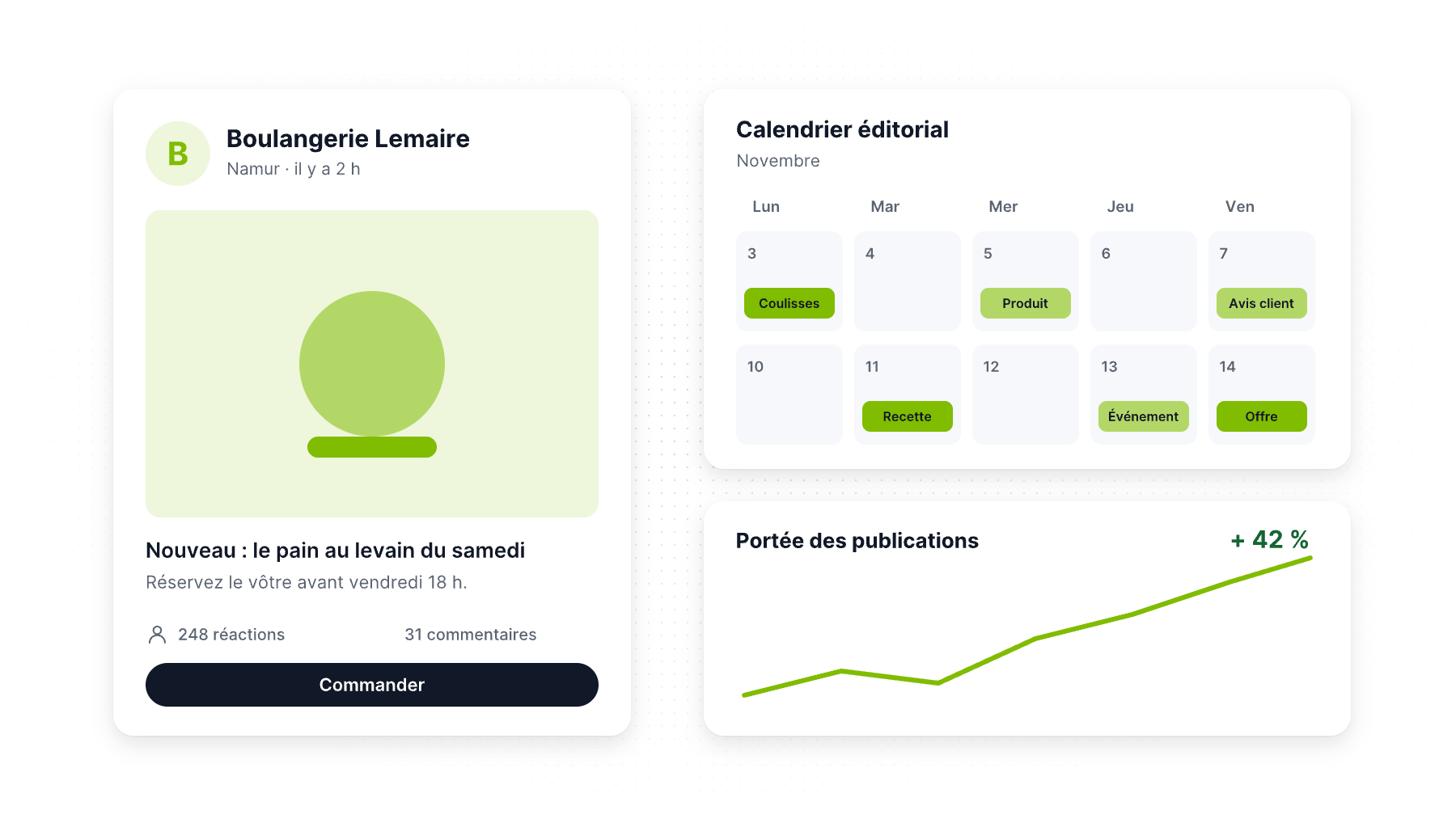
Social media is where most of your customers already spend time: 84% of US adults use YouTube and 71% use Facebook (Pew Research Center, 2025). For a bakery in Austin, a CPA firm in Charlotte or a remodeling contractor in Minneapolis, the real question is no longer “should we be on social?” but “which platform, what content, and how do we do it without losing three evenings a week?”
This guide covers what matters in 2026 for a US small business: audience data, choosing platforms, what the algorithms actually reward, a social media strategy you can sustain, paid social, and the US rules many businesses overlook: the FTC’s rules on fake reviews and influencer disclosures, sweepstakes laws, photo releases and AI-generated content.
It’s written for businesses that handle social media in-house, and it flags where data is weak or self-reported by the platforms.
Social media statistics for US businesses in 2026: what the numbers say
The most reliable independent source is the Pew Research Center, which surveyed 5,022 US adults between February and June 2025. Share of US adults who say they ever use each platform:
| Platform | US adults who use it | Who stands out |
|---|---|---|
| YouTube | 84% | A majority in every age group |
| 71% | A majority in every age group; highest among adults 30 to 49 (80%) | |
| 50% | About 8 in 10 adults ages 18 to 29, vs. 19% of adults 65 and older | |
| TikTok | 37% | About half of 18- to 29-year-olds use it daily |
| 32% | Popular for messaging, including with international contacts | |
| 26% | Younger adults stand out |
Two cautions. First, “ever use” is not the same as active, daily use. Second, the audience figures platforms show in their ad tools are advertising reach estimates, not unique people: don’t mix them with survey data, and don’t add them up.
Which social media platform is best for your small business?
The right platform is the one where your customers are and where you can post consistently. Two well-run accounts beat five abandoned ones. General guidelines:
| Platform | Core audience | Typical small business use |
|---|---|---|
| Adults across age groups, especially 30+ | Local community, events, reviews, local ads | |
| Under 35, highly visual | Storefront, behind the scenes, Reels; retail, restaurants, beauty | |
| Professionals, B2B | Expertise, recruiting, B2B prospecting | |
| TikTok | Young adults | Short video, awareness, hiring younger workers |
| YouTube | Very broad | Tutorials, demos, evergreen video |
| WhatsApp Business | Existing customers | Quick replies, quotes, reminders |
| Nextdoor | Neighbors and homeowners | Local recommendations for home services |
Quick picks by business type:
- Retail, restaurants, beauty: Instagram and Facebook first, with polished visuals and Reels.
- Professional and B2B services: LinkedIn first, with a Company Page and active leadership profiles.
- Contractors and home services: Facebook and Nextdoor for local customers, Instagram to show finished projects.
- Hiring younger workers: TikTok, Instagram and Snapchat.
X, Threads and Bluesky are rarely a priority for a small business. If you serve Spanish-speaking customers, consider bilingual posts and, for ads, one ad per language, reviewed by a native speaker rather than machine-translated.
Not sure where to start? Our social media marketing services help small businesses choose based on their actual customers.
Set up a solid foundation: accounts, access and complete profiles
Before you post, secure your accounts. A Facebook Page whose only admin is a former intern, a nephew or a past agency becomes a real problem the day you need to get access back.
Meta’s free tools
Meta Business Suite is a free tool to manage a Facebook Page and an Instagram professional account in one place: shared inbox, automated replies, post scheduling, insights, ads and access management. Best practices:
- a Meta business portfolio in your company’s name that owns the Page, the Instagram account and the ad account; your agency only gets partner access;
- at least two trusted admins, with two-factor authentication turned on;
- never a fake personal Facebook profile in the business’s name: profiles are for people, and Meta can disable it;
- an Instagram account switched to a professional account, required for insights and ads;
- the same business name, address and phone number as on your website and Google Business Profile.
An ad account created inside an agency’s business portfolio can’t be moved to yours later (TechWyse, 2026): settle ownership before you create it. Scattered or lost access? It’s one of the first things we check in a free social media audit.
Your LinkedIn Company Page
LinkedIn says complete Pages get 30% more weekly views and that posting weekly doubles engagement. These are LinkedIn’s own global figures, but the advice holds: fill in your logo, banner, description, website and industry, then invite your connections to follow the Page.
WhatsApp Business
The free WhatsApp Business app offers a business profile, a catalog, away messages and quick replies. For a contractor who receives photos of damage or a shop confirming curbside pickups, it’s often the most useful day-to-day tool.
How social media algorithms work in 2026, according to the platforms
The “algorithm secrets” sold online rarely cite a source. Here’s what the platforms say themselves.
Instagram: watch time, likes and sends
In January 2025, Instagram head Adam Mosseri named three major ranking signals: watch time, likes and sends (shares by direct message). In 2026, the Reels originality rule extended to photos and carousels: accounts that mostly post other people’s content without transforming it are no longer recommended to non-followers, watermark or not (PetaPixel, April 2026).
Facebook: everything is a Reel, and originality counts
Since June 2025, all videos posted on Facebook are shared as Reels, with no length limit. Since July 14, 2025, repeatedly reposting other people’s content reduces distribution for the whole account; editing, voiceover or commentary count as transformation.
TikTok: engagement, not follower count
According to TikTok’s official page on the For You feed, recommendations are based on user interactions (videos liked, shared, commented on, accounts followed) and video information (captions, sounds, hashtags). Watching a video to the end is a strong signal, and neither follower count nor past viral hits are direct factors.
LinkedIn: consistency first
LinkedIn doesn’t publish detailed, recent rules about its feed; its only quantified recommendation is about consistency: post once a week.
Three social media myths to drop
- The best time to post: no platform publishes one. Check when your followers are online, then test two time slots for a month.
- Hashtags: Instagram has limited them to five per post since December 2025, and Mosseri says they no longer increase reach. Two or three specific hashtags, like #austinbakery, are enough.
- Buying followers: those accounts will never buy from you, they skew your insights, and Meta took action against roughly 500,000 accounts for spam or fake engagement in the first half of 2025. In the US, buying fake followers or views for commercial purposes can also violate the FTC’s rule on fake social media indicators (see below).
In practice: create your own content, grab attention in the first seconds and give people a reason to share.
What to post and how often: a social media content plan you can sustain
Mosseri gives no universal posting frequency and recommends a pace you can keep up. Two solid posts a week for a year beat ten posts the first week followed by silence.
Content ideas that work for small businesses
- Behind the scenes: the workshop, the morning prep, a finished job site.
- Answers to questions you hear on the phone: an electrician explaining a GFCI outlet, an esthetician walking through a facial.
- Before-and-after posts, with the customer’s written permission if their home, face or car is recognizable.
- Team introductions, with each employee’s written consent: they build trust and help with hiring.
- Practical updates: holiday hours, new services, events.
Formats that fit each platform
Vertical 9:16 video is now the norm: Instagram Reels can run up to 3 minutes, with text and buttons kept inside the safe zone. Add captions: many people watch with the sound off, and captions make your content accessible. On Instagram, alt text and auto-generated captions for Reels are set in the advanced settings when you post.
A routine you can actually keep
- One hour a week: film or photograph three moments of real work.
- Half a day a month: write and schedule the month’s posts in Meta Business Suite.
- Ten minutes a day: reply to messages and comments.
Assign this routine to one person, with a backup during vacations. See also our article on building a social media content calendar.
Negative comments and reviews: respond, don’t delete
Future customers will read your reply more than the complaint:
- Reply once, politely, sticking to the facts and without delay, then offer to continue privately.
- Never share a customer’s personal details; if you’re bound by confidentiality (healthcare, legal, financial), don’t even confirm they’re a client.
- Hide insults and spam; deleting legitimate criticism often amplifies it.
- For defamatory posts, take dated screenshots and talk to an attorney.
Keep in mind that the FTC prohibits review suppression, and the Consumer Review Fairness Act bars contract clauses that stop customers from posting honest reviews. Our guide on how to respond to negative reviews has templates.
Facebook, Instagram, LinkedIn and TikTok ads: what US advertisers need to know
Paid social reaches a precise local audience, but the rules have tightened. To compare it with paid search, read our Google Ads guide for small businesses.
Sensitive targeting and Special Ad Categories
Since January 2022, Meta has removed detailed targeting options related to health, sexual orientation, religion and political beliefs: a clinic targets an area, an age range and a clear message. Since 2023, ads shown to teens under 18 on Facebook and Instagram can only be targeted by age and location.
In the US, ads about housing, employment and credit or financial products must run in a Special Ad Category, which limits targeting by age, gender and ZIP code to prevent discrimination. A property manager, a staffing agency or a lender who skips this step risks rejected ads.
Political and social issue ads
In the US, ads about elections, politics or social issues require Meta’s authorization process and a “Paid for by” disclaimer. A small business sponsoring a post on a local ballot measure or an environmental cause can fall into this category: review your ads before boosting them.
Boost a post or use Ads Manager?
Boosting is fine for a test; to choose your objective (messages, calls), location and budget, use Meta Ads Manager. To avoid a restricted ad account:
- pay with a company card and turn on two-factor authentication;
- avoid ads that call out personal attributes (“Are you diabetic?”), which Meta rejects, and before-and-after images for health or weight loss;
- if your account is restricted, appeal through Meta’s process; never open a new account to get around it.
LinkedIn Ads for B2B
LinkedIn lets you target by job title, company, industry, seniority and skills, with a minimum daily budget of $10. Our social media marketing page also covers paid social.
TikTok for US businesses in 2026
After years of uncertainty, TikTok closed a deal in January 2026 creating a US joint venture with investors including Oracle, Silver Lake and MGX, which ended the threat of a nationwide ban. Separate restrictions still apply on government devices: federal agencies and many states ban TikTok on their employees’ work devices.
Those bans target government devices only: TikTok is legal for businesses and individuals. Two precautions:
- use a dedicated device rather than the phone that holds your client files;
- if you work with government agencies, check their internal rules.
TikTok Shop has been available in the US since 2023, letting merchants sell directly in the app. It can be worth testing for consumer products, with an eye on margins, returns and fulfillment requirements.
Photos, giveaways and page ownership: US legal basics
Three topics come up constantly with small businesses: using people’s photos, who controls the Page, and giveaways.
Photos of customers, employees and events
Most states recognize a right of publicity: using a recognizable person’s image to promote your business generally requires their permission. The safe practice is a signed photo release from every recognizable person, kept on file, and a separate release from employees rather than a clause buried in an employment contract. For minors, get a parent’s or guardian’s written consent. And remember that an image you found online is protected by copyright by default: if you hire a photographer, make sure the license covers social media and advertising use.
Who owns your Facebook Page?
In practice, whoever controls it in the Meta business portfolio. Make sure your company owns the Page, the Instagram account and the ad account, that two trusted people are admins, and that your agency only has partner access you can revoke at any time.
Sweepstakes vs. contests: the distinction that changes everything
In most states, a promotion that combines a prize, chance and consideration is an illegal lottery. A sweepstakes (winner picked at random) is legal only if you remove consideration: “no purchase necessary” and a free alternative method of entry with substantially similar odds. A skill contest, where entries are judged on merit, is treated differently. The classic “like, comment, and we’ll pick a winner” giveaway is a sweepstakes, so the rules apply. Common recommendations:
- publish official rules: sponsor, eligibility, entry period, how and when the winner is chosen, prize and its value, odds, who pays taxes;
- state “no purchase necessary” clearly, and void the promotion where prohibited;
- limit entry to adults unless you’ve reviewed the extra rules for minors;
- check registration requirements: New York and Florida may require registration (and sometimes bonding) when the total prize value exceeds $5,000, and Rhode Island has its own rule for in-store retail promotions over $500;
- award the prizes you advertise;
- follow the platform’s rules: Meta requires a release of Facebook or Instagram and an acknowledgment that the platform doesn’t sponsor the promotion, and doesn’t allow you to require sharing on personal timelines or tagging friends to enter. Check the current version of these rules.
For any giveaway with a significant prize, have an attorney review your mechanics and official rules before launch.
Influencer marketing and fake reviews: FTC rules you can’t ignore
Partnering with a local creator can work well, but the FTC regulates how it’s done.
The FTC Endorsement Guides
Under the FTC’s Endorsement Guides, updated on June 29, 2023, creators must disclose any material connection with a brand: payment, free or discounted products, a family or business relationship. The disclosure must be “clear and conspicuous,” which the FTC now defines as “difficult to miss.” In practice:
- use plain words such as “#ad,” “Advertisement” or “Paid partnership,” placed where people will see them without clicking “more”;
- a platform’s built-in disclosure tool alone may not be enough, and a disclosure only on the creator’s profile page isn’t;
- a spoken endorsement in a video needs a spoken disclosure, and a Spanish-language post needs a Spanish-language disclosure;
- the advertiser is responsible too: brief your creators in writing, monitor their posts and fix problems.
The FTC rule on fake reviews and testimonials
Since October 21, 2024, the FTC’s Trade Regulation Rule on the Use of Consumer Reviews and Testimonials has prohibited fake reviews and testimonials (including AI-generated ones), buying positive or negative reviews, undisclosed insider reviews from employees or managers, company-controlled review sites presented as independent, review suppression, and selling or buying fake social media indicators such as followers or views. Violations can bring civil penalties of more than $50,000 each (the amount is adjusted annually for inflation).
Concretely, don’t offer discounts in exchange for 5-star reviews, don’t ask employees to post reviews without disclosing their connection, and don’t buy followers.
AI-generated content on social media: labels and disclosure
There is no general federal law requiring you to label AI-generated content in marketing, but deception rules still apply: an AI image presented as a real customer, a real project or a real result can be misleading under FTC law. Several states have also passed laws on deceptive AI-generated content, especially in political ads.
Meta displays an “AI info” label, triggered by technical signals or self-disclosure, and requires you to disclose realistic video or audio that was digitally created or altered. In practice:
- an obviously illustrated graphic or text you’ve reviewed and stand behind rarely causes problems;
- a fake realistic photo of your team, customers or storefront should be avoided or clearly labeled;
- a synthetic voice imitating a real person is off-limits without their consent.
Social media also feeds AI search
Your customers already ask ChatGPT, Gemini or Perplexity about local businesses. Consistent information across your website, social profiles and Google Business Profile can increase your chances of being cited. That’s the focus of our AI search optimization services.
How to measure social media ROI
Likes don’t pay the bills. To see whether social media brings in leads, connect it to your website with UTM parameters in Google Analytics 4. Google recommends utm_source, utm_medium and utm_campaign, and points out that values are case-sensitive: “Facebook” and “facebook” become two separate sources. Use a lowercase naming convention:
| Link posted on | utm_source | utm_medium | Example utm_campaign |
|---|---|---|---|
| Instagram profile (organic) | social | bio-2026 | |
| Facebook post (organic) | social | spring-promo | |
| Meta ad | {{site_source_name}} (filled in by Meta: fb, ig…) | paid_social | open-house-may |
| LinkedIn Page | social | technician-hiring |
For Meta ads, use that dynamic parameter: the same ad runs on Facebook and Instagram, and a hard-coded source would credit everything to one network. GA4 then groups these visits under “Organic Social” or “Paid Social.” Use utm_content to compare two creatives in the same campaign.
Native metrics worth tracking
- Instagram: average watch time, likes and sends per account reached, as Mosseri recommends.
- Facebook: reach and Reels views, messages received.
- LinkedIn: visitors, followers, content performance and competitor benchmarks.
Log the inquiries you receive by direct message every month: Google Analytics can’t see them. Need help connecting the dots? See our web analytics services.
Social media and SEO: what’s established
No official source makes social posts a Google ranking factor. But search is spreading across platforms, and since July 10, 2025, public content from Instagram professional accounts can appear in Google and Bing. Social media complements your website without replacing it: your website is what drives your organic rankings. Read our SEO guide for small businesses and our local SEO guide.
Social media for small businesses: FAQ
Which social media platform should a small business be on in 2026?
It depends on your customers: Facebook reaches adults of every age, Instagram, TikTok and Snapchat skew younger, LinkedIn is for B2B. Start with one or two platforms you can feed consistently.
How often should a business post on Facebook, Instagram or LinkedIn?
No platform gives a universal number. Instagram recommends a pace you can sustain, LinkedIn suggests once a week. Consistency matters more than volume.
Is it legal to run a “like, comment and win” giveaway?
Yes, if it’s structured as a legal sweepstakes: no purchase necessary, a free way to enter, published official rules, and registration in states like New York or Florida when prizes exceed $5,000. Have an attorney review the mechanics.
Can I post photos of customers or employees without permission?
Don’t. For business use, get a signed release from every recognizable person and keep it on file. If someone asks you to remove a photo, take it down.
Do influencers have to say a post is sponsored?
Yes. Under the FTC Endorsement Guides, any material connection (payment, free product, discount) must be disclosed clearly, for example with “#ad” at the start of the caption. The brand can be held responsible too.
Our agency or an employee created our Facebook Page: who owns it?
Whoever controls it in the Meta business portfolio. Make sure your company owns the Page, Instagram account and ad account, with two trusted admins and partner-only access for your agency.
Do I need to label images or videos made with AI?
Meta requires you to disclose realistic AI-generated or altered video and audio, and the FTC prohibits misleading content. To be safe, label any realistic image of people that was created with AI.
Do social media posts improve my Google rankings?
No official source makes them a ranking factor. But Instagram professional posts can appear in Google, and social media can drive brand searches. Measure their contribution with UTMs.
Want social media that brings in customers without eating your week? Request your free social media audit: we review your accounts, content and insights, then propose a plan that fits your business. Discover our social media marketing services.