 0498 70 98 60
Web Design Agency Silicon Valley: Sites for Technical Buyers and French-Speaking Markets

Hiring a web design agency Silicon Valley product teams can trust starts with an honest question: who reads your site? In Santa Clara, Sunnyvale, or Mountain View, the first visitor is often an engineer checking whether your API, chip, or model fits a stack she already runs. The second is a procurement lead looking for your security posture. The third may be a distributor in Lyon or a systems integrator in Montreal, reading in French.
Référenceur designs for all three. Our agency is Belgian and Luxembourgish, from two countries where one company website commonly runs in two or three languages, and every member of the team writes and works in both French and English. That lets us build your U.S. site and its French version as one system, with copy written by people who think in each language rather than by a translation plugin. We’ve been building business sites for over 15 years, 107 Google reviewers have rated us 4.7/5 on average, and U.S. projects run remotely, over video calls and shared files. Before any project starts, you can request a free assessment of the site you have today.
This page covers design and build. For organic search, see our SEO work for Silicon Valley companies; for the full range of services in the region, start at our Silicon Valley digital marketing hub.
Who Actually Reads a Silicon Valley Website
The 2026 Silicon Valley Index, published by Joint Venture Silicon Valley, counts nearly 140,000 software developers and about 84,000 engineers among the employed residents of Santa Clara and San Mateo counties in 2024. Those are your readers, and so are the people they report to. They skim less than marketers expect and verify more. A headline that says “AI-powered platform” tells them nothing; a latency figure, a list of supported SDKs, or a pinout diagram tells them whether to keep reading.
The same report finds that 40% of residents were born abroad, as of 2024, and that 53% speak a language other than English at home. Your buyers, your hires, and often your founders switch languages every day. For design, that has a concrete consequence: navigation, labels, and microcopy should be plain enough to survive translation, because sooner or later they will be translated.
Competition for attention is just as dense. Near the end of 2025, the Index counted 312 unicorns in Silicon Valley and San Francisco combined. Many of them sell to the same platform teams you do, with sites that look alike: dark hero, gradient, vague claim. A site that states plainly what the product does, for whom, and with which limits is already different.
Pages Technical Buyers Open Before They Talk to Sales
Every product category has a short list of pages that decide whether a buyer books a call. We design those first, then build the rest of the site around them.
| Page | Who reads it | What it has to show |
|---|---|---|
| Product or platform overview | CTO, staff engineer | What it does, how it fits an existing stack, limits stated plainly |
| Docs entry and quickstart | Developers testing a trial | A working example in minutes, code samples, version notes |
| Spec pages and datasheets | Hardware and semiconductor buyers | HTML spec tables plus the PDF, part numbers, compliance marks |
| Security and trust | Procurement, security reviewers | Certifications you actually hold, data handling, a contact for questionnaires |
| Pricing or “how to buy” | Finance, team leads | Tiers or a clear path to a quote, regional availability |
| Changelog | Current users, analysts | Dated entries that prove the product ships |
For hardware and chip companies, we publish key specifications as HTML pages next to the PDF datasheet. An HTML spec table can be linked, searched, translated, and corrected without reissuing a document, and it gives the French version real content to localize instead of a file name.
Docs deserve the same care. Whether they live in your CMS or on a separate docs platform, we design the handoff: shared header, consistent search, and a path back to pricing or sales when a developer is ready.
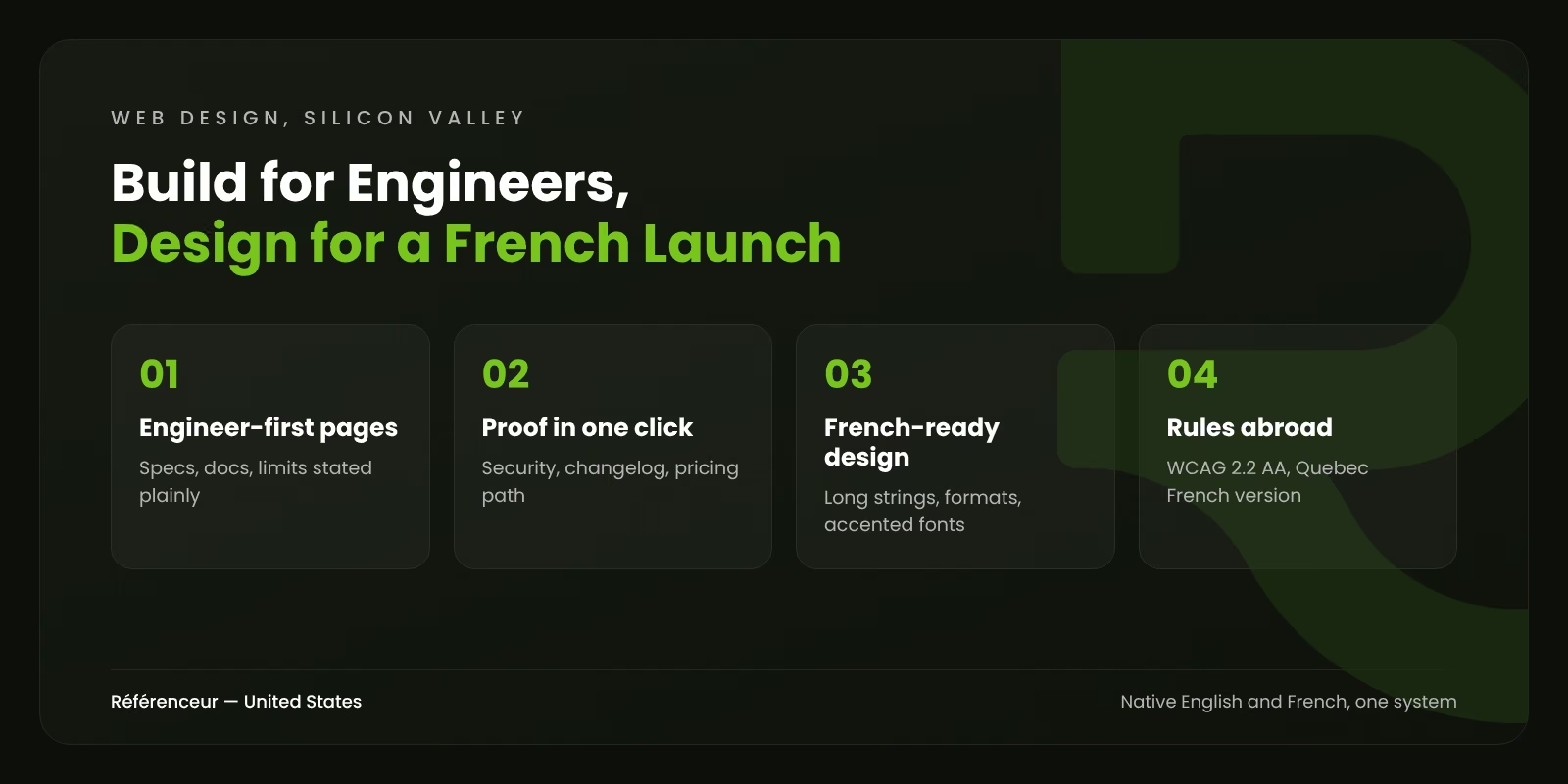
Designing Now for the French Pages You’ll Add Later
Most Silicon Valley teams don’t launch in French on day one. The expensive mistake is a site that can’t accept a second language without a rebuild. When we scope a French version website, Silicon Valley teams often discover that the problem isn’t the words; it’s the templates. We design for French from the first wireframe, even when those pages arrive a year after launch.
Our French-readiness checklist:
- Room for longer strings. French copy usually takes more space than English, so buttons, menus, and table headers must wrap cleanly. No fixed-width buttons, no text baked into images.
- Local formats. French writes 1 250,50 € where English writes €1,250.50, and Canadian addresses use postal codes such as H2X 1Y4. Forms, price displays, and validation rules need to handle both.
- Fonts that carry every character. Some display typefaces lack é, ç, œ, or the « » quotation marks in every weight. We test real French text in each weight before the type choice is final.
- A URL structure ready for languages, such as /fr/ or country folders like /fr-ca/, managed from the same CMS. Our guide to bilingual French-English websites compares the options.
- A language switcher that lands on the equivalent page, not the French homepage.
- Real copy in the mockups. We review designs with French strings, never with lorem ipsum.
Accessibility and Language Rules That Follow Your Site Abroad
Selling outside the U.S. changes what “finished” means for a website. For California tech companies, two legal regimes usually decide it.
The European Accessibility Act has been enforceable by EU member states since June 28, 2025, and it covers ecommerce services, meaning products or services sold to consumers through a website or app. In a June 2025 briefing, the law firm Travers Smith suggested meeting at least level AA of WCAG 2.2 as a minimum for websites and apps. We design and build to that level as a default, which also covers much of the U.S. picture explained in our practical guide to ADA website compliance.
In Quebec, the Charter of the French Language gives consumers the right to be informed and served in French. Éducaloi, a Quebec legal-information organization, explains that a business operating in Quebec may offer its site in another language only if a French version of comparable quality is also available, and that fines for businesses have been set at C$3,000 to C$30,000 since the June 2022 amendments. A half-translated site with English checkout pages is the pattern to avoid.
Treat this as orientation, not legal advice: your counsel decides which rules apply to your company and markets. Our job is to give your lawyers a site that can comply without a redesign. If you’re unsure where your current site stands, ask us to look at it before your next sprint planning.
A Build Schedule Split Between San Jose and Europe
For most of the year, our day starts nine hours before yours. In practice, your morning overlaps with our late afternoon, so we hold reviews then and do the heavy work while California sleeps. You comment on designs in shared files; we answer before your next standup.
- Inventory: analytics, top pages, docs setup, CMS constraints, and the URLs that already bring in leads.
- Page plan for both languages, with each page marked “English now, French later” or “both at launch.”
- Design system: components built and tested with real English and French strings.
- Build on WordPress or the headless setup your engineers prefer, with a staging site you can break safely.
- Launch with every old URL redirected; our article on website redesign SEO explains why this step protects your rankings.
- French pages written natively by our team and reviewed by your partners or subsidiary in each market.
Why a Belgian and Luxembourgish studio for a California build? Because we work every day in the situation your expansion team is about to face: one brand, several French-speaking audiences, and an English-speaking board. We know that a reader in Brussels, one in Geneva, and one in Montreal won’t react to the same sentence in the same way. Our web design agency services page describes our general approach, and the wider work for French-speaking markets is described on our francophone marketing page.
Get a Free Assessment, then name the market that comes after the U.S. We’ll review your site with that launch in mind.
Frequently Asked Questions About Web Design in Silicon Valley
Can You Work From Our Existing Figma Design System?
Yes. If your product team already maintains a design system, we extend it rather than replace it. We add the marketing components it usually lacks, such as comparison tables, long-form templates, and spec layouts, and we test each one with French text so the system holds up when you add a language.
Do French Pages Need Their Own Screenshots and Images?
Often, yes. If your app is already available in French, show the French interface; if it isn’t, keep English screenshots and say so in a French caption rather than pretending otherwise. Any text inside an image, from diagrams to banners, needs a French version, and alt text should be written in French as well.
Will a French Version Slow Down Our Release Cycle?
It shouldn’t, if the workflow is set up from the start. We tag each page with its translation status, so an English update flags the French page for review instead of silently leaving it outdated. Product launches can go live in English first, with French following on a schedule you choose.
How Do You Handle Datasheets and Other PDFs?
We keep the PDF for buyers who want to download it, and we publish the key specifications as an HTML page that links to it. That page can be updated, translated, and linked from distributor sites. For French markets, we localize units, decimal separators, and compliance wording, not just the headings.
Do You Build Headless Sites, or Only WordPress?
Both. Many marketing teams prefer WordPress because they can publish without an engineer. If your developers want a headless front end, we design for it and agree early on how previews, redirects, and the language switcher will work, since those are the points where headless projects tend to slip.