0498 70 98 60
Hacked WordPress Repair Silicon Valley: Clean the Site, Answer the Security Review, Protect Every Language
A prospect’s security team runs your domain through its vendor-risk tool on Tuesday. On Wednesday, your account executive forwards a question: why does the French version of your blog redirect to a counterfeit sneaker store? That’s why the hacked WordPress repair Silicon Valley companies rely on has to do more than remove malware: the cleanup has become part of the sale.
Référenceur cleans compromised WordPress sites remotely, documents what happened in language a security reviewer accepts, and checks every language version, not just the English one. We’re a Belgian and Luxembourgish agency whose people think in French and work just as easily in English, so spam injected into your French, Belgian, Swiss, or Quebec pages gets read and understood, not skimmed past. Our team has kept WordPress sites running, and brought hacked ones back, for more than 15 years. Google reviewers rate us 4.7/5 across 107 reviews, and you can request a free assessment as soon as you notice a problem.
Not sure the site is compromised? Start with a free scan of your domain below.
Why a Hacked Marketing Site Turns Into a Deal Problem
In the Bay Area, your marketing site gets inspected by people who aren’t buying from it. Customers’ security teams scan vendor domains during procurement. Investors and acquirers look at your public footprint during due diligence. Joint Venture Silicon Valley’s 2026 Index counted more than 520 M&A exits in Silicon Valley and San Francisco in 2025, with exit value above $40 billion, plus 15 IPOs. Deals like these typically include a look at the target’s security posture.
A hacked WordPress site rarely touches your product data. It still raises questions you have to answer in writing:
- When did the intrusion start, and how was it found?
- Which systems could the attacker reach from the site?
- Did the site collect personal data, and could it have been exposed?
- What changed so it won’t happen again?
That’s why our cleanup always ends with a written incident summary your security lead can attach to a questionnaire or share with a customer under NDA.
Hacked WordPress Repair Silicon Valley Teams Can Track Step by Step
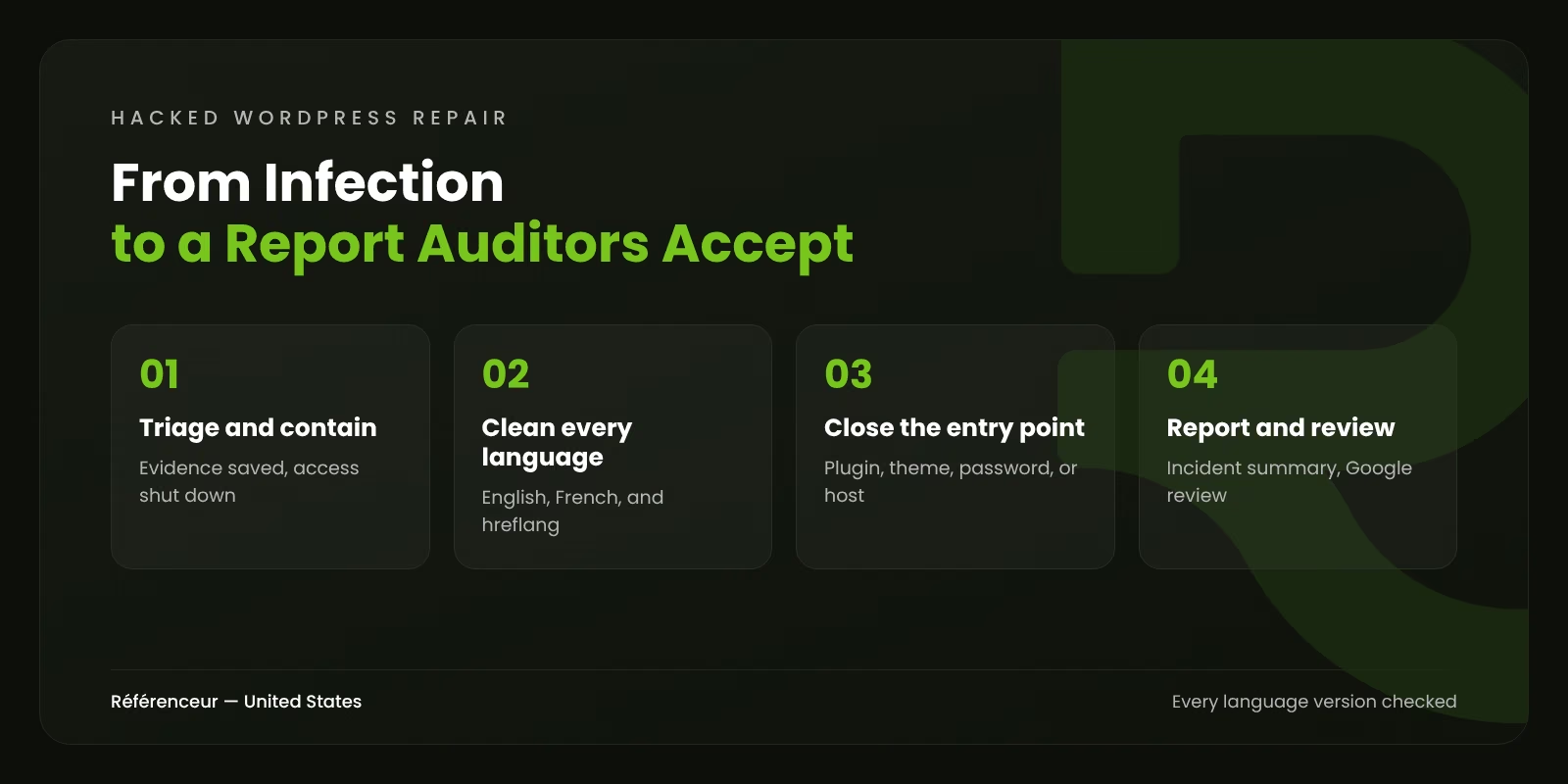
Every infection is different, but the order of work isn’t. Here is how a typical engagement runs. Timings are typical, not promised, and depend on the size of the site and the access we get.
| Phase | Typical timing | What we do | What you receive |
|---|---|---|---|
| Triage | First hours | Scan, confirm the infection, back up the current state for evidence | A first diagnosis and a plan |
| Containment | Same day | Reset credentials, block the attacker’s access, put a firewall in front of the site | A site that stops spreading the infection |
| Cleanup | One to two days | Remove malicious files, database injections, rogue users, and spam pages in every language | A clean copy, compared against known-good versions |
| Root cause | In parallel | Identify the entry point: plugin, theme, stolen password, or hosting | The vulnerability named and closed |
| Google review | A few days to a few weeks | Fix every listed issue, file the review request in Search Console | Warnings removed once Google confirms |
| Report | End of engagement | Timeline, entry point, data assessment, hardening done | An incident summary for customers and auditors |
Handling the first steps yourself while access is being set up? Follow our eight-step checklist for a hacked WordPress site, in order.
Why Attackers Move Faster Than Your Update Schedule
Many Silicon Valley marketing sites are updated “when someone has time,” which usually means the growth marketer who installed half the plugins. Patchstack’s report on WordPress security in 2026 shows why that rhythm no longer works:
- 91% of the 11,334 new vulnerabilities it recorded in the WordPress ecosystem in 2025 were in plugins, and 9% in themes. WordPress core itself had only six, all low priority.
- 46% of vulnerabilities had no fix from the developer when they were publicly disclosed. Updating can’t protect you from a patch that doesn’t exist yet.
- For heavily exploited vulnerabilities, the weighted median time to first exploitation was five hours.
So a weekly update routine leaves a gap of several days during which a known flaw can be used against you. Part of our hardening work is closing that gap: removing unused plugins, adding a firewall that can block known exploits before a patch ships, and monitoring for changes to files that should never change. For the technical side of the cleanup itself, our guide on removing malware from WordPress without reinfection explains each step.
When the French Version of Your Site Is Infected Too
Multilingual sites hide infections better. Translation plugins store each language version as its own set of posts, strings, and menus, so a cleanup that only checks English pages can leave the French ones infected. We regularly see three patterns:
- Spam pages created only under the /fr/ or /fr-ca/ path, where the English-speaking team never looks.
- Cloaked redirects that trigger only for visitors whose browser language is French, or who arrive from a French-language search.
- Hreflang annotations edited to point the “French” alternate at a spam page, which quietly steers French searchers away from your real content.
Our team reads French natively. We can tell a spammy French page from a legitimate one at a glance, spot a fake page imitating a French bank or public agency, and rewrite any of your French content the attacker damaged. If each language version sits in its own Search Console property, we check the Security Issues report in every one of them.
Personal Data Under California, EU, and Swiss Rules
If your WordPress site collected names, emails, or other personal data, the incident may carry legal obligations, and with French-speaking visitors in Europe, those obligations may come from more than one legal system. A few examples your counsel may look at:
| Jurisdiction | Rule | What it says, in one line |
|---|---|---|
| California | CCPA, Civil Code section 1798.150 | Consumers can sue when nonencrypted, nonredacted personal information is breached because a business failed to keep reasonable security; the statute sets damages of $100 to $750 per consumer per incident, or actual damages if greater, and the California Privacy Protection Agency adjusts those amounts for inflation every other year ($107 to $799 from January 1, 2025) |
| European Union | GDPR, Article 33 | A controller notifies the supervisory authority without undue delay and, where feasible, within 72 hours of becoming aware of a breach, unless it’s unlikely to result in a risk to people |
| Switzerland | Revised Federal Act on Data Protection (revFADP), effective September 1, 2023 | When a breach is likely to result in a high risk for the people concerned, the controller reports it as soon as possible to the Federal Data Protection and Information Commissioner (FDPIC) |
The table is a starting point for that conversation, not legal advice; only your counsel can say which obligations apply and on what timeline. Our part is technical: preserving logs, establishing what the attacker could reach, and giving your lawyers facts instead of guesses. How we collect that evidence is described in our WordPress data breach article.
Lifting Google’s Warning After the Cleanup
When Google detects hacked content, malware, or social engineering, it can show a warning label in search results or an interstitial warning in the browser. Google’s Security Issues report in Search Console lists the problems. Once every issue is fixed on every page, you select Request Review and describe what you fixed.
According to Google, reviews take anywhere from several days to several weeks, and Google asks site owners not to resubmit before getting a final decision. A rejected review usually means something was missed, often in another language version or in pages the attacker created outside your menus. Our guide on clearing a Google “dangerous site” warning covers what to write in the request.
Already cleaned up and want a second check? Run the scan again after any fix.
Why Silicon Valley Teams Call a Belgian and Luxembourgish Team
In an incident, the time difference helps. Our working day in Belgium and Luxembourg begins around midnight Pacific Time, so an infection you report in the evening can be triaged by the time your team logs back on. Response times are typical, not promised, and we confirm them when you contact us about your site.
The second reason is language. A French-speaking team catches what an English-only cleanup misses on a multilingual site, and it can talk directly to your colleagues or partners in Paris, Brussels, or Montreal if their pages were hit too. Our hacked WordPress site repair service page describes the full method, the Silicon Valley hub lists our other services in the region, and we describe our wider support for U.S. companies selling in French on our French-speaking markets page.
Get a Free Assessment: send the affected domain and its language versions, and we’ll reply with a first diagnosis and a plan.
Frequently Asked Questions About Hacked WordPress Repair for Silicon Valley Companies
Can You Work Within Our Incident Response Plan?
Yes. If your security team has a runbook, we follow it: who approves access, where evidence is stored, who communicates with customers. We work through accounts you create for us, log what we do, and hand back access when we’re done.
Should We Take the Site Offline While You Clean It?
Sometimes. If the site is actively serving malware or phishing pages to visitors, a maintenance page protects them and your reputation while we work. If the infection is limited to hidden spam pages, keeping the site online is usually fine. We make that call with you during triage.
What Can We Tell Customers Who Ask About the Incident?
Stick to verified facts: what happened, when it was found, whether product systems were affected, and what you changed. Our incident summary gives you that material in plain English, and in French if your European customers need it. Anything touching legal obligations should be reviewed by your counsel first.
Does Each Language Version Need Its Own Google Review?
It depends on how your site is set up in Search Console. If all languages sit under one property, one review covers the issues listed there. If your French or French Canadian versions have their own domains or properties, each one shows its own Security Issues report and may need its own request.
Will You Sign Our NDA Before Getting Access?
Yes. Many technology companies ask for one before sharing hosting or admin access, and we’re used to signing it at the start of an engagement. It doesn’t slow down triage: we can begin the external scan while the paperwork is completed.