0498 70 98 60
Optimized Google Business Profile: What the Data Actually Proves
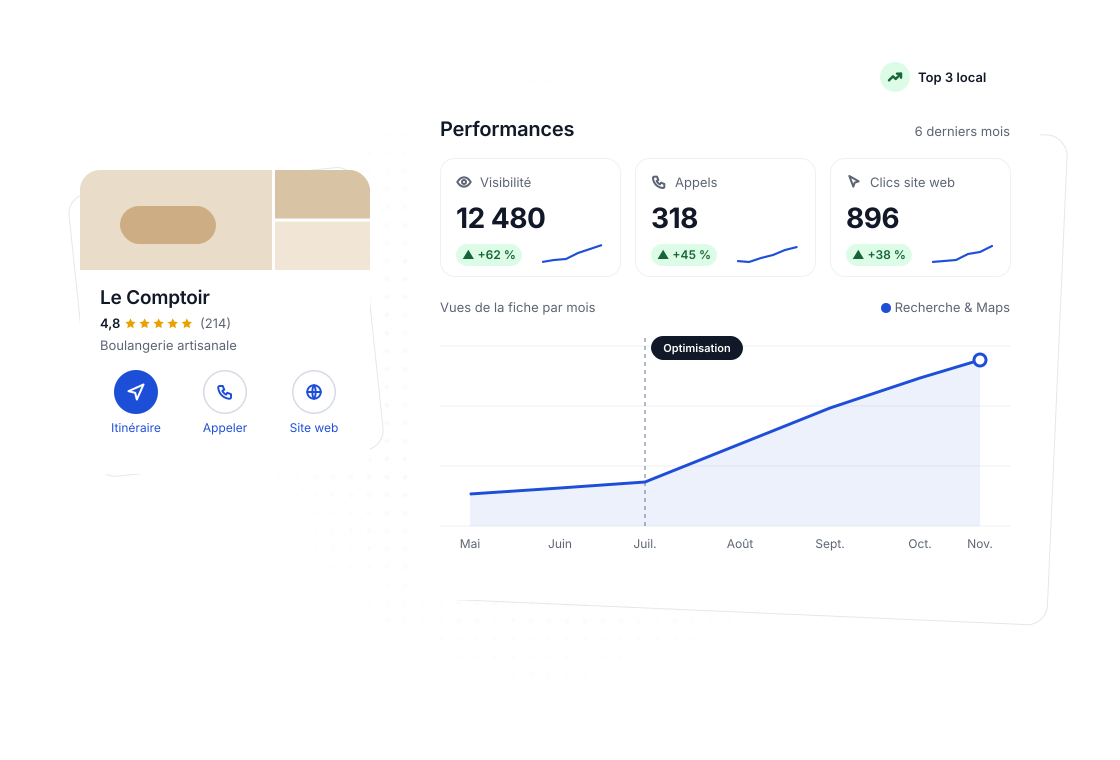
“Optimize your Google Business Profile and watch the calls roll in.” You’ve probably heard some version of that promise, usually followed by a statistic with no source. Some of those numbers are real, some are outdated and some are invented.
This article does something different: it looks at what the most credible sources actually say about an optimized Google Business Profile, separates proven effects from correlations and opinions, and turns the evidence into a short list of priorities for US businesses.
How to read local SEO statistics
Before the numbers, three quick filters:
- Who measured it? Google’s own claims, independent surveys and vendor studies don’t carry the same weight.
- What kind of data is it? A consumer survey measures what people say they do. An expert survey measures what practitioners believe. Neither proves cause and effect.
- Is it recent and from the right market? A 2019 European study says little about US consumers in 2026.
What Google itself says
Google is careful about what it reveals about local ranking, but its help center states a few things clearly:
- Local results are based mainly on relevance, distance and prominence.
- Complete and accurate business information helps your profile show up for the right searches.
- More reviews and positive ratings can help your local ranking.
- There’s no way to request or pay for a better local ranking.
Google’s Business Profile help center also claims that customers are 2.7 times more likely to consider a business reputable if they find a complete Business Profile on Google Search and Maps, 70% more likely to visit and 50% more likely to consider purchasing from businesses with a complete profile. Google doesn’t publish the methodology behind these figures on that page, so treat them as Google’s own estimate rather than independent research.
What this proves: completeness and reviews are confirmed by Google as factors. What it doesn’t prove: how much any single change will move your rankings.
What local SEO experts rank highest
Whitespark’s Local Search Ranking Factors is the best-known expert survey in the field. The 2026 edition, published in November 2025, gathered input from 47 local search experts. Their top 10 factors for the local pack and Google Maps:
- Primary GBP category
- Proximity of address to the point of search
- Keywords in GBP business title
- Physical address in city of search
- Business is open at time of search
- High numerical Google ratings
- Address is showing on GBP (not a service-area business)
- Additional GBP categories
- Quantity of native Google reviews (with text)
- Proper placement of the map pin
Three lessons stand out:
- Several top factors are things you can’t fully optimize: your location relative to the searcher, and whether your address is in the city being searched.
- Several are entirely in your control: categories, accurate hours, reviews and the map pin. Our guide to the Google Business Profile primary category covers the #1 factor.
- “Keywords in business title” ranks #3, but adding keywords that aren’t part of your real name violates Google’s guidelines and can lead to suspension. See our guide to suspended profiles.
What this proves: what experienced practitioners observe and believe. It’s an informed opinion, not a controlled experiment.
What US consumers say about reviews
BrightLocal’s Local Consumer Review Survey 2026 polled 1,002 US adults. Among the findings reported:
- 85% say they’re more likely to use a business after reading positive reviews, and 77% are put off by negative ones.
- 41% always read reviews when browsing for a local business, up from 29% in 2025.
- 31% will only use businesses rated 4.5 stars or higher.
- 74% look for reviews written in the last three months.
- 80% are more likely to use a business that responds to all its reviews, and 50% are put off by generic or templated replies.
What this proves: reviews strongly shape consumer intent, and recency matters as much as volume. A business with 300 reviews, the latest from 2023, can look less trustworthy than a competitor with 60 recent ones. It doesn’t prove that each new review produces a specific number of calls.
To grow reviews within the rules, see our guide to Google reviews and US law.
What your own data can prove
The most reliable data about your profile is your own. Google’s Performance report shows calls, direction requests, website clicks, bookings, messages and the search terms that led people to your profile. Combined with UTM-tagged links in Google Analytics, it lets you measure:
- Whether a category change increased views for the right searches
- Whether more recent reviews correlate with more calls
- Which posts or offers produce website visits
Our guide to Google Business Profile insights explains the setup.
Myths the data doesn’t support
| Claim | What the evidence says |
|---|---|
| “Posting every day boosts rankings.” | Google doesn’t list post frequency as a ranking factor. Posts help conversion and keep the profile current. |
| “Paying Google improves your Maps ranking.” | Google states there’s no way to pay for better local ranking. Ads are shown separately and labeled. |
| “Keywords in the name are a safe shortcut.” | They may correlate with rankings, but they violate Google’s guidelines unless they’re part of your real name. |
| “Review volume is all that matters.” | Ratings, text reviews and recency all matter to consumers. |
| “One-time optimization is enough.” | Hours, reviews, photos and categories change. Profiles need regular upkeep. |
Priorities for an optimized Google Business Profile
Based on the evidence above, here’s where to focus first:
- Correct primary and additional categories, aligned with your highest-value services
- Complete, accurate information: name, address or service area, phone, website, hours and holiday hours
- A steady flow of genuine reviews from all customers, with personal replies
- Accurate map pin and consistent name, address and phone data across the web
- Fresh photos, posts and products to convert the people who find you
- Measurement: Performance report and UTM tracking, reviewed monthly
- AI readiness: consistent information that AI tools such as AI Overviews, AI Mode and Ask Maps can reuse
Want a data-driven profile audit?
Référenceur audits your Google Business Profile against these factors, benchmarks it against your top Maps competitors and gives you a prioritized action list. It’s part of our local SEO services. Contact us for a free audit.
FAQ
Does an optimized Google Business Profile improve rankings?
Google confirms that complete, accurate information and more positive reviews can help local ranking. Distance to the searcher still plays a major role, so optimization improves your chances without guaranteeing a position.
What is the most important Google Business Profile ranking factor?
In Whitespark’s 2026 expert survey, the primary GBP category ranks first for the local pack and Google Maps. Proximity to the searcher and keywords in the business title follow. This reflects expert opinion, not a controlled study.
Are the “2.7 times more likely” statistics real?
They come from Google’s Business Profile help center, which doesn’t detail its methodology there. Treat them as Google’s own estimate.
How recent should my reviews be?
In BrightLocal’s 2026 US survey, 74% of consumers said they look for reviews written in the last three months. A steady flow matters more than a one-time push.
How do I measure the results of optimization?
Use the Performance report in your Business Profile for calls, directions and website clicks. Add UTM parameters to your website link to track visits and conversions in Google Analytics. Log each change you make so you can connect results to actions.
Want to know which of these priorities matter most for your profile? Contact Référenceur for a free audit.