 0498 70 98 60
Marketing in France for US Companies: Language, Consent, and the Channels That Count
Marketing in France for US companies fails less often on strategy than on details a U.S. team never had to think about: an English slogan on a French ad, a cookie banner with no reject button, a sales page that sounds like a press release from Austin. French buyers notice all three within seconds.
Référenceur sits right next door. Our offices in Francorchamps, Belgium, and Wemperhardt, Luxembourg, are in French-speaking Europe, our team thinks in French and writes U.S. English just as fluently, and French consumer habits are the ones we deal with every working day. For U.S. companies, that means one partner who can brief your Chicago team in English in the afternoon and review a Lyon landing page in French the next morning. For the broader approach, see our French-language marketing agency overview; this page is about France alone.
Sizing the French Market Before You Spend
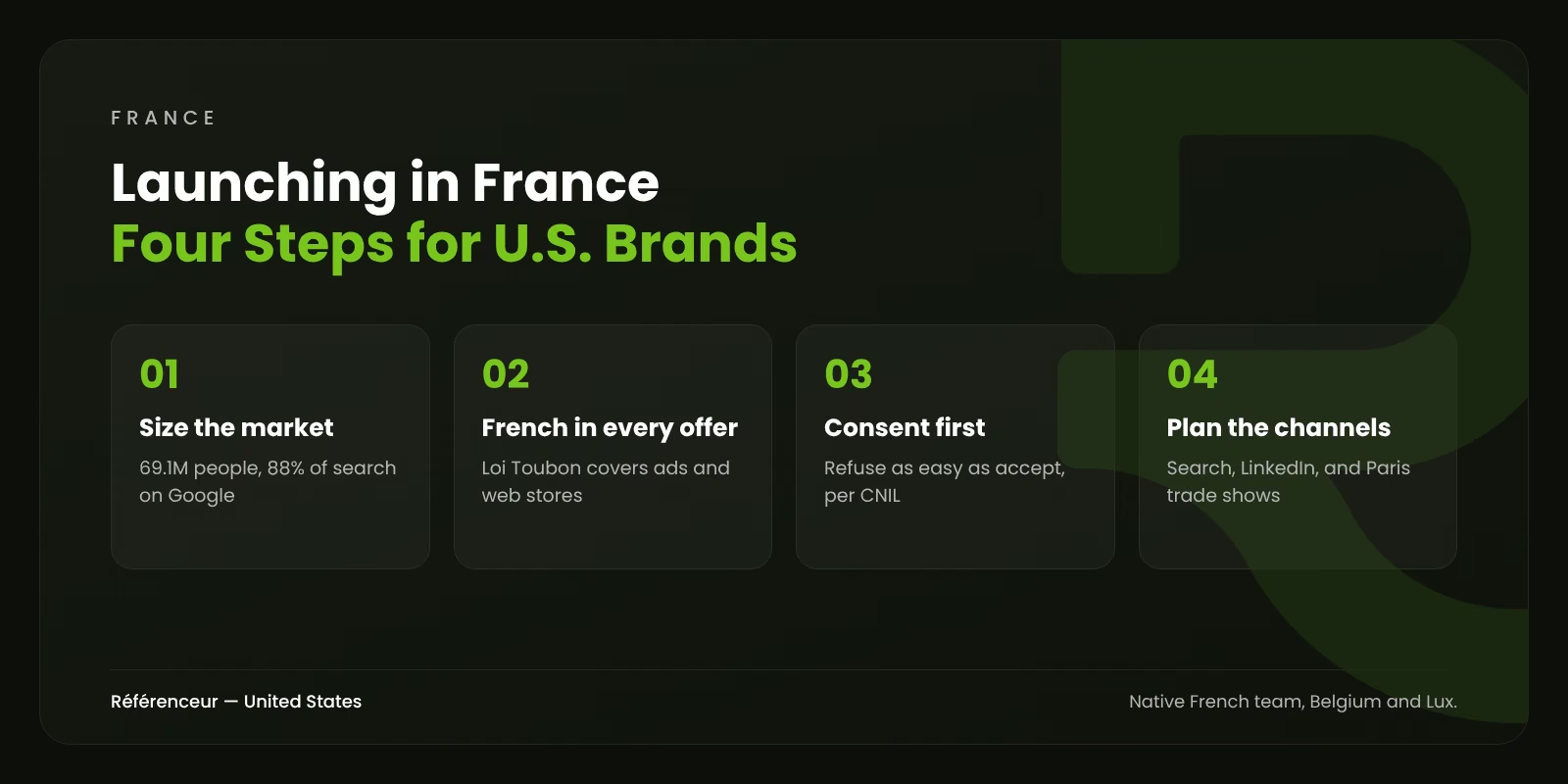
France is large, but its shape matters more than its size. Insee, the national statistics office, estimates the population at 69.1 million on January 1, 2026, with 66.8 million in metropolitan France and 2.3 million in the overseas departments and regions. Insee also reported that in 2025, deaths outnumbered births for the first time since the end of World War II. For marketers, that points to a mature, aging consumer base where trust and reassurance carry weight.
Search is more concentrated than in the U.S. StatCounter’s data for September 2026 gives Google 88.14% of the search market in France across all devices, with Bing at 5.49%, Ecosia at 1.34%, and Qwant at 0.86%. Google first, then, but Bing’s share is large enough to test for B2B offers.
If you plan to launch a US brand in France, three questions come before any media budget:
- Who buys: consumers, small businesses, or large accounts with procurement teams?
- Where: nationwide shipping, or a few cities where you can deliver service?
- In which language will after-sales support run, and who will answer in French?
The Loi Toubon: French Is Required in Your Offer and Your Ads
France’s law of August 4, 1994, on the use of the French language, known as the Loi Toubon, is short and broad. Article 2 makes French mandatory in the naming, offer, presentation, instructions for use, and warranty terms of goods, products, and services, and in invoices and receipts. The same applies to all written, spoken, or audiovisual advertising.
The Ministry of Culture adds three points that matter for online sellers:
- The obligation covers goods offered on online sales sites and platforms, not only shop shelves.
- The DGCCRF, France’s consumer protection authority, checks compliance with Article 2, including in ecommerce.
- In advertising, trademarks registered with INPI, France’s patent and trademark office, are excluded, and slogans registered separately also fall outside the obligation.
In practice, a U.S. company should plan French versions of its product pages, checkout, terms of sale, warranty information, transactional emails, and ads. According to the ministry, a registered English tagline can stay, but the descriptions around it should be in French. This is a summary, not legal advice; have your counsel confirm it before launch.
Cookie Consent the CNIL Way
The CNIL, France’s data protection authority, treats cookie banners as a priority, and many U.S. setups fall short. Its FAQ on cookies and other trackers, updated April 29, 2026, sets out expectations that differ from typical U.S. practice:
| Typical U.S. setup | What the CNIL expects |
|---|---|
| One “Accept” button, with “Manage settings” hidden behind a link | Refusing must be as easy as accepting; the CNIL recommends a “refuse all” button at the same level and with the same look as “accept all” |
| Scrolling or continuing to browse counts as agreement | Continuing to browse should be read as a refusal to consent |
| Analytics and ad tags fire on page load | Consent comes first; some audience measurement can be exempt only if strictly necessary and limited to anonymous statistics |
| The banner asks again every visit | Keeping the user’s choice for six months is described as good practice |
The fines are large. On September 1, 2025, the CNIL fined a Shein subsidiary 150 million euros for, among other things, placing advertising cookies before visitors interacted with the banner and continuing to read trackers after they clicked “refuse all.” The same day, it fined Google 325 million euros, finding in part that refusing personalized-ad cookies at account creation was harder than accepting them.
We set up Google Consent Mode, Google Tag Manager, and GA4 so that tags respect the visitor’s choice, then we check the result in the browser rather than trusting the plugin’s settings. Your lawyer validates the policy text.
Rewriting a U.S. Pitch for French Buyers
Translation is the smallest part of the job. Take a Denver software company whose homepage promises to “crush your quarterly goals.” Translated literally, the line sounds aggressive and vague to a French operations manager. The fix is a different argument, not better vocabulary.
What changes most often:
- Register. Business copy addresses the reader as “vous.” The casual “tu” works for some youth and lifestyle brands, rarely for B2B.
- Claims. Superlatives without proof read as noise. French buyers respond to specifics: what the product does, how it’s supported, and who already uses it in Europe.
- Structure. Longer explanatory pages are normal, especially in B2B. A product page that’s three bullets and a button can look unfinished.
- Legal pages. French visitors expect a “mentions légales” (legal notice) page that identifies the publisher, alongside terms of sale and a privacy policy. Ask counsel what yours must include.
- Support. A French phone number or chat in French, with stated hours on Paris time, reassures more than a toll-free U.S. number.
Our French website localization service rewrites pages on these lines, and our French SEO agency work makes sure the French pages target what people in France actually type into Google. Choosing between a /fr/ folder and a .fr domain? Our international SEO guide weighs both.
Channels: Google First, LinkedIn for B2B, and Paris Trade Shows
For most U.S. entrants, paid search on Google is the fastest test of demand, because 88% of searches go through it. B2B companies add LinkedIn, where a French company page with French posts signals that you plan to stay.
Events still open doors in France. VivaTech, held each year at Paris Porte de Versailles, usually in June, reported more than 200,000 visitors and more than 15,000 startups for its 2026 edition, according to the organizer. A trade-show presence only pays if marketing runs around it:
| Timing | Action |
|---|---|
| Six weeks before | French landing page for the event, with a meeting booking form |
| Two weeks before | LinkedIn posts in French and paid search on your brand and event terms |
| During the show | Leads tagged by source in your CRM, follow-up drafted in French |
| Within a week after | Personalized French follow-up and a remarketing audience of booth visitors |
If France is the first step of a wider European rollout, our page on European expansion marketing for U.S. startups covers sequencing across countries.
Paris Is Not the Whole Country
Many U.S. plans treat France as Paris plus shipping. Lyon, Lille, Bordeaux, Toulouse, Marseille, and Nantes each have their own business communities, trade media, and local search results. A service company that wants clients in Lille, close to the Belgian border, needs a page that talks about Lille, a Google Business Profile in French if it has a local address, and reviews in French. Our local SEO guide explains the mechanics, which work the same way in France.
That regional nuance is where a neighbor helps. When U.S. firms look for a French digital marketing agency for American companies, they usually find firms that are strong in one language and merely adequate in the other. A team from Belgium and Luxembourg, French-speaking from day one, reads the difference between a Parisian and a provincial buyer without a briefing note, and U.S. clients work with us remotely through video meetings, shared screens, and a monthly report in English. Get a Free Assessment of your French pages, consent setup, and ad plan, or request a free assessment before you commit to a French launch date.
Frequently Asked Questions About Marketing in France
Can We Keep Our English Slogan in French Ads?
According to the Ministry of Culture, trademarks registered with INPI fall outside the French-language obligation, and so do slogans registered separately. An unregistered English slogan is a different case. Your counsel should confirm your situation; in any event, the copy around the slogan should be in French.
Is Google Ads Enough, or Should We Also Use Microsoft Advertising?
Start with Google, since it handles about 88% of searches in France according to StatCounter’s September 2026 data. Bing’s 5.49% share justifies a second test, especially in B2B. We usually launch Microsoft Advertising once Google campaigns have shown which keywords convert, then import the winners.
Can We Run Analytics Without Asking for Consent in France?
Only in narrow cases. The CNIL says consent isn’t needed for audience measurement that is strictly necessary and limited to producing anonymous statistics, under conditions it spells out. In our reading, standard GA4 with advertising features doesn’t fit that description. Plan for consent and configure your reporting so you can still read trends.
How Long Before a French Launch Shows Results?
Paid search gives readable data within weeks, once campaigns have enough clicks. Organic search in French takes longer, typically months, and no one can promise a ranking or a date. We set expectations in a free assessment and report monthly on what moved.
Should We Start With France or With Every French-Speaking Market?
Usually France or one other market first. The language travels, but Belgium, Switzerland, Quebec, and francophone Africa each need their own offer, pricing, and sometimes vocabulary. Once France works, our pages on marketing in Belgium and marketing in Quebec show what changes next door.