 0498 70 98 60
Selling Online in France and Quebec: Ecommerce Localization for U.S. Stores
Selling online in France and Quebec looks like one project because both markets read French. In practice, it is two launches with different currencies, payment habits, consumer rules, shipping routes, and even different words for the same product. A U.S. store that simply translates its English catalog usually meets the same result in both places: traffic, carts, and very few completed orders.
Référenceur’s team lives and buys online in Belgium and Luxembourg, in French first and English second. We pay in euros, read EU return policies as customers, and know how a Belgian or Swiss buyer reacts to a checkout that feels foreign. That is the ecommerce localization French-speaking customers notice: not the translation itself, but everything around it. With U.S. merchants, everything happens remotely: screen-sharing sessions on video, plus a monthly written report.
Four Francophone Markets, Four Checkouts
France is the largest prize. According to figures from Fevad, the French ecommerce and distance-selling federation, published in February 2026, French consumers spent €196.4 billion online in 2025, up 7% from 2024, across 3.2 billion transactions. The average order fell 3% to €62. Its key figures released that July count 42.2 million online buyers aged 15 and over, or 72.9% of that age group, and show marketplaces handling 32% of online product sales.
Belgium, Switzerland, and Quebec are smaller, and none of them shares France’s playbook.
| Market | Currency | Payment buyers look for | Rules and logistics to plan |
|---|---|---|---|
| France | Euro | Cards on the domestic Cartes Bancaires network, PayPal, buy now, pay later | EU consumer rules, EU customs and VAT, French-language product information |
| Belgium (Wallonia and Brussels) | Euro | Bancontact | Same EU rules as France; a Dutch-speaking north if you want the whole country |
| Switzerland (Romandy) | Swiss franc | TWINT, cards | Not in the EU: separate customs, Swiss VAT, and Swiss consumer law |
| Quebec | Canadian dollar | Interac debit, credit cards | Quebec’s Charter of the French Language, Canadian customs and sales taxes |
A store can serve all four, but each one needs its own prices, payment options, and policies on the page. Our marketing for French-speaking markets page explains how we rank these markets before you spend a dollar.
The Checkout Is Where Localization Pays Off
Most orders lost in French-speaking markets die on the last two screens. These are the points we review first in a French checkout audit:
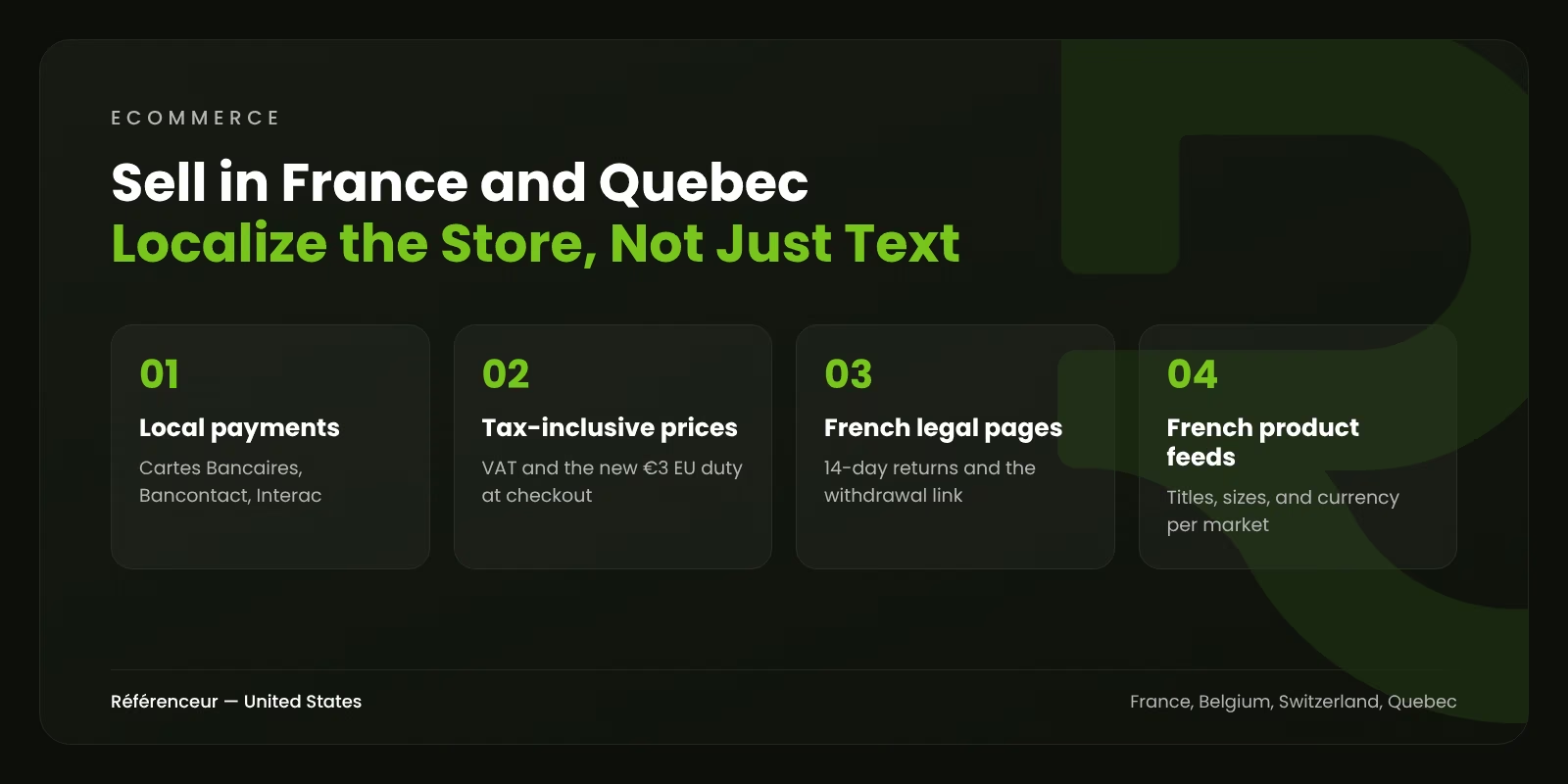
- Local payment methods visible before the payment step, not only after a card form fails. A Belgian shopper who doesn’t see Bancontact often leaves.
- Prices shown with taxes included. In the EU, the selling price displayed to consumers includes VAT, so a U.S.-style “plus tax at checkout” reads as a bait-and-switch.
- Duties and taxes collected at checkout (delivered duty paid), so no one receives a customs bill at the door.
- Addresses that accept French formats: postal code before the city, apartment and building details, and Quebec’s “app.” abbreviation.
- Delivery to pickup points, which many French and Belgian shoppers prefer to home delivery.
- Order emails, invoices, and return labels in French, with dates written day first (1/11/2026 means November 1).
EU Consumer Rules Your French Store Has to Display
These rules apply to businesses that sell to consumers in the EU, wherever the business is located. None of this is legal advice: have a lawyer who knows EU consumer law review your setup.
- 14-day right of withdrawal. Under the EU Consumer Rights Directive (2011/83/EU), consumers can cancel an online purchase within 14 days without giving a reason. For goods, the period starts when the customer receives them. Your French terms and order confirmation need to explain how it works.
- Withdrawal function since June 19, 2026. Directive (EU) 2023/2673 requires an electronic way to withdraw: a clearly labeled button or link, reachable without logging in, a two-step confirmation, and an automatic acknowledgment by email or another durable medium.
- Tax-inclusive pricing, as noted above, and clear delivery costs before the order is placed.
- French-language consumer information. France’s Toubon Law requires French in product presentation and instructions for consumers; ask your counsel what that means for your packaging and inserts.
A plain French returns page is also a selling point, not just a legal duty.
Shipping to the EU After July 1, 2026
The economics of shipping small parcels from the U.S. changed in 2026. Until June 30, 2026, goods worth up to €150 entered the EU without customs duty (VAT has applied since 2021). On July 1, 2026, the EU removed that exemption and introduced a temporary flat duty of €3 per item category in a parcel worth up to €150, with items that share a tariff code counted once. A parcel with a sweater and a scarf, two categories, owes €6. The flat rate is meant to last until the EU’s customs data hub takes over, planned for 2028. Separately, the EU customs reform approved in September 2026 adds a handling fee on online orders shipped from outside the EU, which member states were due to start collecting by November 1, 2026. The European Commission sets the amount, so check the current figure before you set prices.
For a U.S. store, that means three decisions:
- Whether to collect duties and VAT at checkout (simplest for the buyer) or let the carrier bill the customer (often fatal to repeat orders).
- Whether to keep shipping single orders from the U.S. or move fast-selling products to a warehouse inside the EU.
- How to reprice low-value items, where a few euros of duty can erase the margin.
Switzerland and Canada have their own customs regimes, so we plan them separately.
Quebec: Same Language, Different Rulebook
Quebec buyers read French, but they are not French buyers. Prices are in Canadian dollars and are usually shown before sales taxes, a habit closer to the U.S. Interac debit is a familiar way to pay. Vocabulary shifts too: Quebec shoppers “magasinent” rather than “font les boutiques,” and a hoodie is often a “kangourou” in Montreal but a “sweat à capuche” on a Paris product page.
The legal frame is Quebec’s Charter of the French Language. According to a May 2025 analysis by the Canadian law firm McCarthy Tétrault, Bill 96 did not significantly change the rules for French-language websites aimed at Quebec users, but complaints about non-compliant sites were expected to rise. Since June 1, 2025, generic terms and product descriptions on packaging must be in French even when they appear inside a trademark registered in another language; products made before that date can be sold until June 1, 2027, under certain conditions. How these rules apply to a seller with no presence in Quebec is a question for Canadian counsel, not for us.
French Product Pages and Feeds That Google Can Match
French ecommerce SEO starts with keyword research done in French, market by market. Translating “running shoes” gives you a term; checking how people in Lille, Liège, Lausanne, and Laval actually search gives you a strategy.
Product pages then need more than translated descriptions:
- Sizes in European or Canadian systems, with a conversion chart where needed, and metric units throughout
- Material, origin, and care information in French, which French buyers expect to find on the page
- A French title and description for every product in your Google Merchant Center feed, with the currency of each target country
- Structured data that matches the visible French price and availability
- Reviews from French-speaking customers once you have them, shown next to the product
Marketplaces deserve a decision of their own. With roughly a third of French online product sales going through marketplaces, Amazon.fr or a French marketplace such as Cdiscount can help you test demand before you invest in your own store. Our ecommerce SEO agency page covers the organic side for your own store, and our ecommerce SEO guide lists the on-page checks that apply in any language. If you are still choosing between a French subfolder and a separate domain, read our guide to international SEO first.
How We Launch a U.S. Store in Its First French-Speaking Market
We work from Francorchamps, in Belgium’s French-speaking Wallonia, and Wemperhardt, in northern Luxembourg, so we judge your store as a local shopper would. A typical first launch runs in this order:
- Choose one first market based on margin after duties, payment fit, and the competition in your category.
- Fix the checkout: currency, local payment methods, tax-inclusive prices, duties, addresses.
- Write the French legal pages and returns flow with your counsel, including the EU withdrawal function if you sell in the EU.
- Localize the top product and category pages first, through our French website localization process, then the rest of the catalog.
- Launch Shopping and search campaigns in French to collect early data; our Google Ads for French-speaking markets service handles that part.
- Review orders, returns, and search data monthly before adding the next market.
Before your first parcel leaves for Europe or Canada, let a native French-speaking team from Belgium and Luxembourg test your store: Get a Free Assessment. We’ll go through your checkout as a French, Belgian, or Quebec shopper would.
Frequently Asked Questions About Selling Online in France and Quebec
Do France and Quebec Need Separate Storefronts?
Usually, yes. France and Belgium can largely share one French storefront, since both use the euro and the same EU consumer rules. Quebec needs its own version: different currency, taxes, delivery promises, legal notices, and vocabulary. Many platforms let you run both from one back office.
Do EU Return Rules Apply if We Ship From the United States?
Generally, yes. The EU right of withdrawal protects consumers in the EU when a business directs its sales to them, wherever that business is located. Showing euro prices, French pages, and EU shipping options is a strong sign that you target EU buyers. Ask your counsel to confirm your obligations before launch.
Should We Start on Amazon.fr or on Our Own Store?
A marketplace is a fast way to test whether French buyers want your product, without building payments, customer service, and logistics on day one. Your own store gives you margin, brand control, and customer data. Many brands do both. You can request a free assessment to compare the two for your category.
Who Pays the New €3 EU Duty on Small Parcels?
Legally, duty is owed on import; commercially, someone has to absorb it or pass it on. Most platforms collect it from the buyer at checkout, as part of a tax-inclusive price. If you don’t, the carrier will usually bill your customer at delivery, which hurts both conversion and reviews. Budget for it per item category, not per parcel.
How Should We Handle Sizes, Units, and Product Specs in French?
Convert everything; don’t just translate it. Show European clothing and shoe sizes for France, Belgium, and Switzerland, keep a clear chart for Quebec, and switch to metric units on every page. Write specs in full sentences where buyers look for them, because those details also feed your Merchant Center listings and the answers AI shopping assistants give. Our contact page is the fastest way to ask about a specific catalog.