 0498 70 98 60
Law Firm SEO NYC: Rebuilding Your Site for New York’s New Advertising Rules
Law firm SEO NYC work changed in 2026 for a reason many firms haven’t caught up with yet: on June 1, 2026, New York replaced the attorney advertising rules that shaped almost every firm website in the state. Pages written for the old rules now carry labels, disclaimers, and caveats that may no longer be required, while a few new obligations are easy to overlook. Référenceur works out of Belgium and Luxembourg, in French and English every day, and we approach a rulebook the way any outsider to a market should: line by line, before touching a single page. Send us your URL through our free assessment form, and we’ll point out which parts of your site still reflect the pre-2026 rules.
What Changed on June 1, 2026, and Why Your Website Feels It
An order signed in May 2026 by the presiding justices of the four Appellate Division departments deleted New York’s Rule 7.1 (advertising) and Rule 7.3 (solicitation) and replaced them with versions of the ABA’s 2018 Model Rules, along with the ABA comments. Rule 7.4 on specialization was folded into the new Rule 7.1(c). The result is a short, principle-based standard: a lawyer may not make a false or misleading communication about the lawyer or the lawyer’s services, through any medium.
Here is how key website items compare, based on the court order and NYSBA commentary from August and September 2026.
| Website element | Before June 1, 2026 | Under the amended rules |
|---|---|---|
| “Attorney Advertising” label | Required by former Rule 7.1(f) | No longer required |
| Past-results disclaimer | Required by former Rule 7.1(d) | Removed from the rule; still a sensible safeguard against misleading claims |
| Detailed testimonial conditions | Spelled out in Rule 7.1 | Removed; general false-or-misleading test applies, and the FTC Act still governs reviews and endorsements |
| Specialist or certified claims | Rule 7.4 | Rule 7.1(c): a certification claim must name the certifying organization |
| Lawyer name and contact details | Covered by the old, more detailed Rule 7.1 | Rule 7.1(d): name and contact information of at least one responsible lawyer or firm |
| 30-day bar on personal injury solicitation | In force | Eliminated |
| Paying for referrals (Rule 7.2) | Regulated | Unchanged |
Two rules stayed put: Rule 7.2 on payment for referrals, and Rule 7.5 on firm names, letterhead, and professional notices, which New York kept and had last amended in June 2020. Nothing on this page is legal advice. Your ethics counsel decides what your firm publishes.
A Post-Rewrite Cleanup Checklist for New York Firm Websites
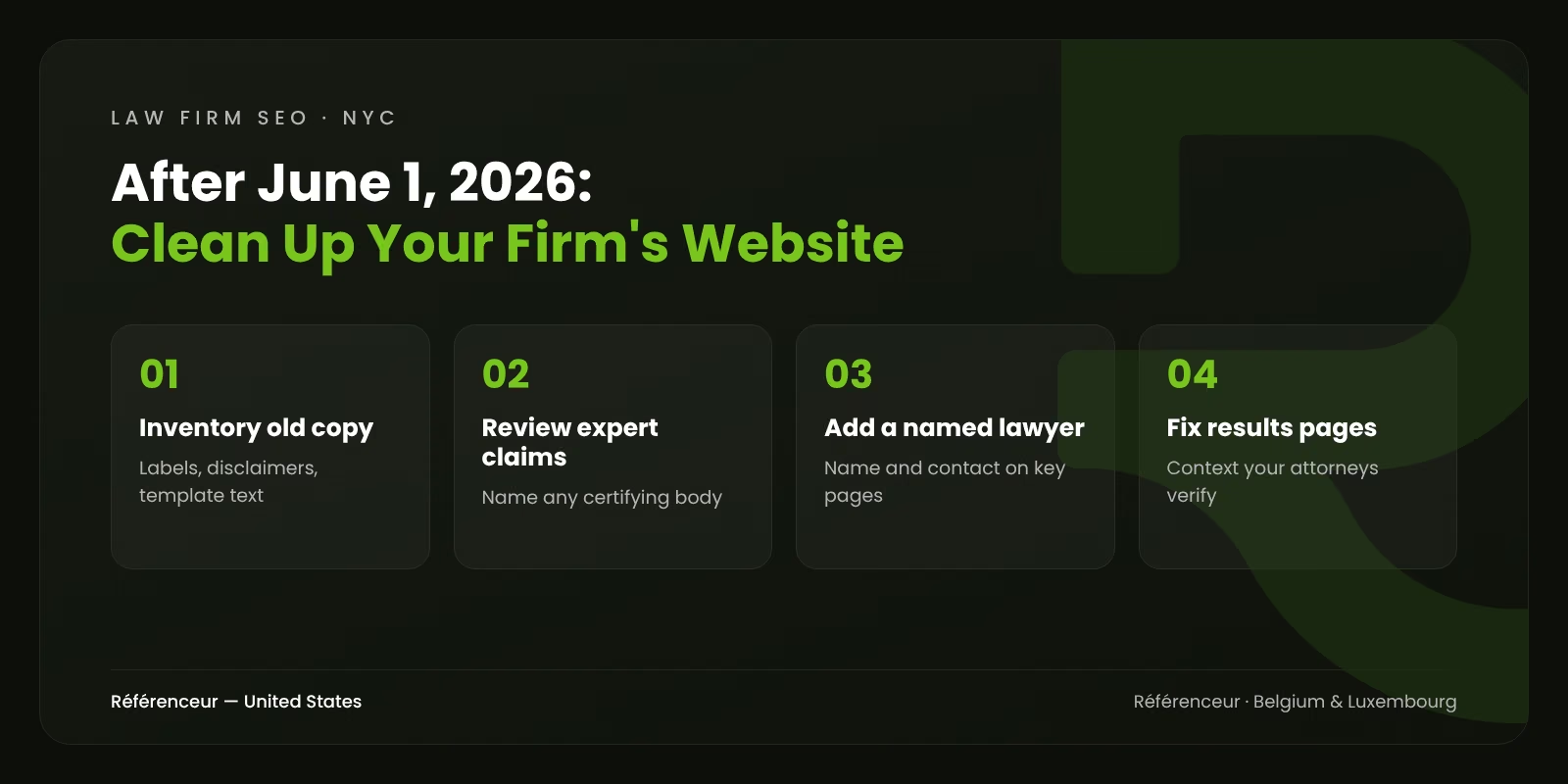
Most firm sites in the city were written for the old regime. This is the cleanup order we’d suggest, with every change approved by a lawyer at your firm:
- Inventory the legacy language. List every page that carries the old label, the old results disclaimer, or boilerplate copied from a template. Decide with counsel which items stay as voluntary safeguards and which go.
- Audit every “specialist” and “expert” claim. Practice pages, bios, title tags, and schema markup all count. If a page says “certified,” it now needs to name the organization that certified the lawyer.
- Put a responsible lawyer on every key page. Rule 7.1(d) asks for a lawyer’s or firm’s name and contact information. A visible attorney byline with bar admissions also strengthens the experience and trust signals Google looks for on legal topics.
- Rewrite results pages with context. Settlement and verdict pages are allowed, but a number with no facts around it can still mislead. We draft summaries your attorneys can verify against the file.
- Re-check testimonials and reviews. A September 2026 NYSBA article reminds lawyers that a testimonial needs the person’s permission to use their name, image, and likeness. Reviews and endorsements also remain subject to the FTC Act.
- Review your lead vendors. Rule 7.2 didn’t change, so any pay-per-lead or directory arrangement deserves a fresh look with counsel before you scale it.
One Firm, Five Boroughs: Google Business Profile Without Shortcuts
Firms that serve the whole city often want a map listing in each borough. Google’s rules limit what’s allowed, and New York attorney marketing that ignores them risks suspended listings.
Google’s guidelines say a virtual office, or any location used only as a mailing address, isn’t eligible for a Business Profile. A desk in a coworking space qualifies only if the office has clear signage, receives clients during business hours, and is staffed by your team in those hours. So a Downtown Brooklyn mail drop won’t carry a listing, but a staffed satellite office in Jamaica, Queens, can.
Individual attorneys can have their own practitioner profiles if they are public-facing and reachable at the verified location during stated hours. Google says the firm should keep a separate profile for the office, the practitioner’s profile title should contain only the lawyer’s name, and one lawyer shouldn’t hold several profiles to cover different specializations. Business names must match the firm’s real-world name, without added location keywords.
Where you have no staffed office, organic pages do the work instead: a page on how your firm handles cases in Bronx County courts, for instance, written from real experience, can rank without breaking any Google rule. Our Brooklyn digital marketing page explains how we approach borough-level search more broadly.
Immigration Practices: Searches in Haitian Creole, French, Wolof, and Pulaar
French and Haitian Creole both appear among the 10 citywide languages that New York City agencies must offer under Local Law 30 of 2017, the city’s language access law. Under Local Law 13 of 2023, the Mayor’s Office of Immigrant Affairs also designates temporary languages based on recent demand; its guidance last updated in August 2025 listed Wolof and Pulaar/Fulani, two West African languages whose speakers often also know French.
For an immigration practice, that list hints at unmet search demand. Clients from Haiti, Senegal, Guinea, Côte d’Ivoire, or Mali often search in French first, then switch to English when they don’t find answers. That is where a French-speaking team helps: we can draft and review French pages ourselves rather than relying on machine translation, and we flag every legal statement for your attorneys before it goes live.
What a well-built multilingual immigration section includes:
- One URL per language version, linked with hreflang annotations (see our international SEO guide), so a Creole-speaking reader in Flatbush lands on the Creole page.
- Plain explanations of process and timing, reviewed by a lawyer who speaks the language or paired with a clear note on which languages your staff actually speaks.
- Consultation booking that tells visitors which languages they can be served in.
- Attorney bios that list every language spoken.
For the design side of a two-language site, see our page on French-English bilingual website design.
Personal Injury and Corporate Firms Need Different NYC Lawyer SEO
Personal injury. The new Rule 7.3 defines solicitation as a communication the lawyer initiates, and the 30-day blackout for injury and wrongful death matters is gone. That mostly concerns outreach and remarketing, which your counsel should review, rather than pages people find on their own. On the organic side, NYC lawyer SEO for injury firms means pages tied to the situations New Yorkers actually face: scaffold falls, delivery bike collisions, subway platform injuries, building defects. Each page should explain the process in plain English without predicting an outcome.
Corporate and international firms. Some corporate firms work alongside lawyers admitted abroad. New York lets them practice as licensed legal consultants under Part 521 of the Court of Appeals rules, but with limits: they can’t hold themselves out as members of the New York bar or advise on New York or federal law unless that advice is based on the advice of a lawyer qualified to give it. Their bios should use the permitted titles, such as “legal consultant, admitted to the practice of law in France.” Schema markup and bio pages should match that wording exactly, because an AI summary that calls a consultant “a New York lawyer” creates exactly the kind of misleading impression Rule 7.1 targets.
Working With Référenceur From Belgium and Luxembourg
There is no Référenceur office in Manhattan or anywhere else in the U.S. The people doing the work sit in Francorchamps, Belgium, and Wemperhardt, Luxembourg, usually six hours ahead of Eastern Time, so edits are often waiting when your day starts. Calls happen over video, scheduled so neither side is up at midnight. Every draft goes to your designated attorney before publication, and a monthly report ties pages to consultation requests.
On our side of the call: native French and English speakers, more than 15 years of search work, an average of 4.7/5 from 107 Google reviewers, and partner status with Google, Microsoft Advertising, Semrush, and HubSpot. Every client we can name is based in Europe. If your firm serves French-speaking clients, or works with European companies and lawyers, a Belgian and Luxembourgish agency that switches between English and French in the same meeting is a practical fit.
Our national guide to SEO for law firms covers the general method, built on our SEO services; the New York SEO agency page and our New York digital marketing hub cover other sectors. Firms with a Florida office face a different rulebook, covered on our page about law firm SEO in Miami.
Request a free assessment of your site against the amended rules.
Frequently Asked Questions About Law Firm SEO in NYC
Should We Remove the “Attorney Advertising” Label From Our Website?
The amended rules no longer require it, so removing it is a choice, not an obligation. Some firms keep it as an internal policy. For SEO, the label matters little; we’d simply keep it out of title tags and meta descriptions, where it wastes space.
Do Old Blog Posts Need to Be Updated After the Rule Change?
Only the ones that discuss New York advertising rules or repeat outdated disclaimers in the body. A post explaining the 30-day solicitation rule, for example, is now wrong and could hurt trust. We flag those posts during the audit and suggest an update, a redirect, or removal.
Can a Foreign Legal Consultant Have Their Own Practice Page?
Yes, as long as the page describes what they’re licensed to do. A page on French corporate law by a consultant admitted in France can help clients a great deal. It should state the jurisdiction of admission clearly and avoid suggesting New York bar membership.
Can We Show Up in Queens Searches Without an Office There?
Not in the map results, unless you have a staffed location that meets Google’s rules. You can still appear in organic results with genuinely useful content about cases in Queens.
Will You Write Pages in Haitian Creole or Wolof?
We write and review French and English ourselves. For Haitian Creole, Wolof, or Pulaar, we work from content your bilingual staff or a professional legal translator has prepared, then handle the structure, hreflang, and technical SEO. That way, no page goes live in a language nobody on either team can check. To discuss your firm’s languages and practice areas, request a free assessment.