 0498 70 98 60
Google Ads Agency Silicon Valley: Paid Search for Crowded AI Auctions and French-Speaking Markets
Before you compare a Google Ads agency Silicon Valley founders recommend with an in-house hire, look at the auction you’re about to enter. Your competitors in AI, developer tools, and chips are often fresh from a funding round, bidding on the same category terms, and willing to lose money on clicks to win the category. Outspending them is rarely the plan. Outthinking them is.
Référenceur builds that plan from Europe. We’re a Google Partner agency with roots in Belgium and Luxembourg, and our French-speaking team writes ads, landing pages, and reports in French and English with equal ease. That means one team can run your U.S. campaigns and the French-language campaigns that come with expansion into France, Belgium, Switzerland, Luxembourg, or Quebec. We’ve run paid search campaigns for more than 15 years, and our clients’ 107 Google reviews give us a 4.7/5 average. We work remotely, and you can request a free assessment of your current account before changing anything.
What $80 Billion in AI Funding Does to Your Auctions
The 2026 Silicon Valley Index from Joint Venture Silicon Valley reports that AI companies in Silicon Valley and San Francisco attracted nearly $80 billion in venture capital in 2025, about 83% of all the VC invested in the two areas. Deals above $100 million made up 57% of venture funding, and the region drew nearly half of all U.S. venture dollars.
Much of that money ends up in marketing budgets, and some of it in Google Ads. In practice, that shows up in three ways:
- Broad category terms attract several well-funded bidders at once, and their bids aren’t always driven by return.
- Category names shift quickly. A term that was empty six months ago can turn crowded after one product launch.
- Brand searches get contested. A competitor’s ad above your own name is common in fast-moving categories.
The response isn’t a bigger budget. We protect your brand terms, put most spend on problem-based searches that only a qualified buyer types, and keep broad category terms on a short leash with strict targets. We also look for auctions your competitors haven’t entered yet, and French-language searches in Europe and Quebec are often among them.
Google Ads Management Silicon Valley Companies Need, by Business Model
A developer tool with a free tier and a semiconductor supplier with a six-month sales cycle shouldn’t run the same campaigns. Here is where we usually start:
| Business model | Main risk | What we optimize toward |
|---|---|---|
| AI startup, early category | Paying for curiosity clicks from people researching the topic | Demo requests that sales accepts, imported from your CRM |
| Developer tool with free tier | Thousands of sign-ups that never activate | Activation events, such as a first API call or a connected repo |
| B2B SaaS, mid-market | Leads that look good but never close | Qualified opportunities and pipeline value |
| Chips and hardware components | Clicks from hobbyists and students | Sample requests, quote requests, and distributor referrals |
| Robotics and deep tech | Tiny search volume, long cycles | Content downloads and meetings, with patience on bidding |
Every model depends on the same foundation: conversions that reflect revenue, not form fills. That’s the part most accounts get wrong. Our Google Ads conversion tracking guide explains how we import offline conversions from your CRM, so Smart Bidding learns from deals, not from clicks.
Drawing the Map: Bay Area Targeting for B2B Tech Buyers
Google Ads can target the United States at many levels. Its list of location target types includes states, cities, postal codes, Nielsen DMA regions, congressional districts, and even airports and universities. You can also draw a radius of at least 1 km, about 0.6 mile, around an address, though Google warns that ads aimed at a very small area may show only intermittently. For a Valley company, the useful question is where your buyers sit, not where your office is.
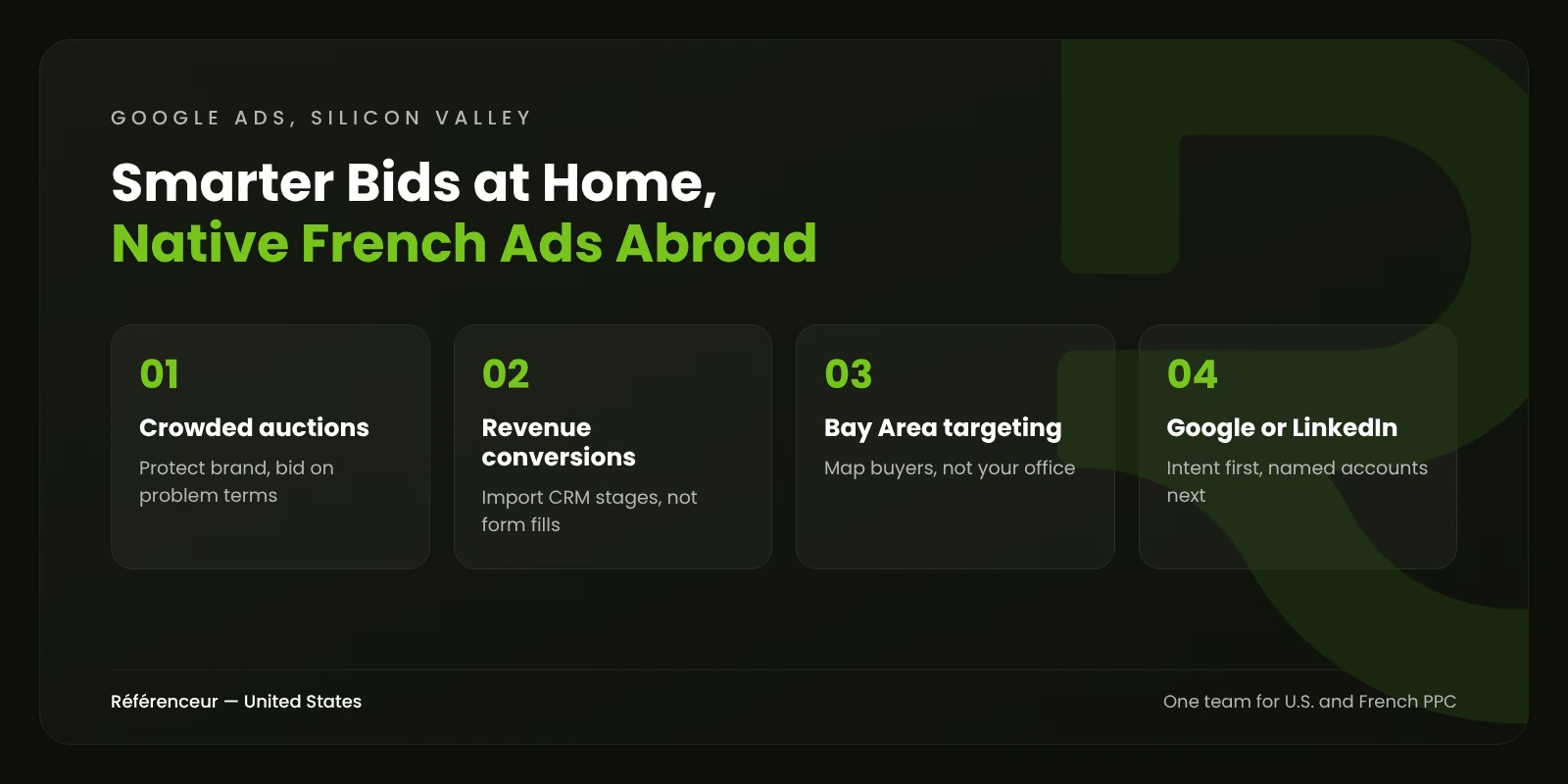
- Selling nationally. If your customers are mid-market companies across the U.S., a Bay Area-only campaign mostly places you in the priciest corner of the auction, next to your competitors. Target the country, then compare results by metro in the location report.
- Selling to the Valley itself. Contract manufacturers, test labs, and recruiting tools often sell to nearby companies. A list of cities or ZIP codes from San Jose to Palo Alto usually fits better than the San Francisco-Oakland-San Jose DMA, which stretches well beyond the Valley.
We also check the location option on every campaign. Google’s default, “Presence or interest,” can reach people who merely show interest in a place, so for most B2B campaigns, French ones included, we switch to “Presence” so ads reach people who are in, or regularly in, the area.
What a Click Costs, and Why Averages Mislead Tech Advertisers
WordStream by LocaliQ’s 2026 benchmarks, drawn from 13,474 U.S. search campaigns that ran between April 2025 and March 2026, put the typical cost per click at $5.42 across industries. Business services came in at $5.87 per click and $93.69 per lead. The study has no separate category for software, AI, or chips, so treat those figures as rough context, not a forecast for your account.
Three checks tell you more before you commit a budget:
- Keyword Planner, set to your real locations. Its “top of page bid” range approximates what advertisers have historically paid, from about the 20th to the 80th percentile, and Google bases it on your location and network settings. A San Jose-only plan and a nationwide plan can show very different numbers.
- An allowable cost per click worked back from revenue. Suppose one click in 50 becomes a lead and one lead in five becomes a sales opportunity. That’s 250 clicks per opportunity, so at $20 a click, each opportunity costs $5,000. If your average deal can’t carry that, change the keywords, not just the bids.
- Auction Insights after two or three weeks, to see who shares your auctions.
If you’d like a second pair of eyes on those numbers, send us your current figures and we’ll run the math with you.
Google Ads or LinkedIn Ads for Bay Area B2B?
Many B2B tech companies test both, because the two platforms answer different questions. Google captures people who already search for a solution. LinkedIn reaches people by who they are, whether or not they’re searching yet.
| Question | Google Ads | LinkedIn Ads |
|---|---|---|
| What you target | Searches that describe a problem or a product category | Profiles by seniority, industry, and location, plus company lists you upload |
| When it works best | Buyers already know the category and search for it | The category is new, or you sell to a short list of named accounts |
| Limits to plan for | No searches, no ads: tiny niches get little volume | A $10 minimum daily budget, and an audience of at least 300 members before a campaign can run |
| Typical role | Demo requests, quote requests, and trials | Warming up target accounts before sales reaches out |
LinkedIn’s account lists are uploaded as a one-column CSV of company names. That suits a semiconductor supplier with 40 target customers, but a short list narrowed again by seniority can drop below the 300-member floor. We usually start with Google, where intent is clearest, and add LinkedIn when the account list is defined and sales is ready to follow up. Our Google Ads guide for SaaS companies goes deeper on pipeline-based measurement.
When the Campaigns Go French
Once your U.S. campaigns pay off, the French side brings its own checklist: Presence targeting country by country, the Toubon law’s French-language rule for advertising in France, consent mode for visitors in the EEA, and a plan for answering French leads during European hours, all covered on our Google Ads page for French-speaking markets.
For most of the year, 9 a.m. in San Jose is 6 p.m. in Paris, Brussels, or Luxembourg. For a few weeks each spring and about a week each fall, the gap shrinks to eight hours, because Europe changes its clocks on the last Sundays of March and October, while the U.S. does so on the second Sunday of March and the first Sunday of November. Ad schedules for French campaigns should follow European business hours and get a check during those weeks. Small French markets also bring thin data; we cover bidding with low conversion volume in a blog post on niche-market Google Ads.
Why a Google Ads Agency Silicon Valley Teams Hire Can Be Based in Belgium
You don’t need us in Palo Alto to run your auctions well. You need specialists who understand B2B tech buying, read your CRM data, and answer the hard questions on your weekly call. What a Belgian and Luxembourgish team adds is everything on the French side: ad copy written by native French speakers, keyword lists built in each market, and someone who can call a lead back in Brussels during Brussels business hours.
Our Google Ads agency services page details our general method, and the Silicon Valley digital marketing hub shows how paid search fits with SEO and web design. For a wider view of selling to French-speaking audiences, see how we handle marketing to French-speaking countries.
Want a second opinion first? Get a Free Assessment: share read access to your account, and we’ll show you where the budget goes today and which French-speaking market could pay off first.
Frequently Asked Questions About Google Ads in Silicon Valley
How Do We Stop Competitors From Taking Clicks on Our Brand Name?
Run a dedicated brand campaign, even if you rank first organically, and watch the Auction Insights report to see who else appears on your name. In the U.S., Google generally doesn’t stop others from bidding on a brand name as a keyword, but its trademark policy lets owners file a complaint about their trademark used in ad text. We set up the brand campaign, track competitors weekly, and help you decide when a complaint is worth filing.
Can We Translate Our Best English Ads Into French?
Keep the arguments that win in the U.S., but have the ads written in French from the start. A translated ad keeps English logic and English search terms, which French buyers notice. Our writers rebuild each ad around the words French buyers use, then test the French variants against each other rather than against the English originals.
Which Conversions Should a Hardware Company Send Back to Google Ads?
Sample requests, quote requests, and distributor referrals that your sales team qualifies are the most useful. Datasheet downloads help as a secondary signal, but bidding on downloads alone tends to attract students and hobbyists. We import qualified stages from your CRM and give them the most weight.
Should Our Ads Run Only During Pacific Business Hours?
Not at first. Engineers and managers often research tools in the evening or on weekends, and a narrow schedule can cut off those searches. We start with ads running at all hours, then use the hour-of-day and day-of-week reports to lower bids where leads rarely turn into opportunities.
Can We Get Reports in Both English and French?
Yes. Your U.S. team gets reports in English, and a European or Quebec colleague can receive the same figures in French. Both versions come from one dashboard, so nobody argues about which number is right.