 0498 70 98 60
Marketing for European Companies Expanding to New York
Marketing for European companies expanding to New York starts with an awkward split. Your board signs off on the plan in French, Dutch, or German, while every buyer in Manhattan reads your offer in American English and sizes you up against local vendors in a single afternoon. Most launches lose their first months in the gap between those two conversations.
Référenceur works from the French-speaking part of Belgium and from Luxembourg, and every person on the team writes in both French and English. In practice, we can sit in your headquarters’ steering meeting in the morning and brief your New York sales lead after lunch, with nothing lost on either side. We’ve been at this for more than 15 years, and 107 Google reviewers give us an average rating of 4.7/5. This page covers what is specific to New York; the broader method, from localization to ad scheduling, is on our U.S. entry page for European companies.
Who Is Already in the Room: Benelux and French Networks in Manhattan
New York concentrates the official support structures that Belgian and Luxembourgish companies rely on when they cross the Atlantic. Few founders use them as marketing assets, and that’s a missed opportunity.
| Organization | What it offers | What your marketing should have ready |
|---|---|---|
| BelCham, the Belgian-American Chamber of Commerce in the USA | A Midtown base on Seventh Avenue, more than 430 active members, a coworking space, and J-1 visa sponsorship | A U.S. company page and founder bios in American English before your first member event |
| Belgium’s regional trade offices (AWEX for Wallonia, Wallonia-Brussels International, hub.brussels, Flanders Investment & Trade) | Regional trade representatives in New York, most of them based at the Consulate General of Belgium | A short landing page per mission or meeting, so every introduction lands somewhere specific |
| Luxembourg Trade and Investment Office (LTIO) New York | Free, tailored support for companies targeting the eastern U.S., plus access to the BeNeLux Catalyst accelerator for tech startups | A case study rewritten for U.S. readers, with results stated the way American buyers expect |
| French-American Chamber of Commerce | Events and introductions for French companies in New York | LinkedIn profiles for your U.S. staff, written in English and consistent with your website |
These networks open doors. They don’t generate demand on their own. A warm introduction from a trade commissioner still ends with a prospect typing your name into Google, and what they find in the next 30 seconds decides whether a second meeting happens. Our SEO agency services make sure that search shows the right pages.
Two Languages, One Plan: Splitting the Work Between Headquarters and Manhattan
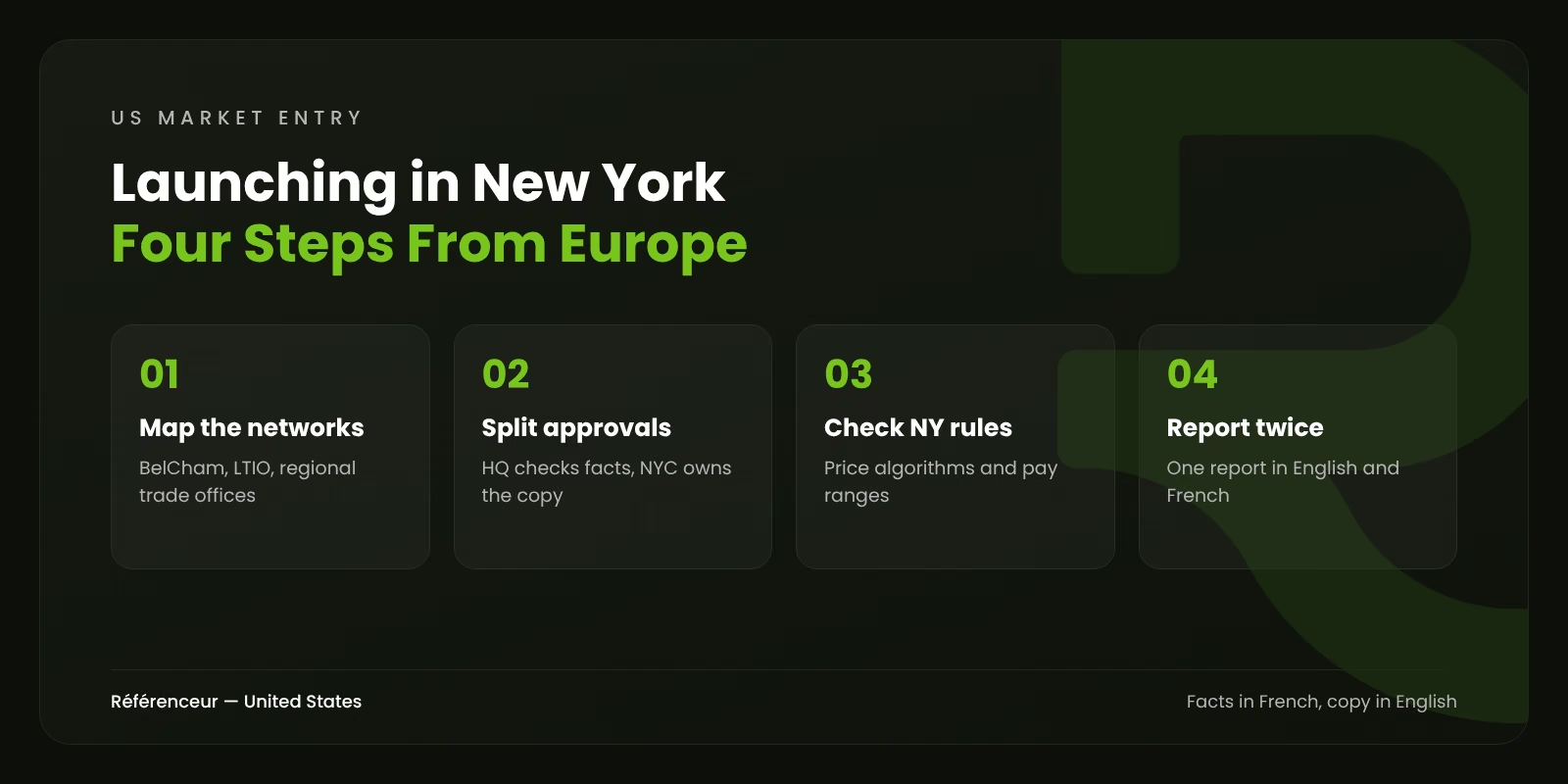
The friction we see most often isn’t strategic. It’s linguistic and organizational. Headquarters wants to approve everything, the U.S. team wants to move fast, and copy bounces between them in two languages until nobody owns it.
Our rule is simple: headquarters approves facts in French, and the New York team approves phrasing in English. Product claims, figures, certifications, and legal wording are validated once, in the language the board reads. Tone, headlines, and calls to action are signed off by the people who will sell with them.
That rule also catches the false friends that make European copy sound foreign in New York. A few we fix almost every week:
- “Actual” used to mean “current” (from the French “actuel”), and “eventually” used to mean “possibly.”
- “Realize a project” instead of “deliver” or “complete” it.
- “Formation” instead of “training,” and “offer” where an American would write “proposal” or “quote.”
- “References” on a page that U.S. buyers expect to call “case studies” or “clients.”
- Corporate suffixes and European legal forms in the headline, which mean nothing to a buyer in Midtown.
New York Rules That Reach Your Website on Day One
Two New York rules regularly surprise European teams, because they touch pages that marketing usually owns. This isn’t legal advice; have a New York lawyer review your pages before you launch.
Personalized prices. Since November 10, 2025, a state law on algorithmic pricing has required sellers whose software sets prices from shoppers’ personal data to show a set disclosure, in capital letters, close to the price. If your European online store personalizes prices, ask your platform how it works before you open to New York shoppers.
Pay ranges in job ads. Since November 1, 2022, New York City’s pay transparency law (Local Law 32 of 2022) has required employers with four or more employees to post a good-faith minimum and maximum salary for jobs that can be performed in the city, including many remote roles. Your careers page and your LinkedIn posts for that first New York hire are marketing assets, so we build them with the range in place. Website accessibility deserves the same early check, since New York courts see many ADA website claims; our ADA and WCAG compliance guide covers the basics.
A 90-Day Launch Calendar for a New York Office
The timeline below is typical for a subsidiary with a small sales team. We adjust it after the assessment.
| Weeks | Workstream | Deliverable | Who signs off |
|---|---|---|---|
| 1–2 | Search research | U.S. keyword map and a New York competitor set, with a summary memo in French | Headquarters |
| 3–6 | U.S. website section | Pages written in American English, with phone numbers and hours on Eastern Time | Facts: headquarters; copy: New York team |
| 5–8 | Paid search | Google Ads campaigns targeted to the metro area and scheduled on New York hours | New York team |
| 6–10 | LinkedIn and events | Company page, staff profiles, and follow-up sequences after chamber or trade-mission events | Both |
| 10–13 | Reporting | First monthly report in English and French, with a scale-or-adjust recommendation | Both |
Paid search is usually the fastest way to test demand while organic search builds; our Google Ads management in New York page shows how we build those first campaigns, and our Google Ads conversion tracking guide explains how to measure them. For LinkedIn and event follow-up, see our social media marketing in New York.
Six Hours Apart, Except When It’s Five
Belgium and Luxembourg are normally six hours ahead of New York. The gap shrinks to five hours when the two sides change clocks on different dates. The U.S. changes clocks on the second Sunday in March and the first Sunday in November, while Europe changes on the last Sunday in March and the last Sunday in October. That leaves three to four weeks a year when recurring meetings drift by an hour, which is exactly when a launch call gets missed.
We anchor every recurring meeting to New York time, schedule ads on Eastern Time, and use the gap as a relay. Your U.S. team sends feedback before leaving the office; we work on it during our morning; revised pages are waiting when Manhattan opens.
Why New York Launches Benefit From a French-Speaking Team in Belgium and Luxembourg
We aren’t a New York agency, and we don’t pretend to be. Référenceur has no U.S. office; everyone on your account sits in Francorchamps, Belgium, or Wemperhardt, Luxembourg. Projects run on video calls and shared screens, and you receive a written report every month. What we bring is the other half of the equation. We know how a Belgian or Luxembourgish board reads a marketing plan, we can defend your U.S. copy to that board in French, and we write for New York buyers in idiomatic American English. If you’re comparing a U.S. market entry agency in New York with a partner closer to headquarters, that combination is the real difference.
We hold partner status with Google, Microsoft Advertising, HubSpot, and Semrush. Our published references, such as Lupulus and Isolpur, are European clients. If headquarters wants a French version of your U.S. site, our bilingual French-English website design service covers it, and the New York hub page lists every channel we run in the city. Still weighing Florida as a first base? Read our page on European companies expanding to Miami.
Tell us where your New York project stands: request a free assessment, and we’ll reply in the language your team prefers.
Frequently Asked Questions About a New York Launch for European Companies
Can We Test New York Before Opening an Office?
Yes, and we often recommend it. A U.S. section of your website, a tightly targeted paid search campaign, and clean conversion tracking can show within a few months whether New York buyers respond to your offer. The office decision is easier with real inquiries in hand.
How Do We Turn Chamber and Trade-Mission Events Into Leads?
Treat each event as a small campaign. Publish a short page before it, connect with attendees on LinkedIn within a few days, and send a follow-up that points to one specific next step. Without that structure, business cards from a BelCham reception rarely turn into pipeline.
Will Our European Brand Name Work With American Buyers?
Usually, yes. Accents and unfamiliar spellings are fine on a logo, but they can hurt in search, email addresses, and phone conversations. We check how Americans are likely to type and pronounce your name, and we make sure the most common misspellings still lead to your site.
Who Should Own the Google Ads and Analytics Accounts?
The legal entity that pays for them, which is often the U.S. subsidiary once it exists. Headquarters should keep admin access in every case. We set up accounts so that ownership never sits with an agency, including ours.
What Do French Companies in New York Get Wrong Most Often?
Launching with a translated website and a European keyword list. U.S. buyers search with different terms and expect different proof, such as named clients, specific results, and a person they can call during New York business hours. When you’re ready to fix that, request a free assessment or simply write to us in French or English.