 0498 70 98 60
Healthcare Marketing Agency Los Angeles: Patient Growth Under California’s Rules

California asks more of medical marketers than federal law does. A pixel that would be a gray area elsewhere can lead to statutory damages here, and a before-and-after gallery has to follow wording rules written into state law. Choosing a healthcare marketing agency Los Angeles clinics can rely on starts with finding one that reads those rules before writing a single headline.
Référenceur has its offices in Belgium and Luxembourg, two countries where switching between languages is part of ordinary business, and everyone on our team writes in French and English as native working languages. Working in two languages shapes how we handle multilingual patient content: we know that a translated page is only as good as the native speaker who checks it, so the Spanish pages we plan for Los Angeles practices are written or reviewed by a native medical translator you approve. We work with clinics remotely, through video calls, shared screens, and monthly reporting.
California Puts a Second Privacy Law on Top of HIPAA
HIPAA applies across the country. California adds the Confidentiality of Medical Information Act (CMIA), which starts at Civil Code Section 56, and its penalty section changes the math for any clinic that runs tracking code.
Under Civil Code Section 56.36(b), a patient whose medical information is negligently released in violation of the act can sue for nominal damages of $1,000 without having to prove any actual harm, plus actual damages if there are any. Under Section 56.36(c), a negligent disclosure can also bring an administrative fine or civil penalty of up to $2,500 per violation, and knowing or willful violations carry higher amounts.
Multiply that $1,000 figure by every visitor whose data a misconfigured tag sent somewhere it shouldn’t, and the exposure becomes obvious. That’s why our measurement plans for California clinics follow three rules:
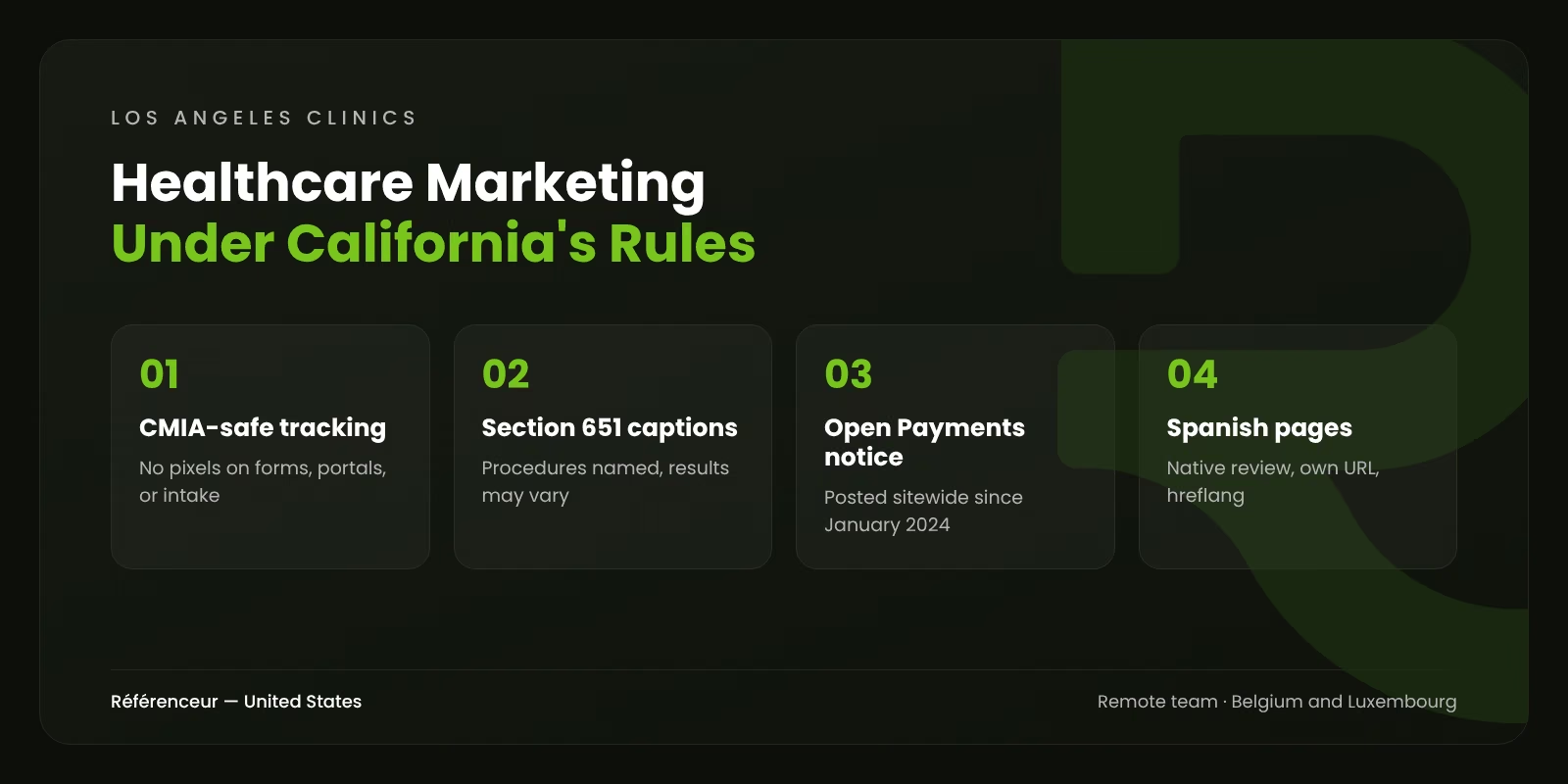
- No advertising pixels on appointment requests, symptom checkers, intake forms, or patient portal pages.
- Conversions recorded as a neutral event (“request sent,” “call over 60 seconds”), with no service or condition attached, as in our conversion tracking setup guide.
- A tag inventory, updated after every website change, that your privacy lead can sign off on, maintained by our web analytics team.
Then there’s the California Consumer Privacy Act, as amended by the CPRA. Its revenue test, set at $26,625,000 in annual gross revenue from January 1, 2025, and adjusted for inflation in odd-numbered years, means a solo practice may fall outside it while a large medical group or management company may not. Medical information covered by the CMIA or HIPAA is treated differently under the CCPA than ordinary visitor data, and drawing that line is a job for counsel. This isn’t legal advice; check with your attorney.
Medical Board Advertising Rules, Translated Into Website Decisions
Business and Professions Code Section 651 governs advertising by California’s healing arts licensees, and it applies to websites and other electronic communications. It doesn’t stop at physicians: dentists fall under the same section, which matters for dental marketing LA practices that lean on smile galleries. Here’s how its main requirements translate into page elements:
| Website element | What Section 651 requires | How we build it |
|---|---|---|
| Before-and-after photos | State the procedures performed; present both views comparably, without lighting or pose tricks; say results may vary for other patients | A caption template under every image, and a photo brief for your staff |
| Images of models | Label them as models, prominently and legibly | A visible “Model” tag, never hidden in alt text only |
| “Board certified” | Only for a qualifying board, such as an ABMS member board, with the board’s full name shown as prominently as the claim | Bios list the full board name next to the claim |
| Superiority claims | “Best” or “leading” only if relevant and backed by objective scientific evidence | Factual credentials instead of superlatives |
| Prices | No “as low as” phrasing; exact prices, with every variable that affects them stated | Consultation fee or a clear range, or no price at all |
The section also bans statements or images that create false or unjustified expectations of favorable results. Physicians who knowingly and intentionally break it face an administrative fine of up to $10,000 per event, and violations can lead to license discipline. We write to that standard and send every claim to the treating provider for sign-off.
The Open Payments Notice Belongs on Your Website
One California requirement surprises many clinics. Under AB 1278, physicians must tell patients about the federal Open Payments database, which shows payments from drug and device companies to physicians and teaching hospitals. The patient notice and the office posting took effect January 1, 2023. Since January 1, 2024, a physician who uses a website in their practice must also post the notice conspicuously on that website, according to the California Medical Association. When a physician is employed by a health care employer, the employer carries the duty.
It isn’t a ranking factor. It is a compliance gap that a careful patient, or a regulator, can spot in seconds. We add the notice to a page that is linked sitewide, usually the footer, and keep it on our launch checklist for every new location site.
Medical SEO Los Angeles in Spanish and Beyond
Los Angeles County is home to nearly 10 million people, and U.S. Census Bureau survey data show that more than half of residents age 5 and older speak a language other than English at home, while close to half identify as Hispanic or Latino. For many practices, Spanish isn’t an add-on; it is a large share of the waiting room.
Good medical SEO Los Angeles work treats each language as its own search market:
- Research Spanish queries separately. Patients don’t simply translate English keywords, and some search in a mix of both languages.
- Give each Spanish page its own URL and link it to the English version with hreflang tags for multilingual sites.
- List provider languages accurately. Section 651 allows ads to state languages spoken, and listing them correctly also helps patients choose.
- Make sure the phone line and the booking flow work in Spanish before the page goes live.
Korean, Armenian, Tagalog, Chinese, and Persian searches also matter in specific neighborhoods, from Koreatown to Glendale. We plan those pages only where your staff can serve the patients they attract.
Telehealth Pages That Stop at the State Line
Telehealth lets a Santa Monica clinic see patients in Fresno or San Diego, and that’s a real growth channel. It doesn’t erase licensing. The Medical Board of California states that physicians who use telehealth to treat patients in California must hold a California license, and state law requires the provider to obtain and document the patient’s consent, verbal or written.
For search, that means a telehealth page should say “for patients located in California” in plain words, name the states where your providers are licensed if you see patients elsewhere, and explain how consent works before the first visit. Paid campaigns for virtual visits, run by our Google Ads agency team, should target only the states where your providers hold a license. A national landing page that implies anyone, anywhere can book creates leads you can’t legally treat.
Working With Our French-Speaking Team From Belgium and Luxembourg
Picture a hypothetical dermatology group with offices in Pasadena and Long Beach and a telehealth line for follow-ups. A first quarter with us could include a tag audit against CMIA risks, captions for every before-and-after image, rebuilt provider bios with full board names, the Open Payments notice, and two Spanish service pages reviewed by a native medical translator.
You’d brief us by video call, early in your morning, when it’s late afternoon in Europe, and receive a report each month on calls, requests, and rankings. Our client references come from Europe, and we make no claim of past work for American clinics. Our guide to SEO for medical practices and our page on SEO for dentists explain the specialty work; our Los Angeles SEO agency page and our digital marketing hub for Los Angeles cover the local market. If you also operate in New York, read our page on medical practice SEO in NYC.
Our team in Belgium and Luxembourg speaks French and English natively and reads California’s rules line by line before it writes a word. Get a Free Assessment of your tracking, your photo galleries, and your patient pages, and we’ll tell you where the biggest risks and opportunities are.
Frequently Asked Questions About Healthcare Marketing in Los Angeles
Do California’s Advertising Rules Apply to Our Dentists and Nurse Practitioners Too?
Section 651 applies to people licensed under the healing arts division of the Business and Professions Code, which covers many professions beyond physicians, including dentists. Each profession can also have its own board rules. We apply the strictest standard across the whole site and flag anything profession-specific for your counsel.
Can We Post Before-and-After Photos on Instagram?
California’s rules cover public communications, including electronic ones, so the same caption requirements apply on social media as on your website: name the procedure, present both photos comparably, and note that results may vary. Platforms add their own ad policies on top, which we check before every campaign. You’ll also need each patient’s written authorization to use their photos.
Is a Small Practice Covered by the CCPA?
Often not, but it depends. The revenue test was set at $26,625,000 in annual gross revenue from January 1, 2025, and the California Privacy Protection Agency adjusts it every two years, so check the current figure. The law has other tests based on data volume and data sales. A management services organization behind several clinics may be covered even when each clinic is small. Your attorney should make that call; we’ll give them a clear map of what your website collects.
Should Our Spanish Pages Simply Mirror the English Ones?
Not word for word. The medical facts must match, but the keywords, examples, and questions often differ, and some services draw more Spanish-language demand than others. We start with the services where Spanish searches and your staff’s capacity overlap, then expand.
Where Should the Open Payments Notice Appear on Our Website?
Anywhere it is conspicuous and easy to reach from every page. Most clinics use a footer link to a short page with the required wording and the link to the federal database. If you’d like us to check your current placement, send us your website address, or book a video call with our team.