 0498 70 98 60
When someone develops knee pain that won’t go away or needs a new primary care physician after a move, the search starts online: symptoms, conditions, specialists, insurance, and “accepting new patients near me.” Medical SEO puts your practice in front of those patients with information that is accurate, readable, and clearly backed by your clinicians.
Référenceur works with physician practices, specialty clinics, physical therapy groups, and other outpatient providers on their organic visibility. We bring more than 15 years of SEO work from Europe and a 4.7/5 average across 107 Google reviews; U.S. practices collaborate with us remotely, with video calls and a report every month. Get a free assessment and see which conditions and services patients search for in your area, and who ranks for them now.
Health Content Is Held to a Higher Standard
Google’s Search Quality Rater Guidelines treat health as a “Your Money or Your Life” (YMYL) topic, where inaccurate information can cause real harm. For these searches, Google wants results from sources that demonstrate first-hand experience, expertise, authority, and trustworthiness, summarized as E-E-A-T. That changes how a medical practice website should be built:
- Named clinical authors or reviewers. Each condition or treatment page should show who wrote or reviewed it, with credentials and a review date.
- Provider bios that carry real weight: board certifications, training, hospital affiliations, languages spoken, and areas of focus.
- Precise, measured language. No promises of cures, no overstated outcomes, and clear guidance on when to seek urgent care.
- Clear practical information: insurance accepted, how to book, what to bring, location, and parking.
As a healthcare SEO agency, we handle the structure, research, writing, and optimization. Your clinicians review every medical statement before it goes live. That review step is what makes the content trustworthy, and it’s not optional.
What Our Medical SEO Work Includes
| Area | What we do | Why it matters |
|---|---|---|
| Service and condition pages | One page per major condition or procedure you treat, written for patients and reviewed by your providers | Matches how patients search and builds topical authority |
| Provider pages | Detailed bios with credentials, specialties, and appointment links | Supports E-E-A-T and answers “who will I see?” |
| Local SEO | Google Business Profile per location and, where appropriate, per provider; consistent listings | Visibility for “near me” and map searches |
| Technical SEO | Speed, mobile layout, accessibility basics, schema markup for medical practices and physicians | Removes barriers for patients and search engines |
| Patient resources | Pre-visit guides, insurance FAQs, telehealth explanations | Reduces phone volume and answers common questions |
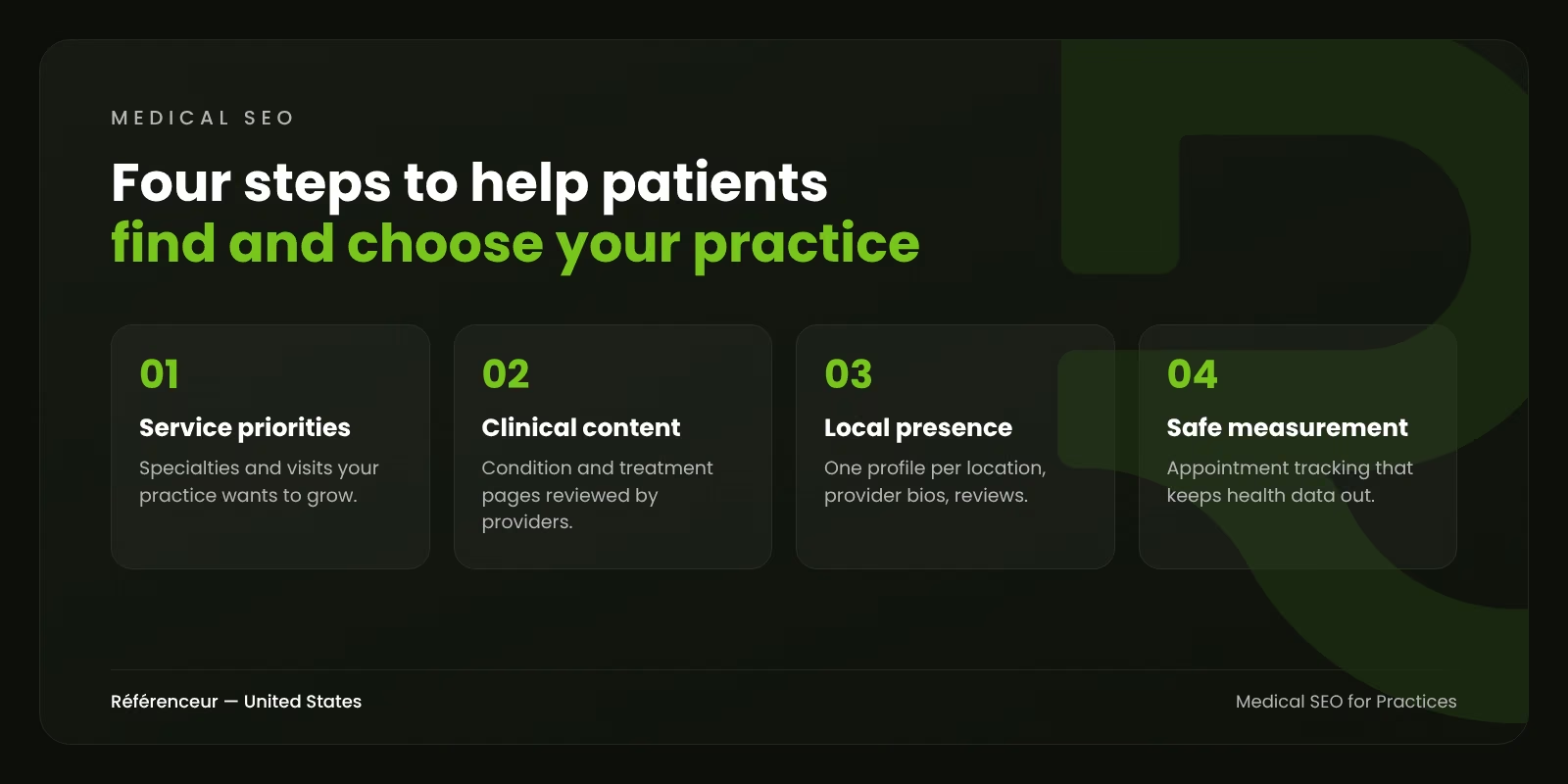
| Measurement | Appointment requests and calls tracked by page, without sending health details to ad platforms | Shows what works while respecting patient privacy |
SEO for Doctors and Privacy: Measuring Without Oversharing
Healthcare marketing measurement has become a sensitive topic. In December 2022, HHS issued guidance warning that tracking technologies on healthcare websites could disclose protected health information. A federal judge in Fort Worth vacated key parts of that guidance in June 2024, and HHS eventually abandoned its appeal. HIPAA itself hasn’t changed, though: if protected health information is disclosed to a third party without proper safeguards, the practice is exposed.
Our approach is conservative. We avoid placing advertising pixels on appointment forms or patient portals, we measure conversions without passing condition-specific details, and we document the setup so your compliance lead can review it. Google’s advertising policies point the same way: they don’t allow personalized ads based on sensitive health information. This isn’t legal advice; confirm your setup with your privacy officer or counsel.
Accessibility Is Part of the Job
A practice website should be usable by patients with visual, motor, or cognitive impairments. Beyond the obvious ethical reason, there’s a regulatory one. Under Section 504, HHS expects organizations that receive its federal financial assistance to meet WCAG 2.1 Level AA on their websites and apps, the standard explained in our practical ADA and WCAG guide. After a one-year extension published in May 2026, the compliance dates are May 11, 2027, for organizations with at least 15 employees, and May 10, 2028, for the rest. Whether and how your practice is covered is a question for your counsel; our job is to build and optimize pages that meet accessibility best practices from the start.
Telehealth and Multi-Location Practices
Practices that offer telehealth face a specific question: where can they legally see patients, and how should that show up in search? Licensing generally ties a physician’s virtual visits to the states where they’re licensed, so telehealth pages should name those states clearly instead of implying nationwide availability. Groups with several clinics need one location page and one Google Business Profile per site (our five-step Google local SEO guide covers the setup), each with its own providers, hours, and services, so patients find the right office, not just the brand.
Paid Search for Medical Practices
Google Ads can fill specific gaps, such as a new location or a new service line, but healthcare ads face strict rules. Some categories, like addiction treatment services, require third-party certification before ads can run in the U.S. Our Google Ads agency team works within those policies when paid search makes sense alongside SEO.
How We Work With Medical Practices
We don’t have a U.S. location; the team works from Belgium and Luxembourg and schedules calls at a time that works for both time zones.
- A video call with the practice administrator and, ideally, a lead physician to define priorities.
- An audit of your website, Google Business Profiles, provider pages, and competitors.
- A content plan organized by service line and patient demand.
- Drafts in native U.S. English, checked and signed off by your clinicians.
- Monthly reporting on visibility, calls, and appointment requests.
Google, Microsoft Advertising, Semrush, and HubSpot recognize us as a partner. We make no claims about U.S. medical clients; the references we cite are European companies. Our SEO agency page details the method, and the U.S. locations hub shows the metros we cover. Practices serving French-speaking patients, from Haitian communities in Florida and New York to Canadian visitors, can also get French-language pages.
Get a free assessment for a clear view of how patients find your practice today.
Frequently Asked Questions About Medical SEO
Who Writes the Medical Content?
Our writers research and draft the content in plain, native U.S. English. A physician or qualified clinician at your practice reviews and approves every page, and we display that review on the page. Nothing clinical is published without your approval.
Can SEO Tracking Violate HIPAA?
It can if tracking tools send protected health information to third parties without safeguards. We design measurement to avoid that, but your privacy officer should review the final setup. This isn’t legal advice.
How Long Does Medical SEO Take to Show Results?
Local profile improvements can help within a few months. Ranking condition and treatment pages in competitive metros usually takes six to 12 months of consistent work. We report progress monthly and never promise specific rankings.
Should Each Doctor Have a Google Business Profile?
In many cases, yes, especially for physicians who see patients under their own name. Google has specific rules for practitioner profiles, and we set them up to avoid duplicates and conflicts with the practice’s main profile.
Do You Work With Dental Practices Too?
Yes. Dental practices follow their own search patterns, from treatment pages for implants and aligners to review replies that protect patient privacy, and we treat dentistry as a separate specialty. Request a free assessment and describe your practice to us.