 0498 70 98 60
Patients don’t search for “a dentist” in the abstract. They search for “emergency dentist open Saturday,” “Invisalign near me,” or “dental implants consultation,” usually on a phone and often while they’re in pain or ready to commit. If your practice isn’t in the map results and the first few organic listings, those patients book somewhere else.
Référenceur offers SEO for dentists that focuses on the treatments that matter to your practice, the neighborhoods you actually serve, and the trust signals patients look for before they call. Behind that work is a European team with 15+ years in search marketing and a 4.7/5 average from 107 Google reviewers, serving U.S. practices remotely. Request a free assessment to see which treatment searches currently send patients elsewhere.
Why Dental SEO Needs a Local, Treatment-Level Strategy
The American Dental Association’s Health Policy Institute counted 205,088 professionally active dentists in the U.S. in 2025, or 60.0 per 100,000 people. In most suburbs and cities, that means several practices within a short drive, all competing for the same three spots in Google’s local results.
Winning that competition rarely comes down to one trick. It comes down to doing the basics thoroughly:
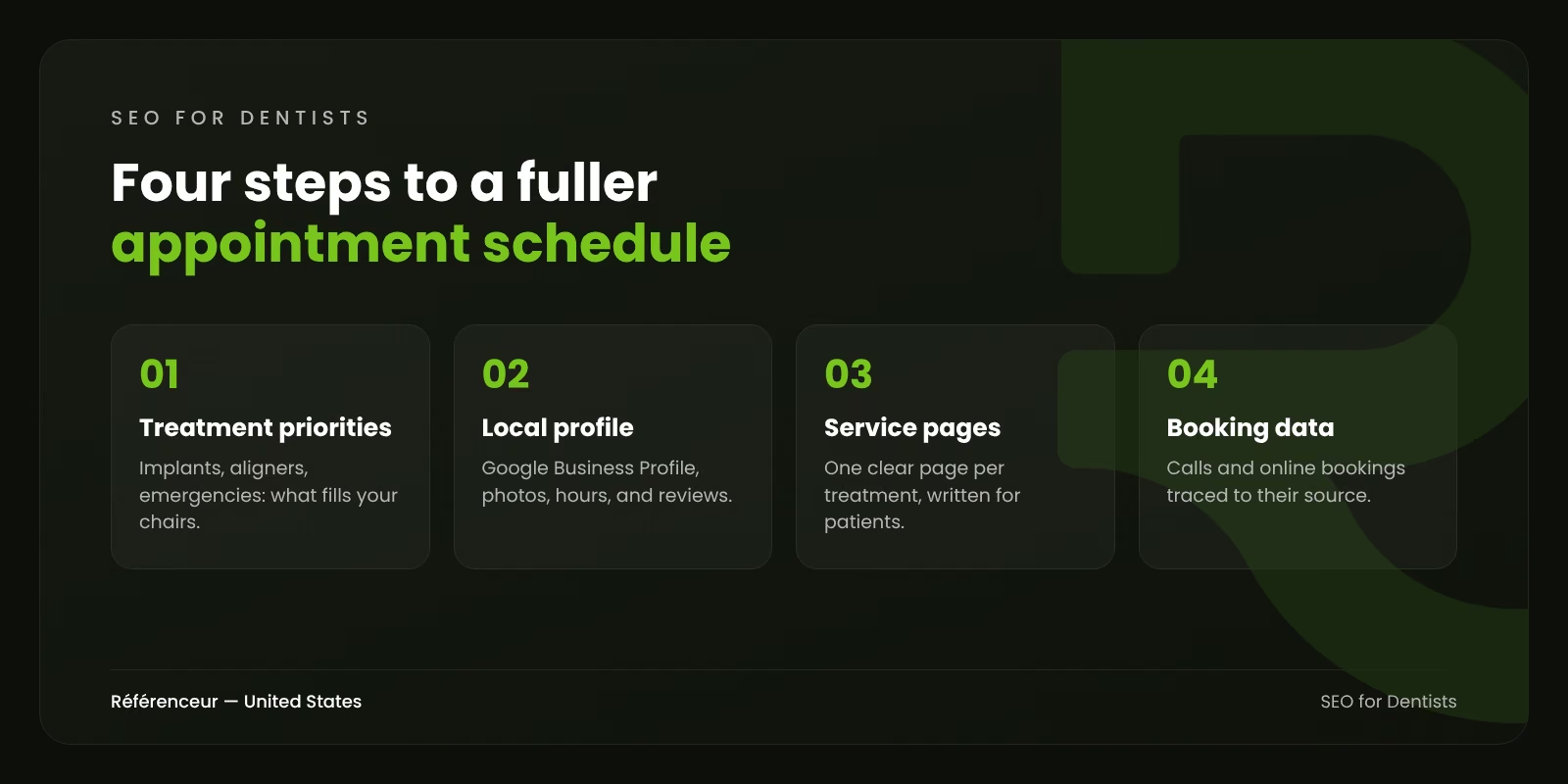
- A complete, accurate Google Business Profile with the right primary category, real photos of your office and team, current hours, and appointment links.
- A dedicated page for each high-value treatment, not a single “services” page listing 20 procedures in one paragraph.
- A steady flow of genuine patient reviews, answered professionally (our guide on how to respond to negative reviews shows how).
- A fast, mobile-friendly site where booking takes two taps, not five.
General dentistry keeps your hygiene schedule full. Implants, clear aligners, veneers, and sedation dentistry usually carry the margins. Our dental SEO work starts by ranking those treatments by value and capacity, so we put effort where a new patient matters most to you.
What Our Dental Practice Marketing Covers
| Priority | What we do | Patient-facing result |
|---|---|---|
| Google Business Profile | Category and service setup, photos, booking link, Q&A, posts for seasonal offers you approve | Better visibility in map results and “near me” searches |
| Treatment pages | Implants, Invisalign or other aligners, crowns, emergency care, pediatric dentistry, each on its own page | Patients find a page that answers their exact question |
| Reviews | A simple, compliant request routine and response templates that protect patient privacy | More recent reviews and a stronger star rating |
| Technical SEO | Page speed, mobile layout, schema markup for your practice and dentists | Fewer lost visits and clearer signals to Google |
| Insurance and financing content | Plain-English pages on the plans you accept and payment options you offer | Answers the question that stops many patients from calling |
| Measurement | Call tracking and booking tracking by page and by source | You see which treatments generate appointments |
If you have several locations or belong to a group, each office gets its own profile and location page, with unique content rather than copies that compete with each other.
Reviews, Privacy, and HIPAA: Handle With Care
Dentists face a trap that most local businesses don’t. When an unhappy patient posts a review, the instinct is to explain what really happened. But a reply that confirms someone was your patient or mentions their treatment can expose protected health information. The HHS Office for Civil Rights has resolved HIPAA cases against dental practices over exactly this kind of review response.
We write response templates that stay polite, invite the reviewer to call the office, and say nothing about the person’s care. We also help you ask for reviews the right way. Federal rules tightened on October 21, 2024, when the FTC’s ban on fake reviews and sentiment-based incentives took effect, and Google separately forbids asking only the patients you expect to be happy. The answer is a consistent routine: ask every patient after their visit, by text or email, with a direct link or a Google review QR code at the front desk.
Tracking deserves the same caution. A Texas federal judge struck down part of HHS’s online tracking guidance in June 2024, yet HIPAA continues to apply any time protected health information leaves your control. We set up analytics and call tracking that measure bookings without sending treatment details to ad platforms, and we recommend you review the setup with your compliance advisor. This isn’t legal advice.
Dental SEO and AI Search
More patients now ask AI assistants questions like “how long do dental implants last” or “is Invisalign painful.” Tools such as ChatGPT, Perplexity, and Google’s AI features usually answer by pointing to a handful of sources. Practices with detailed, accurate treatment pages written for patients, reviewed by a dentist, and clearly attributed have a better shot at being cited and recommended, which is why your website now drives local AI search. We write with that in mind: clear answers first, then detail, with the dentist’s name and credentials on the page.
How We Work With Your Practice
Since we don’t run a U.S. office, everything happens remotely, scheduled around your patients. Belgium and Luxembourg sit roughly six hours ahead of New York, so a call before your first appointment is easy to arrange.
- A video call with the dentist or practice manager to understand your treatment mix, capacity, and goals.
- An audit of your website, Google Business Profile, reviews, and the practices ranking around you.
- A roadmap that starts with the quickest wins, usually your profile and your top treatment pages.
- Patient-friendly copy in native U.S. English, approved by your dentist before publication.
- A monthly report showing calls, bookings, rankings, and the next priorities.
Our partner badges come from Google, Microsoft Advertising, Semrush, and HubSpot. The references we can share, such as Auto-école Georges and Isolpur, are European businesses; no U.S. results are claimed here. To see our broader approach, visit our SEO agency page. Practices in major metros can also check our U.S. locations.
If your practice serves French-speaking families, for example in Miami, New York, Louisiana, or New England, we can build pages in both English and French so those patients feel welcome before they walk in.
Request a free assessment and see how your practice compares to the dentists ranking above you.
Frequently Asked Questions About SEO for Dentists
How Long Before Dental SEO Brings In New Patients?
Google Business Profile improvements and review growth often show results within a few months. Ranking treatment pages in a competitive city usually takes longer, often six to 12 months. Results depend on your market and starting point, and no agency can promise a specific ranking.
Do I Need a Separate Page for Each Dental Treatment?
For your high-value treatments, yes. A patient searching for implants wants to read about implants: the process, recovery, and what a consultation looks like. A dedicated page answers that better and gives Google a clear page to rank for that search.
Can I Offer Patients Something in Exchange for a Review?
Be very careful. The FTC rule bans incentives conditioned on positive reviews, and Google’s policies prohibit incentivized reviews altogether. The safest approach is to ask every patient, offer nothing in return, and make leaving a review as easy as possible.
Is SEO Better Than Google Ads for a Dental Practice?
They do different jobs. Ads can fill the schedule quickly for specific treatments, while SEO builds visibility that doesn’t disappear when the budget stops. Many practices run both. Our Google Ads agency team can manage the paid side if you need it.
Will You Write Content About Clinical Procedures?
Our writers draft patient-friendly content based on interviews with your dentists and reputable public sources. Your dentist reviews every clinical statement before publication. Request a free assessment to discuss your treatment priorities.