 0498 70 98 60
Google’s September 2019 Core Update: What Changed and What to Do
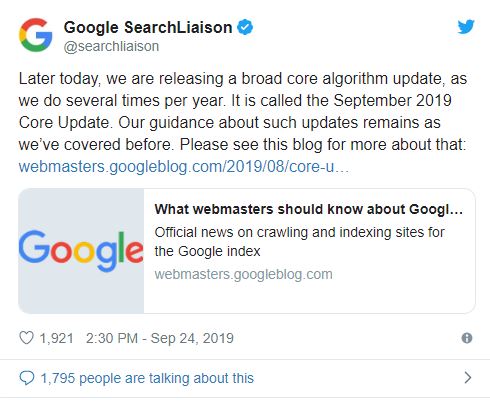
A single tweet from Google SearchLiaison was all it took to announce a new Google algorithm update on September 24, 2019. Google hadn’t pre-announced an algorithm change since the June 2019 core update. Google regularly uses Twitter to confirm updates, big or small, but this September update appeared to have a real impact on organic search rankings.
What was this update about? Will the September 2019 core update affect your site’s rankings? Here’s our breakdown.
The September 2019 Core Update Announcement
Google announced the update publicly, but, as usual with core updates, it gave no specific details about what had changed.
The update took about 36 hours to start showing up in search results, 36 hours during which the entire SEO community was on alert.
After a few days of rollout, many sites saw significant ranking changes, some very positive, others negative. We tracked the update closely and saw very clear ranking shifts on some of our clients’ sites.
Google keeps investing in its broad core algorithm updates. The main goal: reward sites with high-quality, relevant content, so searchers get the best possible answer as fast as possible.
What Else Did Google Change in September 2019?
Plenty of theories circulated. Was the quality of a site’s outbound links now a ranking factor? Were there changes to meta tags? Those guesses were fueled by several other announcements Google made the same month, which are easy to confuse with the core update itself.
Around the same time, Google also launched a new video series on its Google Webmasters YouTube channel, hosted by John Mueller, a Webmaster Trends Analyst at Google. Called “Google Search News,” it works like a mini newscast, recapping what’s new in Google’s tools and search.
John Mueller sums up the key search changes in just a few minutes. Here’s what to remember from September 2019:
New Link Attributes Alongside rel=”nofollow”
As a reminder, the nofollow attribute tells Google not to associate a site with a link it points to. On September 10, 2019, Google introduced two new attributes so that sites can describe the nature of their outbound links more precisely:
- A sponsored link (an ad, a paid placement, or a sponsorship) should use rel=”sponsored”.
- A link created by users (in a comment or forum post) should use rel=”ugc”.
According to Google, specifying the attribute helps it understand and process links more accurately. Many SEO specialists, however, gave the new attributes a lukewarm welcome.
Existing nofollow links don’t need to be changed, but every site owner should know these two attributes exist.
Review Stars in Search Results
Every business wants as many positive reviews as possible, but review stars will no longer show for every site. In mid-September 2019, Google stopped displaying star ratings for “self-serving” reviews, meaning reviews a business publishes about itself on its own site using LocalBusiness or Organization markup.
New Controls for Search Snippets
The most notable change of the month concerns how pages appear in search results.
Site owners can now control their snippets with new robots meta directives: the maximum number of characters shown, the size of image previews, and the length of video previews. A new HTML attribute, data-nosnippet, will also let you keep specific parts of a page out of snippets. Google said these controls would take effect in the fall of 2019.
The goal: give site owners more control over how their content is presented in search results. For more on how Google builds snippets, see our article on how often Google rewrites meta descriptions.
Did Your Visibility Drop After This Update?
Our guide to diagnosing and fixing a traffic drop walks through the checks to run first. Référenceur is a French-speaking SEO agency from Belgium and Luxembourg, and we work with businesses remotely, through video calls, shared screens, and monthly reporting. Get a free assessment of your rankings.
Where Things Stand in 2026
The sponsored and ugc attributes are still in use. Since March 1, 2020, Google treats all three link attributes as hints for crawling and indexing as well as ranking. The Google Webmasters YouTube channel has since been renamed Google Search Central, and Google now confirms core updates on its Google Search Status Dashboard.