 0498 70 98 60
French Website Translation for Hotels in Las Vegas: Pages Quebec and Paris Can Book
French website translation for hotels sounds like a weekend job for a plugin. In Las Vegas, the job touches the nightly rate, the resort fee, the accessible-room description, the show tickets, and the confirmation email, and several of those carry their own rules. This page is for resorts, independent hotels, show producers, and attractions that want a French version able to sell as well as the English one.
Référenceur comes from Belgium and Luxembourg, two countries where French is an everyday working language, and our team writes it natively. That’s the language your guests from Montreal, Paris, Brussels, and Geneva book in. We also write the U.S. English side, so both versions stay aligned. We work remotely, with no U.S. office, and you can request a free assessment of your current site before deciding anything.
Who Reads the French Version of a Las Vegas Hotel Site
Las Vegas welcomed about 4.72 million international visitors in 2025, 4.8% fewer than the year before, according to visitation data from the Las Vegas Convention and Visitors Authority (LVCVA) reported by CDC Gaming Reports in May 2026. Canada and Mexico each supplied about a quarter of them, and Canada kept first place despite a steep drop.
A shrinking Canadian market makes the remaining travelers more selective, not less valuable. A family in Laval comparing two Strip resorts on a phone will notice which one explains its fees, room types, and pool hours in French. The same applies to couples from Lyon or Liège adding Las Vegas to a West Coast road trip, and to business travelers from Dakar or Abidjan in town for a convention.
The website is where that interest turns into a booking or slips away. Ads, social posts, and partnerships with tour operators are a separate job, covered on our page about marketing to French-speaking tourists in Las Vegas.
Quebec French and European French on the Same Booking Path
A French site written for Paris can confuse a guest from Quebec, and the reverse is just as true. The differences show up on exactly the pages that decide a stay:
| On your site | Quebec (fr-CA) | France (fr-FR) |
|---|---|---|
| Breakfast included | déjeuner inclus | petit-déjeuner inclus |
| Dinner reservation | souper | dîner |
| Parking | stationnement | parking |
| Weekend package | forfait fin de semaine | forfait week-end |
| Email address | courriel | |
| Price display | 199,00 $ US | 199 USD |
The meal row matters most. In Quebec, Belgium, and Switzerland, déjeuner usually means breakfast and dîner means lunch, while in France déjeuner is lunch and dîner is the evening meal. A “dîner” credit can promise a guest the wrong meal.
Google lets you label each version with hreflang, combining a language code from ISO 639-1 with an optional region code from ISO 3166-1, such as fr-CA or fr-FR. Google’s hreflang page, revised in September 2026, is explicit on one point: neither hreflang nor the lang attribute tells Google which language a page is in. The words on the screen do. A page tagged fr-CA with English room names and an English checkout still counts as English.
Resort Fees and Room Tax, Spelled Out in French
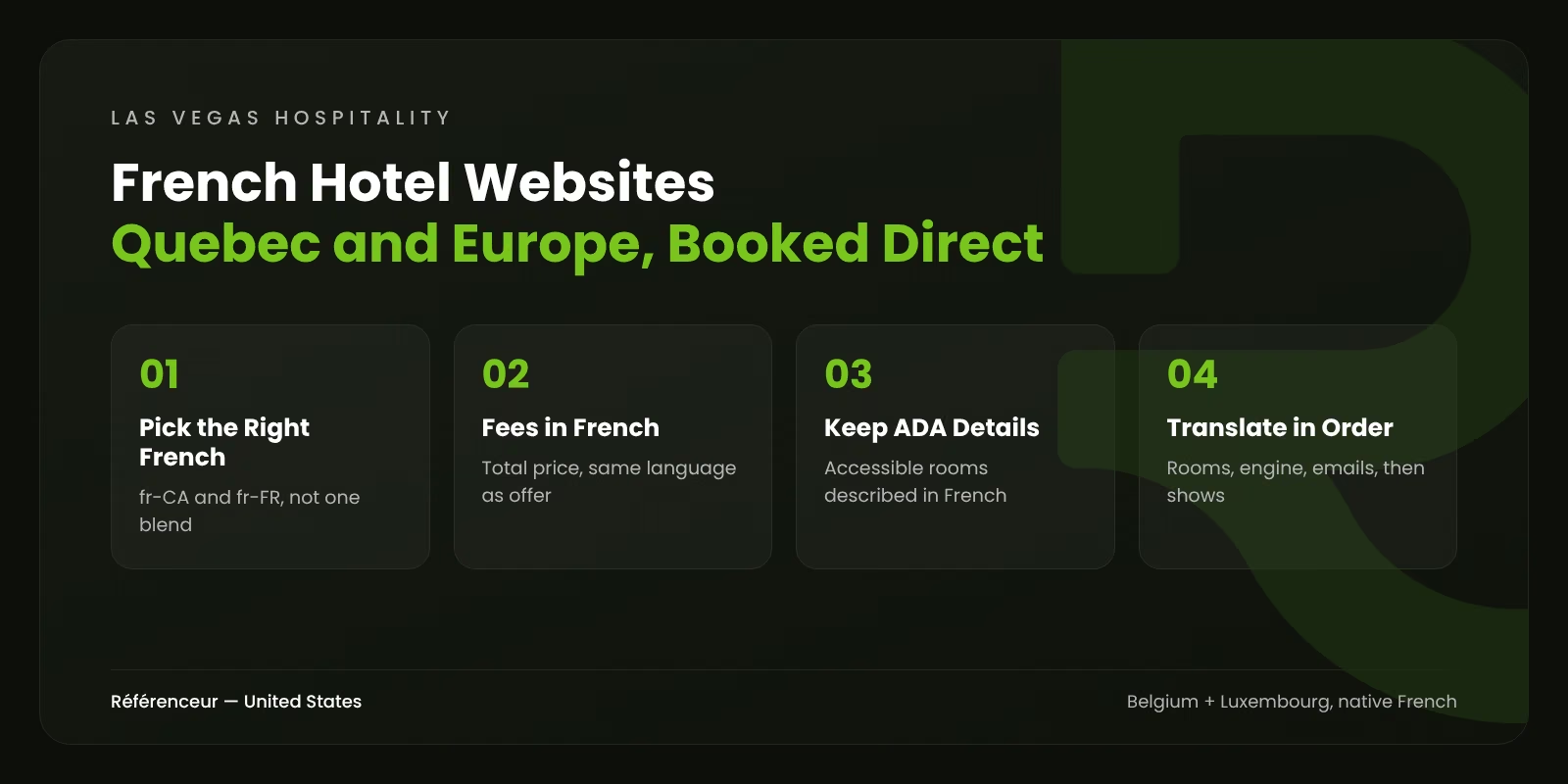
The Federal Trade Commission’s fee rule already requires hotels to fold mandatory resort fees into a total price that stands out more than any other price on the screen; our web design agency in Las Vegas page covers the layout side. One line in the FTC’s guidance matters directly for a translated site: disclosures must be in the same language as the offer. A French rate page with an English-only fee note is a weak spot.
Taxes deserve the same care. In the City of Las Vegas, the room tax is 13.38% inside the Primary Gaming Corridor and 13% outside it. Most of the Strip sits in unincorporated Clark County instead, where the county sets its own rates by area, so each property should state the rate that applies to it. We translate these lines with the numbers intact, and we avoid a bare dollar sign, which a Canadian reader may take for Canadian dollars. No single French term for a resort fee is understood everywhere, so the French page should name the fee and list what it covers.
This is general information, not legal advice; have your attorney check the rule against your rate setup.
Accessibility Details Must Survive Translation
Since March 15, 2012, ADA rules on reservations (28 CFR 36.302(e)) have required hotels to describe accessible features of the property and its rooms in enough detail for a guest with a disability to judge whether a room meets their needs. That duty doesn’t stop at the English pages. A French room page that drops the roll-in shower or the visual alarm description is less useful and harder to defend.
Language also affects accessibility. WCAG success criterion 3.1.1 asks for the page language to be set in the code, and 3.1.2 covers passages in another language, so a screen reader pronounces “salle de bain accessible” in French rather than as garbled English. Our guide to ADA website compliance walks through the rest.
What to Translate First on a Multilingual Hotel Website
A multilingual hotel website rarely needs every page on day one. We usually work in this order:
- Room, rate, and package pages, with fee disclosures and the cancellation policy.
- The booking engine. Many engines offer a French interface, but the room names, package text, and policies you enter are yours to translate.
- Confirmation, pre-arrival, and post-stay emails, sent in the language the guest booked in.
- Show, dining, spa, and pool pages, which often attract the first French searches.
- Practical answers: airport transfer, parking, the age-21 rule for casino gaming, and ID at check-in.
- Replies to French reviews, written by someone who reads them.
The structure behind those pages, from URLs to language switchers, is what our French English bilingual website design service builds.
French Website Translation for Hotels Is Not French SEO
A translated page answers the question a guest already asked. French SEO for Las Vegas hotels starts earlier, with the words people type before they know your name: a family pool, a show for teenagers, a hotel near the convention center. Those queries are researched market by market, not copied from the English keyword list.
The technical layer helps too. Schema.org’s LodgingBusiness type includes availableLanguage, amenityFeature, and checkinTime, so the French page can state in structured data that staff speak French and list the amenities in French. Our schema markup guide explains what Google currently shows.
Shortcuts carry a risk. Google’s spam policies, updated in August 2026, list automated translation among the transformations used to mass-produce low-value pages. A hundred machine-translated pages won’t rank just because they exist.
Why Hotels Give Their French Pages to a Team From Belgium and Luxembourg
Our writers grew up in French, in Belgium and Luxembourg, where hotels, restaurants, and shops switch languages all day. We know which words a Quebecer and a Parisian use differently and which European data rules apply when a guest from Brussels fills out your form. That native French-speaking base is the main reason to work with us. It comes with 15-plus years of search and web projects, a 4.7/5 average from 107 Google reviewers, and partner status with Google, HubSpot, Microsoft Advertising, and Semrush.
We don’t promise bookings. We do build French pages your front desk won’t need to apologize for. If you also want campaigns in France, Belgium, Switzerland, or Quebec, see our French-language marketing agency page; for the rest of your local marketing, visit our digital marketing agency in Las Vegas page.
Planning a French version before the next convention season? Get a Free Assessment of your current site.
Frequently Asked Questions About French Hotel Websites in Las Vegas
Can We Rely on Our Booking Engine’s Built-In French?
For the interface, often yes: buttons, calendars, and form labels usually come translated. Everything you typed yourself, from room names and package descriptions to fee notes and policies, stays in English until someone translates it. Check the final payment screen in French before launch.
Should the French Pages Show Prices in Canadian Dollars?
Show the currency you actually charge, written out as USD or “$ US,” so nobody assumes Canadian dollars. If you add an approximate conversion for convenience, label it as an estimate and keep the charged amount most visible.
Do Show, Restaurant, and Spa Pages Need French Versions?
Not all at once. Start with the pages guests open before booking a room, then add the ones that sell extras. A show page in French with an English ticket checkout is a common gap worth closing early.
How Do We Keep French Pages Current When Rates Change Daily?
Keep rates and availability in the booking engine, where they update automatically, and keep fixed text on the website. When a policy or fee changes, update both languages the same day. A short shared glossary keeps new content consistent. If you’d like an outside view of your current workflow, request a free assessment.
Will French Pages Compete With Our English Pages in Google?
Not when the setup is right. With reciprocal hreflang tags, separate URLs for each language, and fully translated visible text, Google can show the French page to French-speaking searchers and the English page to everyone else. Problems usually come from half-translated pages or automatic redirects based on location.