 0498 70 98 60
Financial Services Marketing Agency NYC: Growth That Clears Compliance Review
A financial services marketing agency NYC firms can rely on has to write for two readers at once: the prospect deciding whom to trust with their money, and the compliance officer who signs off before anything goes live. Wealth managers, registered investment advisers, broker-dealers, fintechs, and the U.S. arms of European banks all answer to different rulebooks, and a campaign that ignores the difference stalls in review. Référenceur’s French-speaking team has offices in Belgium and in Luxembourg, a country known for its banking and investment fund sector, so a culture of pre-approval and recordkeeping feels familiar to us. Request a free assessment of your current site and campaigns.
Start With the Regulator: Who Approves Your Marketing?
New York’s securities industry is large enough that almost every marketing decision has a precedent. The New York State Comptroller reported on October 6, 2026, that the industry employed 207,400 people in the city in 2025, the highest level since tracking began in 2000. It also estimated that in 2024, about one in 13 city jobs was directly or indirectly tied to the industry. The flip side is a crowded field, where generic “trusted partner” copy disappears.
Before planning any channel, we map which rules apply to your firm. This isn’t legal advice, and your compliance team makes the final call, but the starting point usually looks like this:
| Type of firm | Main marketing rule | What it changes online |
|---|---|---|
| SEC-registered investment adviser | SEC Marketing Rule, Rule 206(4)-1 | Testimonials, ratings, and performance need specific disclosures |
| FINRA member broker-dealer | FINRA Rule 2210 | Principal approval, some filings, BrokerCheck links |
| Dual registrant | Both of the above | Two review paths for the same content |
| Bank or fintech advertising financial products | Banking regulators, plus platform policies | Google Ads verification arriving in 2027 |
The SEC Marketing Rule, Turned Into Website Decisions
The SEC adopted the current Marketing Rule on December 22, 2020, and advisers had to comply by November 4, 2022. It applies to SEC-registered advisers that disseminate advertisements, a term that generally excludes one-on-one communications. The rule’s seven general prohibitions start with untrue statements and unsubstantiated claims, and they also require fair and balanced treatment of risks and performance.
Here is how we apply it to the pages an adviser actually publishes:
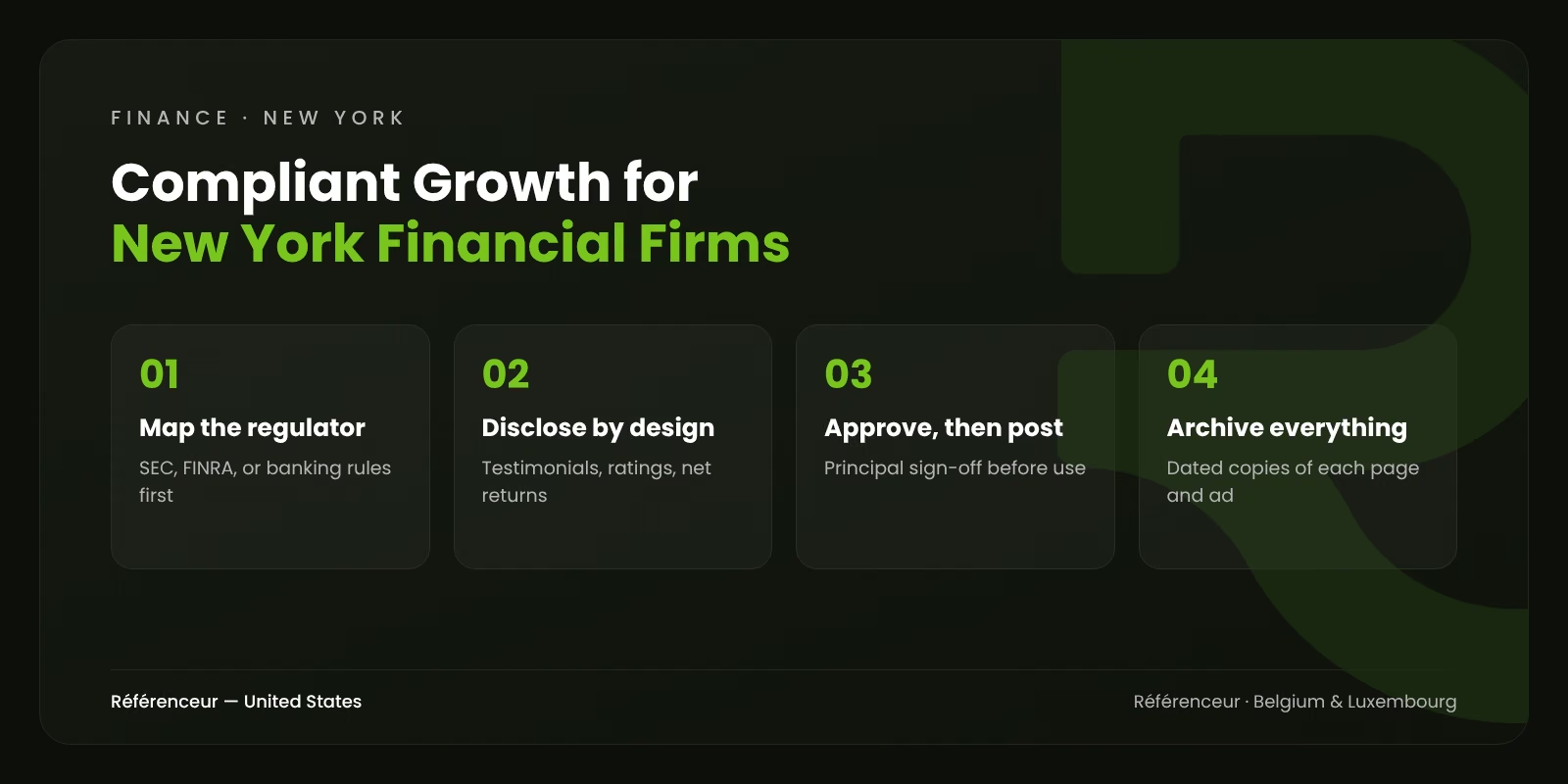
- Client stories and reviews. An ad with a testimonial or endorsement must clearly and prominently disclose whether the person is a client and whether they were compensated. Paid promoters generally need a written agreement, unless compensation is $1,000 or less over the prior 12 months.
- Performance pages. Gross performance can’t appear without net performance, and the rule restricts extracted results, hypothetical performance, and predecessor performance. We never pull a return figure into a headline or a meta description without your compliance team’s approval.
- Ratings and awards. Third-party ratings are allowed with required disclosures about how the rating was prepared.
- Records. Under amended Rule 204-2, advisers must keep copies of every advertisement they disseminate. We hand over dated archives of each page version and ad to support that.
SEC staff keep updating the rule’s FAQs. On January 15, 2026, they added guidance on using actual versus model fees in net performance and on promoters subject to certain self-regulatory orders, so we check the latest FAQs before each campaign.
FINRA Rule 2210 and a Broker-Dealer’s Content Calendar
FINRA Rule 2210 sorts communications into three categories: correspondence, which reaches 25 or fewer retail investors within any 30-day period; retail communications, which reach more; and institutional communications, which go only to institutional investors. A blog post, a landing page, or a public LinkedIn update usually falls in the retail category. That has practical consequences:
- Approval comes first. A qualified registered principal must approve each retail communication before the earlier of its use or its filing with FINRA.
- Some pieces must be filed. New members file certain retail communications at least 10 business days before first use during their first year; communications about registered investment companies and some other products are filed within 10 business days of first use.
- Projections are restricted. Communications generally may not predict or project performance. The SEC approved an amendment on October 15, 2026, that will allow projected performance and targeted returns under conditions (written procedures, a suitable audience, and full disclosure of assumptions and risks), but the current rule applies until the effective date FINRA announces in a Regulatory Notice, and mass-market retail content is unlikely to qualify even then.
- Testimonials carry disclosures. One about investment advice or performance must say it may not be representative of other customers’ experience, that it doesn’t indicate future success, and, if more than $100 in value was paid for it, that it was paid.
- BrokerCheck is required. The page meant for retail investors, and any page with a registered person’s profile, needs a reference and hyperlink to BrokerCheck.
So we build the editorial calendar backward from your review queue, not forward from a publishing date.
Google Ads Verification Reaches U.S. Financial Advertisers in 2027
Google already requires financial services verification in many countries. On October 20, 2026, it announced that the program will come to the United States and Canada in early 2027 for certain financial ads, such as checking accounts and credit cards. Advertisers will have to show authorization from relevant regulators or recognized registries, and Google said it is working with the American Bankers Association to use its registry to verify banks. Google says it will notify advertisers before enforcement begins.
For a New York bank branch, lender, or fintech, that means gathering license and registration documents now, matching the advertiser name in Google Ads to the regulated entity, and planning a pause-free switchover. Our Google Ads team for New York handles the account structure, while your legal team owns the documentation.
SEO for Financial Advisors NYC: Proving Expertise on Money Topics
Search engines hold financial content to a high bar, because bad advice can hurt people. In practice, SEO for financial advisors NYC firms comes down to showing who stands behind each page:
- Advisor bios with credentials, registrations, and the BrokerCheck or SEC adviser search link where it applies.
- Educational articles on topics New Yorkers actually search, such as equity compensation at a Manhattan employer, or co-op financing questions, with a named author and a review date.
- Plain-language disclosures that stay visible instead of being buried in a footer accordion.
- Schema markup for the firm and its advisors that matches the regulatory filings word for word.
Performance claims are where SEO pressure and compliance collide. A meta description that boasts about returns can win clicks and fail review at the same time, so we write snippets around services, process, and audience instead.
LinkedIn for B2B Finance and Fintech in New York
For fintech marketing agency New York work, LinkedIn is usually the main paid and organic channel: CFOs, treasury teams, allocators, and bank partners are reachable by job function and company. Two rules shape what we post. For broker-dealers, a public post is normally a retail communication, while a campaign restricted to institutional investors can fall under the institutional category, but only if there is no reason to believe it will be passed on to retail investors. For advisers, sponsored posts that offer advisory services are advertisements under the Marketing Rule.
We keep a log of each post, its approver, and its approval date, which supports both FINRA and SEC recordkeeping. Our social media marketing page for New York covers the creative side.
A Belgian and Luxembourgish Team for European Financial Firms in New York
Référenceur has no office in New York or elsewhere in the U.S. Our team in Francorchamps, Belgium, and Wemperhardt, Luxembourg, works with you by video, keeps a shared approval log, and reports monthly. For a European bank, insurer, or asset manager opening in Manhattan, a French-speaking partner can brief headquarters in Paris, Brussels, or Luxembourg in French while writing native U.S. English for American clients. Credentials, briefly: 15+ years in SEO and paid search, an average of 4.7/5 over 107 Google reviews, and Google Partner status, plus partner programs with Microsoft Advertising, Semrush, and HubSpot. The clients we cite by name are European companies.
See how this fits a broader plan on our New York digital marketing agency page, then get a free assessment of where your marketing and your compliance process slow each other down.
Frequently Asked Questions About Financial Services Marketing in NYC
Can a Registered Investment Adviser Show Google Reviews on Its Website?
A review written by a client may be treated as a testimonial under the SEC rule. Testimonials are permitted when the ad clearly and prominently discloses client status and compensation. How a review widget is set up, and whether the firm selects which reviews appear, affects the analysis. Your compliance officer or counsel should decide before we install anything.
Who Signs Off on a Broker-Dealer’s Blog Posts?
A qualified registered principal must approve each retail communication before it’s used or filed. We submit drafts through your existing review system and don’t publish until we have that approval in writing.
Does Our Fintech Need FINRA Approval for Its Ads?
Rule 2210 governs the communications of FINRA member firms. If your fintech isn’t a member, other regulators and rules apply, which your counsel can map. Starting in early 2027, Google’s U.S. verification may also apply to some of your ads, regardless of who regulates you.
Can You Write Content About Market Performance?
We write educational content on market topics, with sources, but we avoid predictions. FINRA generally bars projecting performance in communications, with a new, conditional exception for projections and targeted returns that is aimed mainly at institutional and sophisticated investors, and advisers face fair-and-balanced requirements under the SEC rule. Commentary on outlook stays with your investment team, under your review process.
How Do You Handle Recordkeeping for Our Campaigns?
Each page version, ad, and social post we create is archived with its date of first use and its approver. You keep the archive in your own systems, since the books-and-records obligation stays with your firm. To see how this would work with your review process, request a free assessment.