 0498 70 98 60
Entertainment Marketing Agency Los Angeles: Get Titles, Talent, and Studio Services Found
Entertainment companies in Los Angeles market to two very different crowds. Viewers want a trailer, a release date, and a place to watch. Producers and post supervisors want a vendor who can deliver a 4K conform by Thursday. An entertainment marketing agency Los Angeles companies hire has to handle both, often for the same client, and search engines treat each audience differently.
Référenceur is not a Hollywood agency. Our team sits in Belgium and Luxembourg and works natively in both French and English. That is useful in this industry: European films, series, and co-productions need U.S. marketing that respects the original work, and an LA service company bidding on a European co-production has to convince a producer who may read French first. For the broader picture of channels, our Los Angeles digital marketing hub covers the essentials.
Two Markets Inside One Industry
Before choosing channels, we sort the business by who actually searches for it. The same company can sit in two rows.
| Type of business | Who searches | Typical queries | Page that should answer |
|---|---|---|---|
| Studio or production company | Viewers, press, talent agents | Title names, cast, release dates | One page per title, with cast and dates |
| Streaming or digital channel | Viewers | “Where to watch,” series names, episode titles | Series and episode pages, video pages |
| Post-production, VFX, sound | Producers, post supervisors | “Color grading Burbank,” “Dolby Atmos mix stage LA” | Service pages, credits, equipment |
| Equipment and stage rental | Line producers, DPs | Camera packages, stage sizes, availability | Catalog pages with specs |
| Music and podcasts | Listeners, brands, booking agents | Artist or show names, episode topics | Artist pages, episode pages with transcripts |
| Live events | Fans, local audiences | Event name plus city, tickets, dates | Event pages with venue and date |
A studio that ranks well for its titles may still be invisible for “sound mixing studio Culver City,” which is how a producer finds a vendor. That is why we treat business-to-business pages as a separate project from title marketing.
Structured Data for Titles, Screenings, and Talent
Search engines need explicit signals to connect a title, its cast, its screenings, and the company behind it. Structured data provides them. Google’s documentation, last updated in September 2026, supports several types that matter for entertainment:
- Movie. Google’s movie carousel requires a name and an image for each film, and the image should be high resolution and close to the aspect ratio Google’s documentation specifies (written there as 6:9). The carousel appears only on mobile devices. Recommended fields include the release date and the director.
- Event. Screenings, premieres, and live shows can use Event markup with a name, a start date, and a location with an address. Google states that purely virtual events are not supported, so an online-only premiere will not appear this way.
- ProfilePage. A page centered on one person or organization affiliated with the site, such as a director’s or composer’s profile on a production company site, can use ProfilePage markup with a main entity.
- Organization. On your homepage or About page, Organization markup with a logo of at least 112 by 112 pixels and sameAs links to your official profiles helps Google connect the company to its other presences.
None of this forces Google to show a rich result, but it removes ambiguity. Our schema markup guide explains how to implement and test each type.
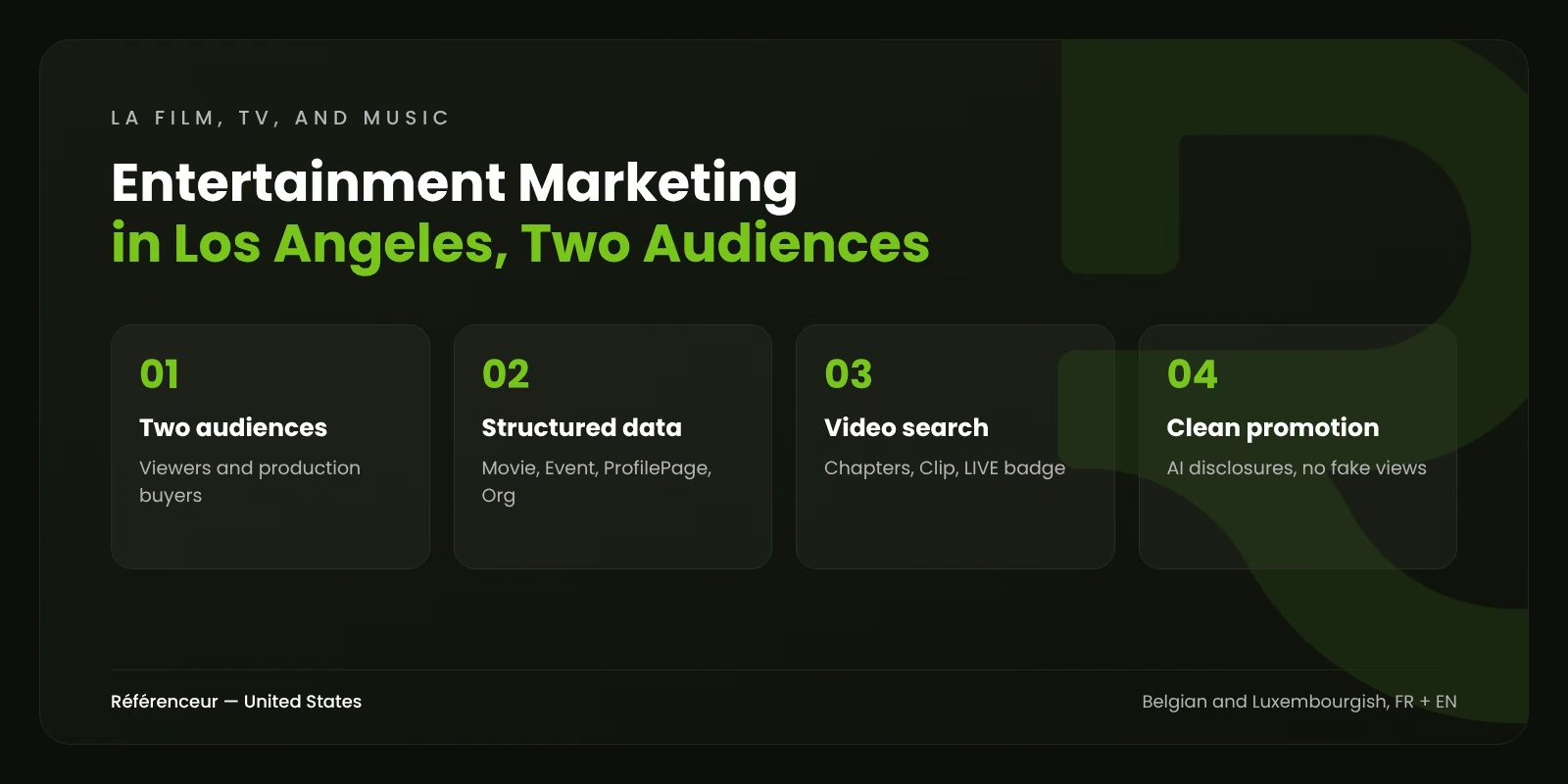
Video Search Beyond the Trailer
For many entertainment brands, YouTube matters as much as Google. Uploading a trailer is not enough, as our guide to video SEO for AI search explains. The video has to be understandable to Google and to viewers searching for specific moments.
Practical steps for an LA studio, network, or creator company:
- Chapters with timestamps in the description. For YouTube-hosted videos, Google can use timestamps and labels in the description to show key moments in Search.
- Video pages on your own site. A page per trailer or featurette, with VideoObject markup including a title, a thumbnail URL, and an upload date, lets your site rank alongside YouTube.
- Clip markup for long content. Panels, interviews, and behind-the-scenes videos can use Clip markup to mark segments with start times and labels.
- Live streams with a LIVE badge. For premieres or Q&A sessions streamed from your site, BroadcastEvent markup and Google’s Indexing API, which supports livestream videos, help Google show the stream while it is live.
Titles, descriptions, and thumbnails should name the work, the cast members who agree to be named, and the format (“official trailer,” “behind the scenes”), because that is what people type.
Bringing a French or European Production to American Audiences
European films and series often reach the U.S. under a different title. That creates a search problem: American viewers search for the English title, critics may use the original, and fans of the director use both.
A sound setup includes:
- One page per title, with the English title as the main heading and the original title stated clearly on the page and as an alternate name in structured data.
- An English-language press page with synopsis, credits, stills, and a contact, so journalists do not rely on a machine translation of the French kit.
- Clear information about versions: subtitled, dubbed, or both, and where each is available.
- Release information by territory, so U.S. viewers do not land on a French release date.
This is where a team that reads the original French press kit, understands its tone, and writes natural U.S. English makes a difference. We can work with the producer in Paris and the U.S. distributor in Los Angeles in their own languages. Our international SEO guide covers the multilingual side.
Media Company SEO Los Angeles Vendors Can Use to Win Bids
Post houses, VFX studios, dubbing studios, and rental companies across Burbank, Hollywood, Culver City, and Santa Monica compete for the same productions, and there are fewer of them to go around than a few years ago:
- FilmLA, the nonprofit that coordinates film permits in the Los Angeles area, counted 19,694 on-location shoot days in 2025, 16.1% fewer than in 2024.
- Bureau of Labor Statistics data show the Los Angeles-Long Beach-Glendale area averaged about 101,100 jobs in motion picture and sound recording in 2025, down from about 149,900 in 2022.
- On July 2, 2025, Gov. Gavin Newsom signed Assembly Bill 1138, raising California’s film and television tax credit program, run by the California Film Commission, from $330 million to $750 million a year.
Incentive-backed projects that come back to California still need vendors, and their producers search with precise needs, often on a tight deadline. Media company SEO that Los Angeles vendors can rely on starts with pages that answer those needs:
- Service pages by task, such as color grading, ADR, foley, subtitling, or dailies, each with the equipment and workflow involved.
- Credits pages with titles you are allowed to name, the work done, and stills when cleared.
- Equipment and stage pages with specs, dimensions, and how to check availability.
- A clear booking or bid request form that asks for dates, format, and budget range.
Paid search on Google Ads can support this, but specialized vendor terms have modest volume. A film marketing agency LA producers trust should say so plainly and spend where the buyers are, which is often LinkedIn and industry directories. Our social media team for Los Angeles handles LinkedIn and Instagram for both studio and vendor accounts.
AI Performers, Fake Views, and the Rules Around Them
Two recent rules affect how entertainment companies promote their work, including campaigns produced in LA but shown nationally.
New York’s synthetic performer disclosure law (S.8420-A/A.8887-B), signed on December 11, 2025, took effect on June 9, 2026. Advertisers who know that an ad includes a synthetic performer (a digitally created human likeness) must disclose it conspicuously. Ads for expressive works such as films, series, and video games are exempt when the synthetic performer is used consistently with the underlying work. Audio ads are exempt as well. A trailer showing a digital character from the film itself may therefore be treated differently from a brand ad using an AI-generated spokesperson.
The FTC’s rule on reviews and testimonials, in force since October 21, 2024, also bans buying or selling fake social media indicators, such as fake followers or views, when they misrepresent influence for a commercial purpose. Buying views to make a trailer look popular puts you in risky territory.
These are summaries for planning purposes, not legal advice. Check with your attorney before a campaign goes live.
We would work with an LA entertainment company the way we work with clients in Europe: remote by default, with scheduled video calls, shared screens during reviews, and monthly reporting. Our Belgian and Luxembourgish roots, with French and English used side by side every day, are an asset when a project crosses the Atlantic. Get a Free Assessment of your title pages, vendor pages, or video setup, and we’ll point out the first fixes.
Frequently Asked Questions About Entertainment Marketing in Los Angeles
Can a Film Get a Knowledge Panel Before It Is Released?
It can happen, but Google decides when and how. A knowledge panel usually appears once Google has consistent, reliable information about a title from several sources.
You can help by publishing a dedicated title page with Movie markup, consistent credits and dates across your site, press materials, and official profiles, and links from the distributor and the cast’s official pages. No agency can promise a panel, and you should be wary of anyone who does.
Should a Post-Production House Show Work Still Under NDA?
No. Use what you can share: the type of project, the workflow, the equipment, and the timeline, without naming the title or showing frames.
Once the title is released and the client agrees, the page can be updated with credits and stills. Keep a list of pending updates so those pages do not stay vague forever.
Is It Worth Buying Views to Launch a Trailer?
Buying fake views is a bad idea, both because of the FTC rule on fake social media indicators and because inflated numbers do not create real interest.
Paid promotion through YouTube’s own ad formats is a different thing. It places the trailer in front of real viewers, and the results are reported in your own Google Ads account. If you want to see how a launch budget could be split, request a free assessment.
Do Podcasts Need Their Own Website?
It helps. A site with one page per episode, a summary, guests, and a transcript gives search engines text to index that an audio file alone cannot provide.
It also gives you a place to collect email addresses and present sponsors, independent of any one listening app.
Can You Coordinate With a Distributor or Sales Agent in Paris?
Yes. Our team works in French every day, so we can discuss positioning, titles, and materials directly with French producers, distributors, or sales agents, then adapt everything for U.S. audiences in English.
Approvals move faster when both sides read the same document in their own language. Contact us to describe the project and who is involved on each side.