 0498 70 98 60
European Expansion Marketing for US Startups: France, Belgium, Luxembourg, and Beyond
European expansion marketing for US startups usually starts with a slide that says “EU” and a budget line that assumes one launch. Then the team learns that Paris, Brussels, Luxembourg City, Geneva, and Montreal read the same language in different ways, follow different rules, and buy on different calendars. This page is for Silicon Valley founders who want a first European market that pays back, then a route into the other French-speaking ones.
Référenceur has its roots in Belgium and Luxembourg, where French is spoken at the office, at the bank, and in the shops. Our people write natively in both French and English, and for more than 15 years we have marketed services and products to francophone buyers from Francorchamps and Wemperhardt. With no American office, we run projects for California companies remotely, through video meetings, screen sharing, and a monthly written report.
The French-Speaking Market Is Bigger Than France
Most founders picture France and stop there. In its 2026 report, the OIF, the intergovernmental body of French-speaking countries, estimates that there were about 396 million French speakers in 2025. Roughly 65% of them live in Africa.
Closer to your first deals, the map looks like this:
- France is the largest single market, with local competition in almost every software category.
- Belgium splits into French-speaking Wallonia, Dutch-speaking Flanders, and bilingual Brussels, home to EU institutions and many European headquarters.
- Luxembourg is small but dense with finance, logistics, and EU-facing holding companies, and French is an everyday business language there.
- In Switzerland, about 23% of residents speak French, according to 2023 figures from the Federal Statistical Office reported by Swissinfo, mostly in the western cantons around Geneva and Lausanne.
- In Quebec, about 6.5 million people speak French most often at home, per the 2021 Canadian census as reported by CBC News.
One language, five rulebooks. So the first decision is which country goes first.
Choosing a Pilot Country
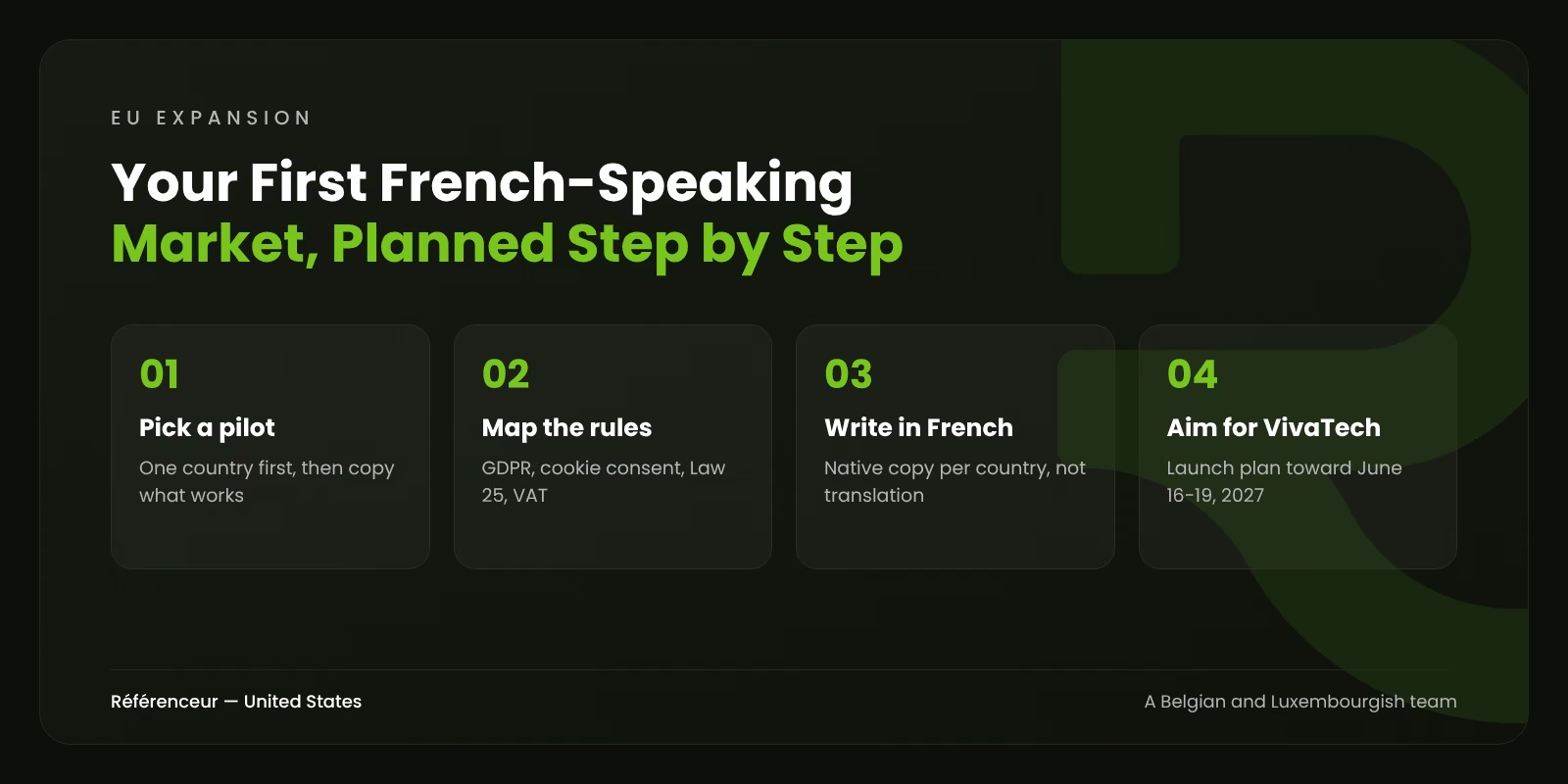
Pick one pilot, prove the funnel there, then copy what worked. For a U.S. software company, the options compare roughly like this:
| Market | Why it can work as a pilot | What to plan for |
|---|---|---|
| France | Largest audience, deep talent pool, strong startup scene in Paris | Crowded categories, French-only expectations in ads and product copy |
| Belgium | Bilingual buyers, EU institutions in Brussels, compact market to test | Separate French and Dutch messaging; no single national campaign |
| Luxembourg | Small, international, decision-makers who are easy to reach | Too small to prove volume on its own; better as a base than a test bed |
| Switzerland (Romandy) | High purchasing power, demanding buyers | Prices in Swiss francs, a non-EU market with its own privacy law |
| Quebec | Same time zone as New York, North American buying habits | French-first rules for commercial advertising under the Charter of the French Language |
A practical pattern for many SaaS companies: start with France and French-speaking Belgium together, using one French copy base adapted per country, and keep Luxembourg and Switzerland as targeted extensions once the offer converts.
The Rules That Change Your Marketing Stack
Your U.S. stack won’t travel as is. These rules most often reshape a launch plan. Read them as questions for your lawyers, not as legal advice.
- GDPR reaches non-EU companies. Under Article 3(2), the regulation can apply to a company with no EU establishment that targets people in the EU with goods or services or monitors their behavior. EU regulators cite behavioral advertising and cookie tracking as examples of monitoring. Article 27 may also require you to appoint a representative in the EU.
- Cookie consent is opt-in. Under the ePrivacy rules, non-essential cookies need prior consent. France’s regulator, the CNIL, fined Google €150 million and Facebook €60 million on December 31, 2021, because refusing cookies took more steps than accepting them.
- Google ties ad features to consent. Google’s EU user consent policy requires you to collect consent from users in the European Economic Area and pass those signals to Google before using ad personalization and measurement. Consent mode is the usual way to send them.
- Quebec has its own default. Section 8.1 of Quebec’s private-sector privacy law, in force since September 22, 2023, under Law 25, requires you to inform people beforehand about technology that can identify, locate, or profile them, and about the means to activate those functions. Law firms read this as “off by default” for non-essential tracking.
- Accessibility applies to consumer services. The European Accessibility Act (Directive (EU) 2019/882) has applied since June 28, 2025, to services such as ecommerce, including those offered by non-EU companies to EU consumers. Microenterprises that provide services, meaning fewer than 10 employees and no more than €2 million in annual turnover or balance sheet total, are exempt.
- VAT follows the customer. If you sell digital services to EU consumers and have no EU establishment, the non-Union One Stop Shop has let you register in one member state and file one return since July 1, 2021, charging each customer’s local VAT rate.
The marketing consequence: you will measure less, so measure better. We set up consent-aware tracking in Google Analytics 4 and Google Ads before launch; our Google Ads conversion tracking guide shows how to keep a usable signal when visitors decline cookies.
Belgium and Luxembourg as Your Base in Europe
If your target buyers speak French, a U.S. company expanding to Belgium and Luxembourg gets two things at once: an EU address and daily contact with francophone customers, partners, and staff.
Both countries court foreign investors. Luxembourg Trade & Invest advises companies opening offices in the country, and its network includes an office in New York as well as the Bay Area, so your first meeting can happen without a flight. In Wallonia, that job falls to AWEX, now presented as the Wallonia Export & Investment Agency, a public agency created in 2004 to promote exports and attract foreign investment. Incorporation, tax, and subsidies are questions for those agencies and your advisers. We cover the marketing side: how a Liège IT manager or a Luxembourg CFO actually searches and decides.
Native French Copy, Not Translated English
Translated SaaS copy fails quietly: headlines run long, the tone reads like a manual, and keywords match what Americans type, not what French buyers search. If you want to launch a startup in France, plan for copy written in French from a brief, not converted from English.
Language rules make this more than a style choice. France’s Toubon law reaches beyond advertising: according to France’s Ministry of Culture, it also covers how products and services are described and offered, online stores included. In Quebec, rules under the Charter of the French Language tightened again when a 2024 regulation took effect: less room for English-only trademarks on signs and a requirement to add French terms, such as a generic term, next to them, according to a DLA Piper summary. Local counsel should confirm how both apply to you.
In practice, our writers adapt:
- Typography: France puts a space before colons, question marks, and exclamation points; Quebec style usually keeps it only before the colon.
- Vocabulary: a Quebec buyer asks for a “soumission” where a French buyer asks for a “devis,” and an invitation to “dîner” means lunch in Brussels, Geneva, or Montreal but dinner in Paris.
- Proof: French buyers look for European references, data hosting details, and named contacts.
- Search terms: we run keyword research in French for each country. Our page on French SEO for SaaS goes deeper, and our international SEO guide covers site structure and hreflang.
A 12-Month Launch Calendar Built Around VivaTech 2027
A fixed event makes a good deadline. VivaTech, the Paris tech show, reported more than 200,000 visitors in 2026, and the organizers have set June 16 to 19, 2027 at Paris Expo Porte de Versailles for the next edition. Starting this fall gives you a realistic runway:
- November to January: pick the pilot country, run French keyword and competitor research, and map consent, privacy, and VAT questions for your advisers.
- February to March: write native French landing pages for the pilot, set up consent mode and GA4, and decide your currency and invoicing display.
- April to May: launch search campaigns with modest budgets, test offers, and collect the first French-language case material you are allowed to publish. For campaign structure by country, read about Google Ads in French-speaking markets.
- June: use VivaTech for meetings, then retarget visitors who consented and follow up with French-language content.
- July to October: expand to the second market, add LinkedIn and partner content, and review cost per qualified opportunity by country.
The U.S. side of your growth plan is covered on our Silicon Valley digital marketing agency page.
Working From California With a Team in Belgium and Luxembourg
Paris and Brussels sit nine hours ahead of Palo Alto for most of the year. Used well, the gap helps: your 8 a.m. is our 5 p.m., so a short daily overlap covers decisions, and work you request before signing off is often done by your next morning. Shared documents and dashboards carry the rest.
Where we come from is the point. Our Belgian and Luxembourgish team thinks in French, reads the CNIL’s guidance in the original, and switches to English for your board update. Everything we do for francophone audiences is summarized on our francophone marketing page.
Get a Free Assessment: tell us which market you’re considering, and we’ll review your current site, offer, and tracking setup to suggest the pilot that fits.
Frequently Asked Questions About European Expansion Marketing
Do We Need a European Entity Before We Start Marketing in France?
Not always for marketing itself. A U.S. company can often test French campaigns and sell from its U.S. entity before opening an office. The real questions are legal and tax ones, such as an EU representative under Article 27 of the GDPR and VAT registration. Your attorney and tax adviser should answer those before launch; we don’t give legal advice.
Should Our First European Website Be in English or French?
French, for any page that asks a buyer in France, Wallonia, or Quebec to act. An English site can carry a first conversation with Luxembourg’s international executives, but elsewhere it signals a vendor that hasn’t committed to the market yet. If you keep both, give each language its own URLs so neither version hides the other.
How Much Does Cookie Consent Reduce What We Can Measure?
It depends on your banner, audience, and industry, so distrust any single figure. Plan for gaps in remarketing lists and session data, use consent mode so Google can model some conversions, and import qualified leads from your CRM so bidding learns from outcomes rather than from cookies.
Is Quebec a Good Stepping Stone Before Europe?
It can be, since Quebec shares North American business habits. But Quebec French, Quebec’s language rules, and Law 25 are distinct, so treat it as its own market rather than a rehearsal for France.
Can You Work Alongside Our Growth Team in the Bay Area?
Yes. You keep strategy and ownership of the ad accounts; we take on French research, copy, campaign builds, and reporting for the francophone markets. To compare notes on your plan, request a free assessment or book a free video call.