 0498 70 98 60
French SEO for SaaS: Rank With Buyers in France, Belgium, Switzerland, and Quebec
French SEO for SaaS is less about translating your marketing site than about rebuilding the path a French-speaking buyer takes from a search to a trial. That path runs through pricing in the right currency, help articles in the right language, review sites in the right country, and, since July 2026, Google’s AI summaries in French. A U.S. software company that only localizes its homepage usually sees French impressions climb and French sign-ups stay flat.
Our team at Référenceur works from Belgium and Luxembourg, in Francorchamps and Wemperhardt, and writes native French alongside fluent English. We’ve done SEO and paid search for more than 15 years, and we read French search results the way your buyers do: as locals. U.S. product and growth teams work with us remotely, through video calls, shared documents, and a monthly report.
Why Translated Keywords Miss French Software Buyers
Running your English keyword list through a translation tool produces terms that are correct and often unsearched. French-language SEO for software companies starts from French results pages instead, country by country.
A few patterns show up in almost every SaaS project we scope:
- Anglicisms differ by market. Buyers in France often keep English product terms such as “CRM,” “onboarding,” or “chatbot,” while Quebec usage leans toward French equivalents such as “clavardage” for chat and “agent conversationnel” for a chatbot. One French page can’t target both well.
- Category words compete. “Logiciel,” “outil,” “plateforme,” and “solution” attract different searchers. In our experience, “logiciel” tends to draw buyers comparing products, while “outil” more often draws people hoping for something free.
- Intent modifiers are French, not translated. Searchers add “avis” (reviews), “comparatif” (comparison), “tarif” (pricing), “gratuit” (free), or “alternative à” to category terms. Your comparison and pricing pages should answer those exact formulations.
- Competitors change at the border. The top results for the same category in France, Belgium, and Quebec often include local vendors you’ve never met in the U.S. Your content plan has to answer them, not your American rivals.
What to Localize First on a SaaS Site
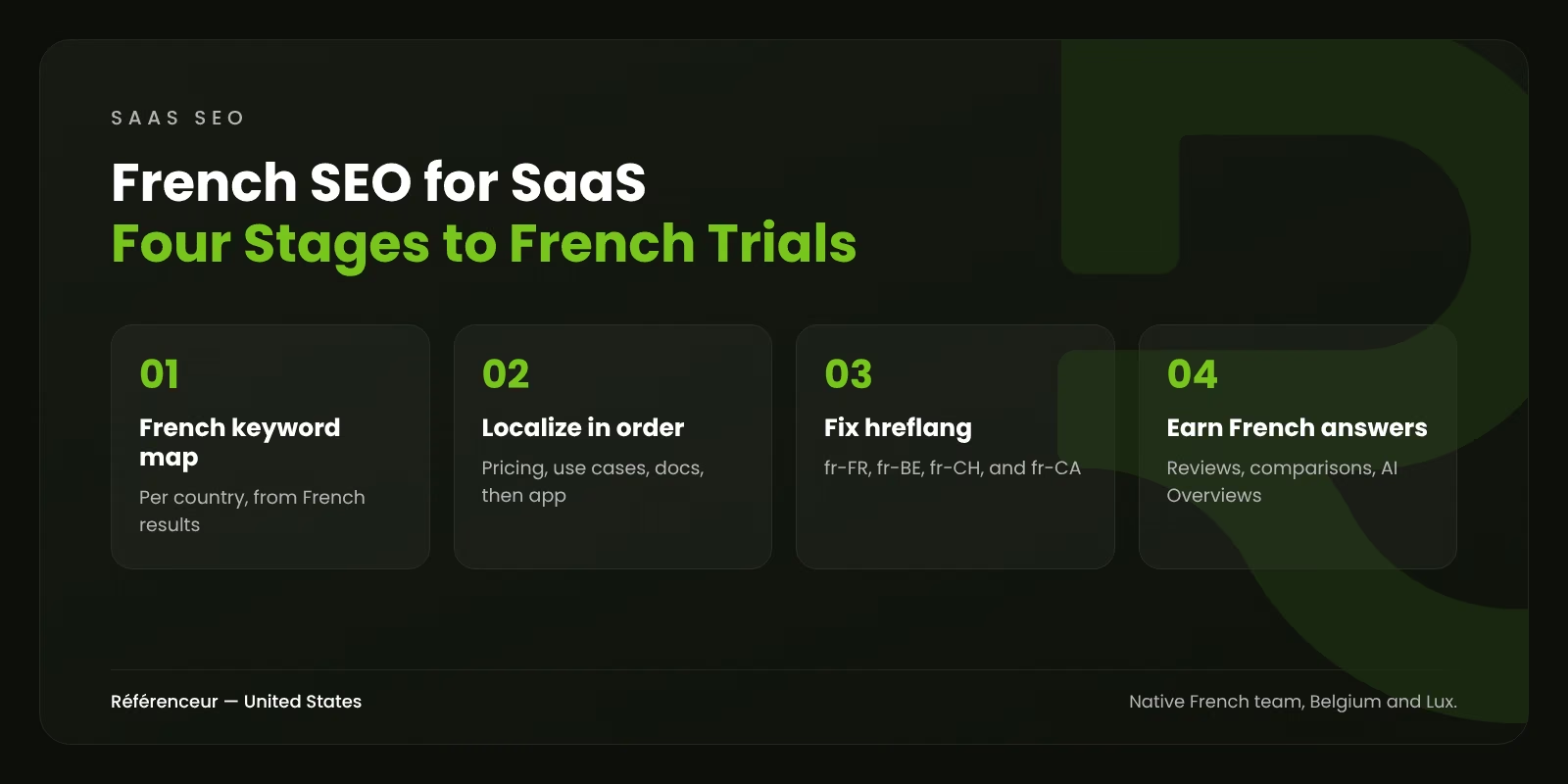
Translating everything at once is slow and expensive. SaaS localization in French works better in a fixed order, starting with pages that drive trials and ending with the product itself:
- Pricing. Separate prices in euros, Swiss francs, and Canadian dollars. French B2B buyers are used to seeing prices before tax, marked “HT,” so state clearly whether VAT or sales tax applies.
- Top use-case and feature pages. The five to ten pages that already bring U.S. trials, rewritten for French search terms rather than translated line by line.
- Comparison and alternative pages. Built against the local competitors you found in research, written fairly and accurately.
- Integrations directory. French buyers check whether you connect to the accounting, payroll, or CRM tools common in their country.
- Help center and documentation. Start with the 20 articles that get the most views, since they rank for long “how to” searches in French.
- Sign-up flow, app interface, and terms. For Quebec, the Charter of the French Language requires software to be available in French whenever a French version exists, on terms no less favorable than other versions. Since June 1, 2023, contracts of adhesion, such as standard terms of service, must also be given to the customer in French before a version in another language can bind them. This isn’t legal advice; check with Quebec counsel.
Site Architecture for Product, Docs, and Help Center
Most SaaS sites aren’t one site. Marketing pages, documentation, the help center, the blog, and the app often live on different platforms, and each one needs a French plan.
| Asset | Setup we usually recommend | What to watch in French |
|---|---|---|
| Marketing site | Subfolders on your main domain, such as /fr-fr/, /fr-be/, /fr-ch/, and /fr-ca/ | Pricing, legal pages, and phone numbers change per country |
| Documentation | A /fr/ path on your docs subdomain, linked to the English pages with hreflang | Code samples stay in English; explanations, headings, and alt text go French |
| Help center | Check that your help desk platform supports localized URLs and hreflang before you translate | Search inside the help center must work in French too |
| Blog | Country-specific articles instead of a full mirror of the English blog | Local examples, regulations, and events |
| Web app | Keep logged-in screens out of the index; localize the login and sign-up pages | Error messages and emails in the user’s language |
For the hreflang layer, Google’s help page on localized versions (updated in September 2026) is the reference, and one line in it matters most for SaaS: alternate URLs don’t need to sit on the same domain, so a docs subdomain and the main site can reference each other. Our international SEO guide covers the structure choices in more depth.
A warning on shortcuts: Google’s spam policies, last updated August 28, 2026, list automated translation among the techniques that can turn mass-produced pages into scaled content abuse when they add little value for users. Machine-translated docs published by the thousand are a risk. Reviewed, useful docs are not.
Trust Signals French Buyers Check Before a Demo
French-speaking buyers research vendors the way American ones do, with local sources. Your SEO plan should cover the pages that rank for your brand, not just your own site.
Review platforms by country. Capterra runs a French edition for France and a separate French-language edition for Belgium, alongside its other country sites. Reviews written in French on those pages often rank for “[your brand] avis,” so asking French-speaking customers for reviews is part of SEO, not only of customer marketing.
Hosting and data protection. French and Belgian procurement teams ask where data is hosted and who can access it, and they expect a GDPR data processing agreement. For the French public sector, the bar is higher: the SREN Act of May 2024 enshrines the “cloud at the center” doctrine for sensitive government data, and ANSSI’s SecNumCloud qualification, in its 3.2 version, requires hosting in France or the EU and majority European ownership of the operator. If that’s your market, a clear French page on hosting and certifications answers questions before sales has to.
Tracking in Quebec. Since September 2023, Quebec’s Law 25 has required companies to disclose, before use, any feature able to identify, locate, or profile a user, along with the means to activate it, and Canadian legal commentary reads the provision as making such features opt-in. Product analytics in a Quebec-facing app needs the same review as your website’s cookie banner. This isn’t legal advice; check with your counsel.
French AI Answers Now Shape the Shortlist
French searchers waited roughly two years longer than Americans: Google’s AI summaries and AI Mode only reached France in summer 2026, once a compromise on publishers’ neighboring rights was reached. Software buyers in France can now get an AI summary above the links when they search for the best tool in a category, and that summary is built from French-language pages.
In our experience, three kinds of French content get pulled into those answers most easily: plain-language definitions of what your product category does, comparison tables with honest criteria, and documentation that explains specific tasks step by step. The same pages help when a buyer asks ChatGPT, Gemini, or Microsoft Copilot in French. On the Google side, our summary of Google’s guide to AI Overviews and AI Mode lists what matters. For a broader plan across assistants, see our work on AI search optimization in French.
Pairing French SEO With Paid Search
French SEO takes months to compound. Google Ads can test French keywords and landing pages in weeks, so we often run a small campaign per country to confirm which terms convert into trials before committing a content budget. The approach mirrors how we manage Google Ads for SaaS companies: bidding toward qualified pipeline, not form fills, with separate campaigns for France, Belgium, Switzerland, and Canada.
Why a French-Speaking Team From Belgium and Luxembourg
Nobody on our team is based in the U.S., and every case study we publish involves a European company. What we offer a software team in California or anywhere else in the country is French that doesn’t need a second reviewer, and SEO that treats each French-speaking country as its own market. We’re a Google Partner and also partner with Microsoft Advertising, HubSpot, and Semrush, and our 107 Google reviews average 4.7/5.
If your company is in the Bay Area, our Silicon Valley digital marketing page shows how French markets fit next to your U.S. growth plan, and our French-language marketing agency page covers every channel in French. To find out which French market your product is closest to winning, request a free assessment; a native French speaker from our office in Belgium or Luxembourg will run it.
Frequently Asked Questions About French SEO for SaaS
Should We Translate Our Docs Before Our Marketing Site?
Usually not all of them. Start with pricing and your strongest use-case pages, then the most-viewed help articles. Docs often bring steady long-tail traffic in French, but buyers need a French reason to sign up first.
Should We Translate Our Product’s Feature Names?
Keep brand-level names, such as your product name and trademarked modules, in their original form. Translate descriptive feature names when French buyers search for the function, for example a reporting or scheduling feature. We check the search data before deciding each case.
How Do We Measure French SEO if Most Sign-Ups Happen in the App?
Pass the landing page language and country into your sign-up event, then into your CRM. That lets us report trials and paid conversions by French market, not just sessions. Where consent rules reduce tracking, we show the measured share alongside the totals.
Do Euro, Swiss Franc, and Canadian Dollar Pricing Pages Need Separate URLs?
Yes, if the prices differ. Each currency version should have its own URL and hreflang annotation, so Google can show the right one in each country. A currency switcher on a single URL hides those versions from search.
What Do You Need From Us to Start?
Read access to Search Console, GA4 or your product analytics, and your help desk platform, plus a list of the countries where you already have customers. If you have French-speaking customers, their contact details for review requests help too. You can share access details before our first call.