 0498 70 98 60
AI Search Optimization in French: Get Named When Francophone Buyers Ask AI
AI search optimization in French starts from a simple observation: when a buyer in Toulouse, Brussels, Geneva, Montreal, or Dakar asks an assistant a question in French, the answer is assembled from French-language sources. Your English pages, however strong, are rarely what gets quoted. If no credible French page, review, or article describes what you sell, the assistant names someone who has one.
Based in Belgium and Luxembourg, Référenceur is a natively French-speaking agency: French is the language our team thinks and writes in, with English as its second working language. We test French prompts the way a Belgian buyer or a Quebec shopper actually types them, and we can tell when an answer sounds like it came from Paris, Montreal, or a translation tool. None of us is based in the U.S., so the collaboration happens over video, on shared screens, and through a report you receive every month.
French-Speaking Buyers Already Ask AI Before They Ask You
The audience is larger than most U.S. teams assume. In its 2026 report on the French language, the Organisation internationale de la Francophonie (OIF) counts hundreds of millions of French speakers, spread across Europe and North America and, above all, Africa.
Those buyers have moved to AI quickly:
- In France, 48% of people aged 12 and over used generative AI, up 15 percentage points in a year, according to the 2026 Baromètre du numérique published by the regulator Arcep on February 9, 2026 (CREDOC survey, June 2025). Among users, 73% rely on it to search for information.
- In Quebec, 52% of internet users had used a generative AI tool, up 19 percentage points, according to the NETendances survey from Université Laval’s Académie de la transformation numérique, released March 19, 2026. Among those users, 84% use ChatGPT, 29% Microsoft Copilot, and 22% Gemini.
ChatGPT visibility in French is now part of the first impression for many of your French-speaking prospects.
Five Engines, Five Ways of Answering in French
Each assistant reaches French content through a different route. Here is what we check first on each one.
| Engine | What matters for French-language answers | What we look at |
|---|---|---|
| Google AI Overviews and AI Mode | Google began rolling both out in France on July 22, 2026, after a two-year delay tied to French neighboring-rights rules for press content. Publishers there can withdraw their content from AI Overviews without a ranking penalty. | Which French pages Google pulls in as supporting links, and whether yours are indexed and eligible for a snippet |
| ChatGPT | The most used assistant among Quebec AI users (84%), per NETendances 2026 | How it describes your brand in French, and which French sites it cites when it searches the web |
| Microsoft Copilot | Built into Windows and Microsoft 365, so it often shows up in work settings; used by 29% of Quebec AI users | B2B prompts typed at work, and how your listings and pages read in Bing |
| Gemini | Used by 22% of Quebec AI users; can draw on Google Search | Consistency between your French site, your Google Business Profile, and what Gemini repeats |
| Le Chat by Mistral AI | A French assistant with a licensing deal, announced January 16, 2025, giving it access to AFP’s news archive back to 1983 | Whether your company appears in French press coverage that this kind of assistant can draw on |
Perplexity belongs in the test set too. The same question in French often surfaces different sources than in English, so we measure each engine separately.
What French-Language Answers Draw On
An assistant answering in French leans on material written in French: press, trade directories, comparison sites, forums, review platforms, and French-language Wikipedia. For a U.S. company, that list is the to-do list.
According to Google’s documentation for site owners (updated December 10, 2025), AI Overviews and AI Mode add no technical hurdles of their own. Any indexed page that can show a snippet in Search qualifies, and Google says no AI-specific files or special schema are needed. The work is mostly editorial. Our summary of Google’s guidance on AI Overviews and AI Mode covers those basics in more detail.
Picture a Colorado maker of avalanche safety gear that wants to sell to ski patrols in the Alps and retailers in Quebec. In English, it shows up in buying guides. In French, it barely exists: no French product pages, no mentions in French outdoor magazines, no listing with French-speaking distributors. Ask an assistant in French for “le meilleur détecteur de victimes d’avalanche pour un pisteur” and the answer will name brands that have a French paper trail. Closing that gap takes three things:
- French pages that answer the questions buyers ask, product by product
- French-language entity signals: a consistent company name, a French “about” page, French descriptions on directories and marketplaces, and the same facts everywhere
- Mentions in French media, associations, and partner sites, which our article on why brand mentions matter for SEO and AI search explains
Writing French That an Assistant Can Quote
There is no single “French” for AI search. Vocabulary, spelling of numbers, and even search habits change across the Francophone world, and assistants mirror the words of the sources they cite.
- Vocabulary: sneakers are “baskets” to a shopper in France and “espadrilles” to one in Quebec, so a page written for one market can miss the other’s question.
- Numbers: Belgium and Switzerland say “septante” for seventy where France says “soixante-dix.”
- Formats: French uses a decimal comma and a space before the euro sign (“49,90 €”), while Quebec prices are in Canadian dollars, written “49,90 $”.
- Question style: French buyers often ask “quel est le meilleur…,” “combien coûte…,” or “est-ce que… vaut le coup.” We write headings and short answers that match those phrasings, so a passage can be lifted cleanly.
We also keep facts quotable: dates, specs, certifications, and delivery zones in plain sentences, not buried in images or PDFs. Our French SEO agency page explains how we handle the organic side of that work.
How We Measure AI Visibility in French Prompts
Rankings alone won’t tell you whether you appear in French answers. We build a tracking routine you can read in a monthly report.
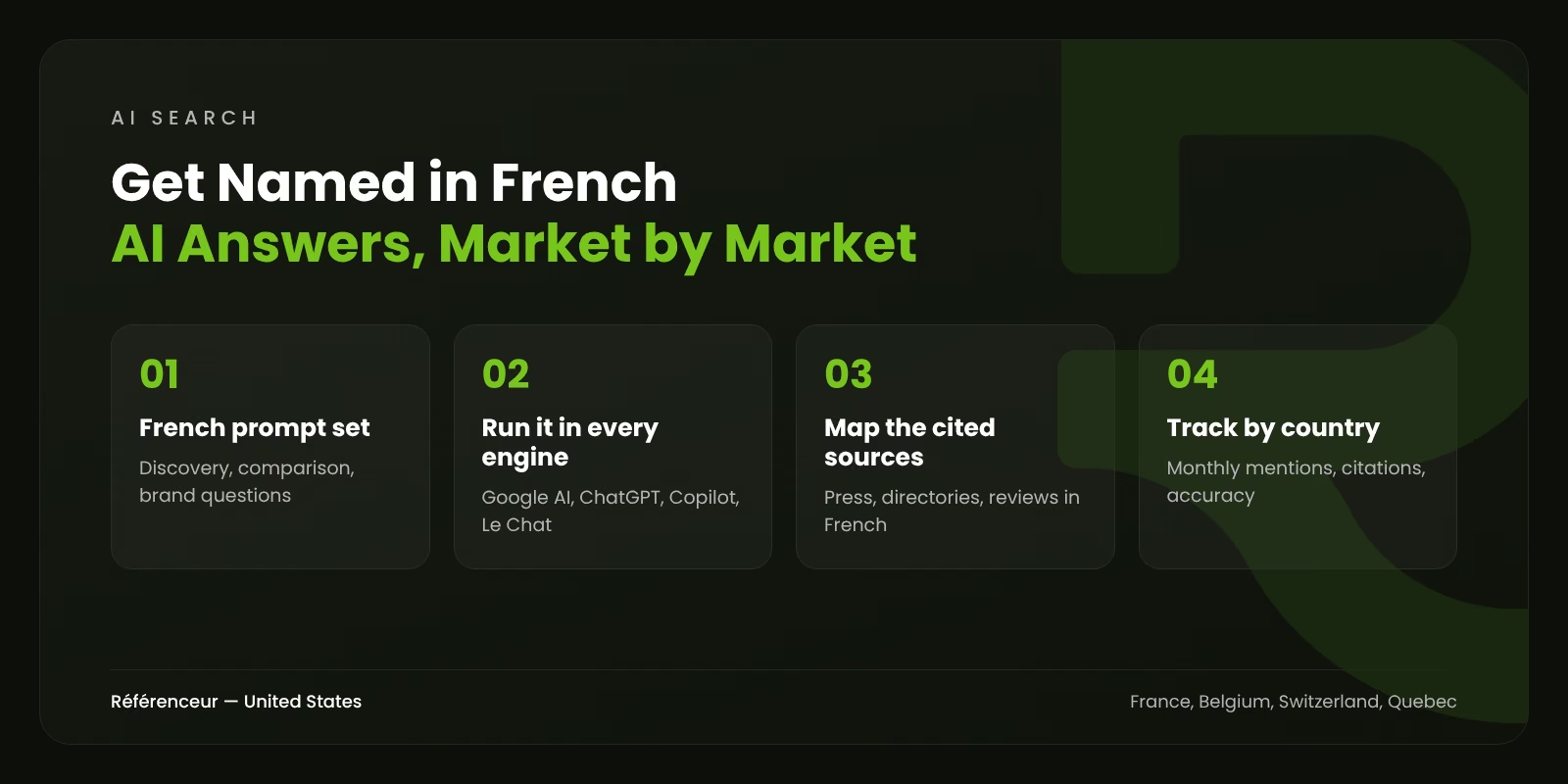
- Draft a prompt set in French for each target market, with 30 to 60 questions split by funnel stage: discovery (“quels fournisseurs…”), comparison (“X ou Y pour…”), and brand (“avis sur…”).
- Run the prompts in each engine, from the right country settings where the tool allows it, and save the full answers.
- Score every answer: is your brand named, linked, described correctly, and positioned against which competitors?
- List the French sources each engine cites, and turn the most frequent ones into targets for content, listings, or outreach.
- Track AI Overviews and AI Mode traffic in Google Search Console, where Google includes it in the Performance report under the “Web” search type, filtered by country.
- Repeat monthly, and compare France, Belgium, Switzerland, Quebec, and any African market separately.
This is how GEO for French-speaking markets becomes something you can manage: a defined prompt set, a citation list, and a trend line per country.
A Francophone Team From Belgium and Luxembourg on Your Side
Many agencies would have to outsource the French. We don’t. Our people work in Francorchamps, in French-speaking Belgium, and in Wemperhardt, Luxembourg, where French sits alongside Luxembourgish and German, so spotting a Paris turn of phrase, a Quebec term, or a machine-translated sentence takes us seconds. Behind that ear: more than 15 years of experience in SEO and paid search, 107 Google reviews with a 4.7/5 average, and partnerships with Semrush, HubSpot, Microsoft Advertising, and Google.
AI search work in French connects with other services. Our marketing for French-speaking markets page covers the full channel mix, and our AI search optimization (GEO) service explains the method we apply in every language. If you want paid visibility inside assistants as well, read our guide to ChatGPT Ads before planning a French test.
We start with a snapshot: 20 French prompts in your category, run across the main engines, with the sources they cite and where your brand stands. Request a free assessment, and we’ll present the findings over video, early in your morning or late in our afternoon.
Frequently Asked Questions About AI Search Optimization in French
Do AI Assistants Give Different Answers in French Than in English?
Often, yes. When an assistant searches the web to answer a French question, it tends to retrieve French-language pages, so the brands it names depend on who has French content and French coverage. A company that dominates English answers can be absent from the French version of the same question.
That’s why we never infer French visibility from English tests.
Should Our Quebec Pages Be Separate From Our France Pages?
For many B2B companies, one well-written international French version is a sensible start, especially if Quebec is not a priority. For consumer brands, or when Quebec matters, a separate Canadian French version usually pays off: prices, vocabulary, delivery terms, and legal notices differ.
We decide market by market. You can ask us for a free assessment of your current French content before choosing.
Will Machine-Translated Pages Be Cited in French AI Answers?
They can be indexed, but they rarely become the source an assistant quotes. Raw machine translation misses local terms, keeps U.S. formats, and adds nothing French competitors don’t already say.
A practical compromise: use machine translation for a first draft of low-stakes pages, then have a native editor rewrite the pages that carry buying decisions, such as product, pricing, comparison, and FAQ pages.
What Changed When Google Launched AI Overviews in France?
Until July 2026, France was one of the few markets where Google did not show AI Overviews. Since the rollout began that month, French users see AI summaries and can use AI Mode, so some French searches now show an answer before anyone clicks.
For U.S. companies, the takeaway is that French pages now need to be quotable, not just rankable. Google says the usual SEO basics apply, and AI Overviews traffic is reported in Search Console under the “Web” search type.
How Long Before French Prompts Start Mentioning Our Brand?
It depends on where you start. Fixing French pages and entity details can show up in assistants that search the web live within weeks of being indexed. Earning French press and directory mentions usually takes several months, and it varies by engine.
We set a baseline in the first month, then report changes by engine and by country every month, so you can see what moves and what doesn’t. To get that baseline, contact our team.