 0498 70 98 60
Real Estate Marketing NYC: Own the Buyer Relationship, Not Just the Listing
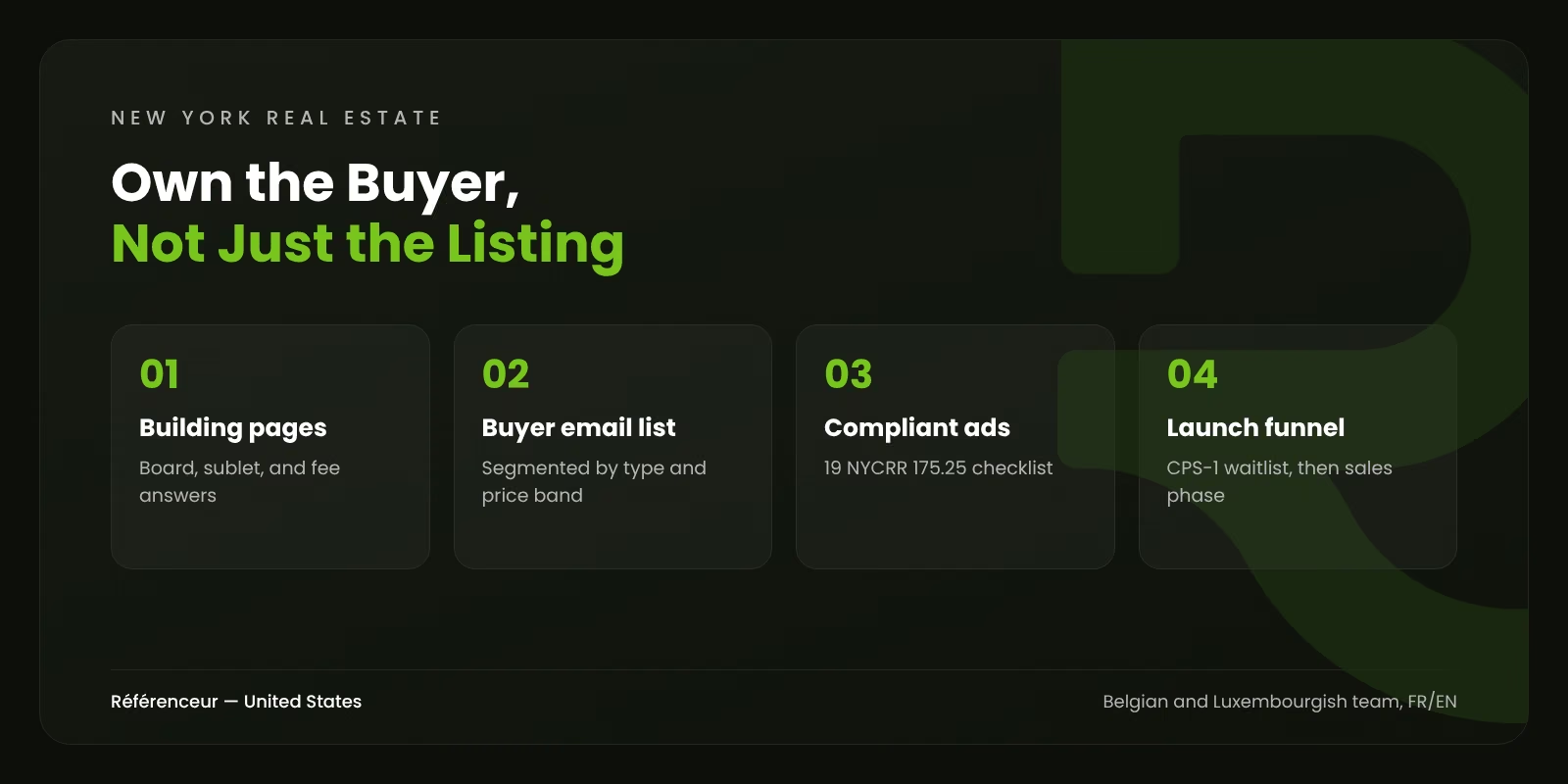
In New York, the same apartment can appear on StreetEasy, the national portals, and dozens of brokerage websites, each page showing identical photos and the same floor plan. None of those pages tells a buyer why they should call you rather than the next agent. Real estate marketing NYC brokerages and agents can build on starts with that gap: assets a portal can’t copy, such as building-level pages, a list of qualified buyers who know your name, and ad copy that holds up under New York’s own rules.
Référenceur is a Belgian and Luxembourgish agency where French is a working language as much as English, which matters in Manhattan more than people expect. A Brussels family shopping for a pied-à-terre and a Wall Street compliance officer read the same listing with different questions, and we write for both. We have no New York office: we work with brokerages over video calls and screen shares, with a written report each month.
Portals Rent You Buyers. Your Own Channels Keep Them
A portal is designed to keep the buyer on the portal. When a deal closes, the saved searches, the alerts, and the next inquiry stay there.
REBNY adds a timing rule that shapes any launch plan. Under its Universal Co-Brokerage Agreement, a member must enter an exclusive listing on the Residential Listing Service (RLS) at the earlier of two moments: when the listing is first publicly disseminated, or when it is first shown to a buyer. REBNY counts a brokerage or agent website, social media, and third-party search portals as public dissemination. In practice, a “coming soon” teaser on Instagram can start that clock, so teaser campaigns need to be scheduled with the RLS entry in mind. Check the current agreement with your broker of record.
What you can own, regardless of where the listing syndicates:
- A buyer and seller email list, segmented by property type (co-op, condo, new development, rental) and price band, so a new exclusive reaches warm contacts on launch day.
- Building pages for the addresses you know well, with the details buyers ask about and portals rarely explain.
- Quarterly market notes on the submarkets you actually work, written in your voice and published on your site first.
- A search presence for your own name. People who meet you at an open house search your name next; they should land on your site and reviews.
Rentals After the FARE Act: A New Pitch on Both Sides
The Fairness in Apartment Rental Expenses (FARE) Act, Local Law 119 of 2024, took effect on June 11, 2025. According to the city’s Department of Consumer and Worker Protection (DCWP), brokers who represent landlords can no longer charge broker fees to tenants, landlords can’t require tenants to hire a broker, and every fee a prospective tenant must pay has to be disclosed in listings. Tenants can still hire and pay their own broker. DCWP enforces the law through the Office of Administrative Trials and Hearings, and tenants can also sue in civil court.
The law changed who the paying client is. A leasing brokerage now has to sell its value to owners: how fast units lease, what a vacant month costs, and how listings are produced and distributed. That calls for owner-facing pages and an email marketing program aimed at property managers rather than renters.
Tenant-side agents face the opposite task. They need a plain page explaining what a renter pays for, when, and why hiring a broker can still make sense in a tight market. On the operations side, every syndicated rental listing template should be checked so fee fields are complete and consistent everywhere the listing appears. Your counsel should confirm how the law applies to your listings; this page isn’t legal advice.
Co-ops, Condos, and Real Estate SEO New York Buyers Actually Use
Neighborhood guides are standard advice, and our page on SEO for real estate explains how they work. New York adds a layer most markets don’t have: the building. Buyers search for a building’s name or address, its sublet policy, whether it allows pied-à-terre ownership, and what its board expects. Published once as clear pages, the answers agents give by email every week become search entry points.
The co-op and condo split changes what those pages need to say. Co-op buyers purchase shares in a corporation and must win board approval; condo buyers acquire real property, usually with a lighter approval process. Cash matters too. In 2025, 64% of Manhattan co-op and condo buyers paid cash, a record share, according to New York Times figures reported by Habitat magazine in January 2026. Content written for mortgage shoppers misses most of that audience.
| Buyer question | Co-op listing page | Condo listing page |
|---|---|---|
| Can I buy it? | Board approval process, typical package contents, interview stage | Right of first refusal, if the building has one |
| What do I pay monthly? | Maintenance, and what it includes | Common charges plus separately billed real estate taxes |
| Can I rent it out? | Sublet policy and its limits | Leasing rules set by the condo board |
| How do I prove funds? | Financial statement and post-closing liquidity the board may request | Proof of funds or loan approval |
Building pages also create technical work: thousands of addresses, duplicate unit pages, and expired listings, all items on our technical SEO audit checklist. Our SEO agency in New York handles that structure so the right pages get crawled.
Luxury Real Estate Marketing NYC Starts Before the Offering Plan
New development marketing in New York runs under the Martin Act, and the Attorney General’s office controls what a sponsor can say before an offering plan is accepted for filing. Its Cooperative Policy Statement 1 (CPS-1), in a version effective November 5, 2025, sets the rules for testing the market:
- Market testing can begin only after the sponsor receives written correspondence from the Department of Law accepting the CPS-1 application, which stays effective for 12 months.
- Each ad must be submitted at least five business days before use and can’t run until the Department says it has no objection.
- Ads must carry the legend “This advertisement is not an offering. It is a solicitation of interest in the advertised property,” along with the registration number and the sponsor’s name and address.
- If a price or cost is shown as an estimate, the word “estimated” must follow it in the same size and type, claims must be substantiated, and ads can’t urge readers to rush to buy.
- No reservations or deposits, binding or not, can be accepted until the plan is accepted.
That shapes the funnel for a luxury launch. The early phase is a waitlist landing page, renderings labeled correctly, and an email sequence that builds interest without promising units. The sales phase starts the day the plan is accepted, so the price sheets, reservation flow, and paid campaigns should be drafted and approved in advance. The sponsor’s counsel signs off on every word.
New York’s Advertising Rules, Applied to Every Channel
New York’s real estate advertising regulation, 19 NYCRR 175.25, was amended effective November 2, 2020, and the Department of State’s guidance applies it to websites, social media, apps, and email. Before any campaign launches, we run copy through a checklist built on that guidance:
- The sponsoring brokerage’s name or logo appears on every ad, post, and profile.
- Each licensee’s full licensed name and correct license title appear; nicknames are allowed only alongside the full name.
- Team names include the word “team,” never “group,” and are followed by “at” or “of” the brokerage name when members’ names aren’t in the team name.
- A salesperson’s first email to a prospect identifies the brokerage.
- Paid placements on third-party platforms are labeled as advertisements and tied to the specific licensee.
- Another broker’s exclusive is advertised only with consent and with the listing broker clearly named.
- Photos are used only with the owner’s permission.
- Where a platform limits characters, disclosures go in a threaded message or on a linked page; a bare “click here for more information” link isn’t enough.
Your broker of record has the final word, and none of this is legal advice.
Reaching Overseas Buyers, Including French Speakers
The National Association of Realtors reported in July 2025 that foreign buyers purchased 78,100 existing U.S. homes between April 2024 and March 2025. New York drew 7% of them, and 47% of all foreign buyers paid cash, compared with 28% of all buyers.
Picture a Belgian couple looking for a two-bedroom in Brooklyn Heights for their daughter’s graduate years. They don’t know what a board package is, they assume a condo and a co-op are the same thing, and they’re reading your site at 7 a.m. their time. A French-language page that explains co-op versus condo, closing costs, and the role of a buyer’s attorney answers them before a competitor does. Our international SEO guide explains how to structure those language versions. The same family may also be comparing Florida; our page on real estate marketing in Miami covers that market’s very different rules.
This is where our background helps. Our French-speaking team, split between offices in Belgium and Luxembourg, writes the French version a Lyon buyer trusts and the English version a Park Avenue board expects, then tracks which one produces the inquiry. For broader site work, see our bilingual French-English website design or our digital marketing agency in New York. Have a launch, a rental portfolio, or a team brand to build? Request a free assessment, and we’ll start with whichever channel sits closest to revenue.
Frequently Asked Questions About Real Estate Marketing in New York City
Can We Tease a New Exclusive on Instagram Before It Hits the RLS?
Under REBNY’s Universal Co-Brokerage Agreement, posting on social media counts as public dissemination, which triggers the obligation to enter the listing on the RLS. Plan teasers and RLS entry together, and confirm the current wording with your broker of record or REBNY.
Should Rental Listings Still Advertise “No Fee”?
Since June 11, 2025, landlord-side brokers can’t charge tenants a broker fee in New York City, so the label carries less weight than it did. What matters now is the complete disclosure of every fee a tenant must pay. We review templates for that, and your counsel confirms the details.
Is a Page for Every Building Worth the Effort?
Not for every building. Start with the 10 to 20 addresses where you close most often or hold the most knowledge. Request a free assessment, and we’ll identify which buildings already draw searches.
How Do You Market a Co-op Without Promising Board Approval?
Describe the process, not the outcome. Explain what the board typically asks for, how long reviews usually take, and how you prepare buyers. Avoid language implying that approval is likely or assured; the board’s decision belongs to the board.
Can You Write Listing Copy in French for Buyers in Europe?
Yes. French and English are both native languages on our team, so we can produce French listing summaries, building guides, and email sequences for buyers in France, Belgium, Switzerland, or Quebec, with the English version kept as the compliance reference. Tell us about your listings and the buyers you’d like to reach.