 0498 70 98 60
Buyers still hire agents. The National Association of Realtors’ 2025 Profile of Home Buyers and Sellers found that 88% of buyers purchased through an agent or broker. The question is which agent. Long before they sign anything, buyers and sellers search for neighborhoods, school districts, market trends, and “what is my home worth.” The agents and brokerages that answer those searches build relationships before the competition knows the client exists.
Référenceur’s real estate SEO work helps agents, teams, and brokerages rank for the local searches that lead to listings and buyer clients. The team behind it has practiced SEO for more than 15 years from Europe, earned a 4.7/5 score on 107 Google reviews, and works with U.S. businesses remotely. Get a free assessment to learn which local searches in your market are realistically within reach.
The IDX Problem: Why Most Real Estate Sites Struggle to Rank
Most agent websites run on an IDX feed that pulls listings from the MLS. That’s essential for visitors, but it creates an SEO problem: the same listing descriptions appear on hundreds of other sites, including the major portals with enormous authority. Your listing pages are rarely going to outrank them.
What you can own is everything the portals do poorly:
- Neighborhood and community guides written from real local knowledge: housing styles, commute patterns, parks, what sells quickly and what sits.
- Market reports for your specific towns or ZIP codes, updated monthly or quarterly with your own analysis.
- Seller content: how pricing works in your market, how long homes typically take to sell, and what to fix before listing.
- Agent pages with real credentials, transaction experience you choose to publish, languages spoken, and reviews.
Good IDX website SEO also means technical care: making sure thousands of expired listing URLs don’t drown your important pages, keeping site speed acceptable despite heavy photo galleries, and controlling which filtered search pages Google can index. Our technical SEO audit checklist lists the checks.
What Our Real Estate SEO Services Cover
| Focus | What we do | Benefit for your business |
|---|---|---|
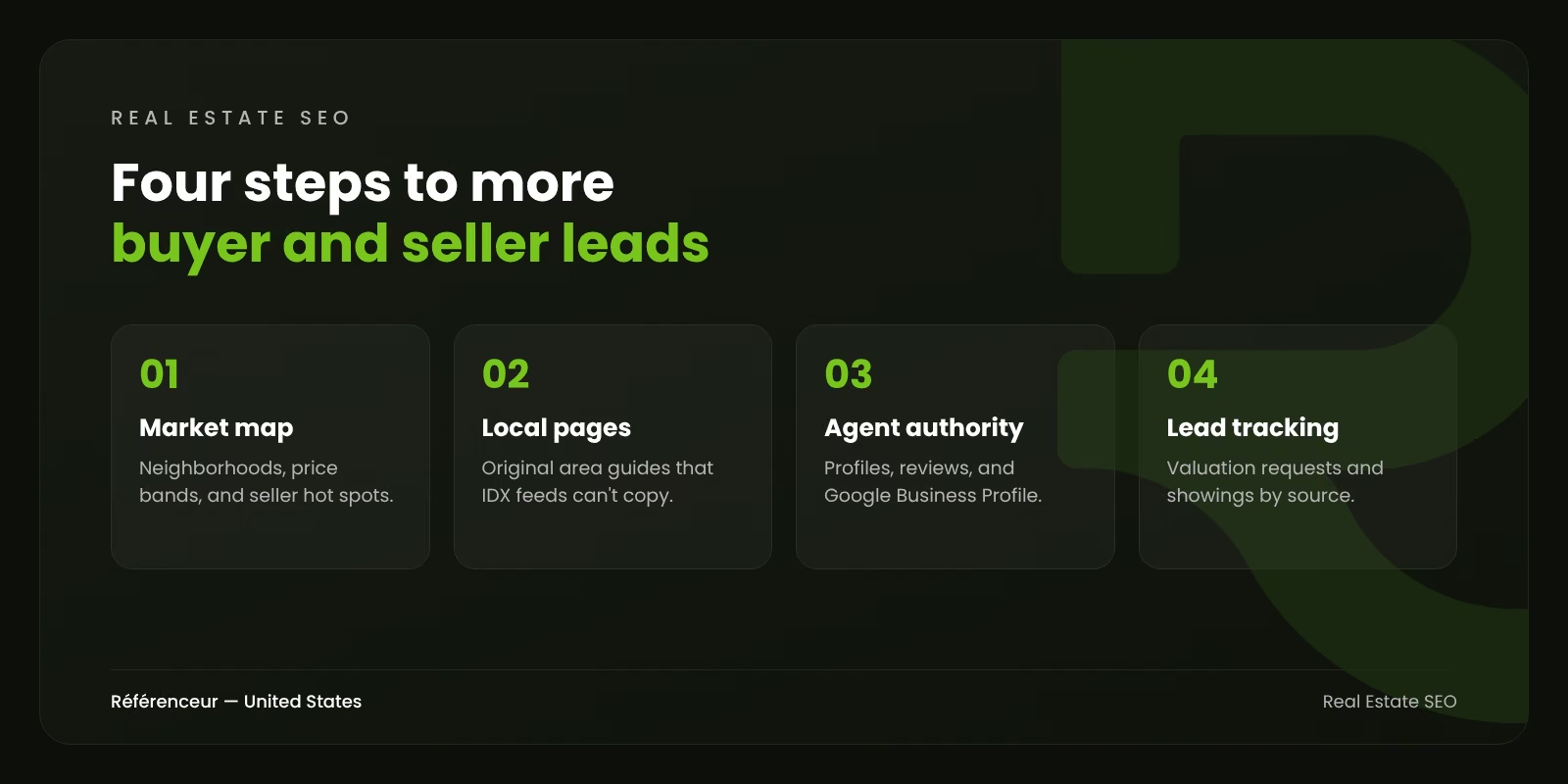
| Neighborhood architecture | A page for each community you actively serve, with original text, photos, and links to live listings | Ranks for “homes for sale in [neighborhood]” and area research queries |
| Seller lead pages | Home valuation pages, selling guides, and market updates | Captures the seller searches that turn into listings |
| Google Business Profile | Profile for the brokerage and, where allowed, individual agents, with reviews and posts | Visibility in map results for “real estate agent near me” |
| Technical SEO | IDX indexing rules, speed, mobile layout, schema markup for agents and the brokerage | Your best pages get crawled and ranked first |
| Content calendar | Monthly market commentary, buyer and seller guides, relocation content | Fresh signals and reasons for past clients to come back |
| Tracking | Valuation requests, showing requests, calls, and form leads by page | Clear view of which content generates business |
SEO for Real Estate Agents vs. Brokerage SEO
An individual agent and a 200-agent brokerage need different strategies. SEO for real estate agents usually centers on a personal brand and a few neighborhoods: the agent who becomes the obvious local expert for two or three communities. Real estate brokerage SEO is more structural. It requires a scalable site architecture, consistent agent profiles, office location pages, and rules that prevent agents from publishing duplicate or competing content.
We adapt the plan to your setup, including team websites that sit inside a larger franchise or brokerage platform where your control over the technical side may be limited.
Video and Visual Content for Local Search
Buyers relocating from another state often research neighborhoods long before they visit. Short neighborhood video tours, published on YouTube and embedded in your area guides, answer questions that text can’t: what the streets feel like, how close the shops are, what typical homes look like. Well-titled videos with accurate descriptions can appear in Google’s video results and give your neighborhood pages a clear advantage over portals that only list properties. Our guide to video SEO for AI search covers titles, transcripts, and markup.
Fair Housing: Content That Stays Within the Rules
Real estate marketing in the U.S. operates under the federal Fair Housing Act, which prohibits discrimination in housing, including in advertising, based on race, color, religion, sex, disability, familial status, and national origin. Many states and cities add more protected classes. This affects how neighborhood content is written: describe homes, amenities, and distances, not the kind of people who “belong” somewhere.
We write neighborhood guides with that discipline. We describe what’s there, such as parks, transit, and housing types, and we link to official school district sites rather than characterizing schools ourselves. On the paid side, Google restricts targeting for housing ads in the U.S. and Canada: advertisers can’t target or exclude by age, gender, parental status, marital status, or ZIP code. Our Google Ads agency team builds campaigns that respect those limits. None of this is legal advice; your broker and counsel remain the authority on compliance.
How We Work With Agents and Brokerages
Because Référenceur has no American office, collaboration runs on video calls, shared documents, and a clear monthly report. Our offices in Belgium and Luxembourg open roughly six hours before East Coast brokerages do.
- A discovery call to identify your target neighborhoods, price ranges, and the balance you want between buyer and seller leads.
- An audit of your site, IDX configuration, Google Business Profile, and the agents ranking ahead of you.
- A content plan built around your local expertise, with interviews to capture what only you know.
- Pages written in native U.S. English and published on a steady schedule.
- Monthly reporting on rankings, traffic, and leads, with recommendations.
Our partner programs include Google, Microsoft Advertising, Semrush, and HubSpot. We present our client references, such as Lupulus and Menuiserie Rosen, as what they are: European businesses, not U.S. agents. Read more about our SEO agency approach or browse our U.S. locations.
For agents who work with French-speaking buyers, such as Canadian snowbirds in Florida or international relocations in New York and Los Angeles, we can add French-language pages that make those clients feel understood. See our page on real estate marketing in Miami for an example. Get a free assessment and start from an accurate picture of your local market.
Frequently Asked Questions About Real Estate SEO
Can My Site Outrank Zillow or Realtor.com?
For broad searches like “homes for sale in [big city],” rarely. For specific neighborhood, condo building, or market-analysis searches, a focused local site can absolutely compete. That’s where we concentrate effort.
Does IDX Hurt My SEO?
IDX itself isn’t harmful, but duplicate listing content and huge numbers of thin URLs can dilute your site. Configuring which IDX pages are indexed, and surrounding them with original neighborhood content, solves most of the problem.
How Long Does Real Estate SEO Take?
Neighborhood pages in a less competitive area can start ranking within a few months. Competitive metros take longer, often six to 12 months for meaningful results. We won’t promise a ranking, but we’ll show monthly progress.
Should Each Agent Have Their Own Website?
It depends on your brokerage’s policy and goals. Often, a strong agent profile on the brokerage site, plus a Google Business Profile where permitted, works better than many small separate sites. We’ll recommend the structure that fits your situation.
What Content Generates Seller Leads?
Home valuation pages, local market reports, and practical selling guides perform well because they match what homeowners research before choosing an agent. Request a free assessment to see which seller searches in your area are worth targeting.