 0498 70 98 60
Ecommerce SEO Agency NYC: Product Pages That Win New York Shoppers
Picking an ecommerce SEO agency that NYC brands can trust comes down to one question: will the agency fix what a New York shopper actually checks before paying? That means the price Google displays, the delivery date, who pays import duties, the size chart, and whether the product page answers those questions without a support ticket. Rankings follow when those pages are right.
Référenceur works out of Belgium and Luxembourg as a French-speaking team whose writers are just as native in English. That mix is useful for two kinds of New York stores: homegrown direct-to-consumer brands that want cleaner product data, and European labels whose catalog was built for Paris, Brussels, or Luxembourg and now has to read as if it were written in Brooklyn.
What a New Yorker Looks for Before Buying From a Brand They Don’t Know
New York shoppers have every option within a subway ride or a two-day delivery window. A product page from an unfamiliar brand gets a few seconds to remove doubt. In our audits, these are the points we check first, because each one maps to a search query or a Google field:
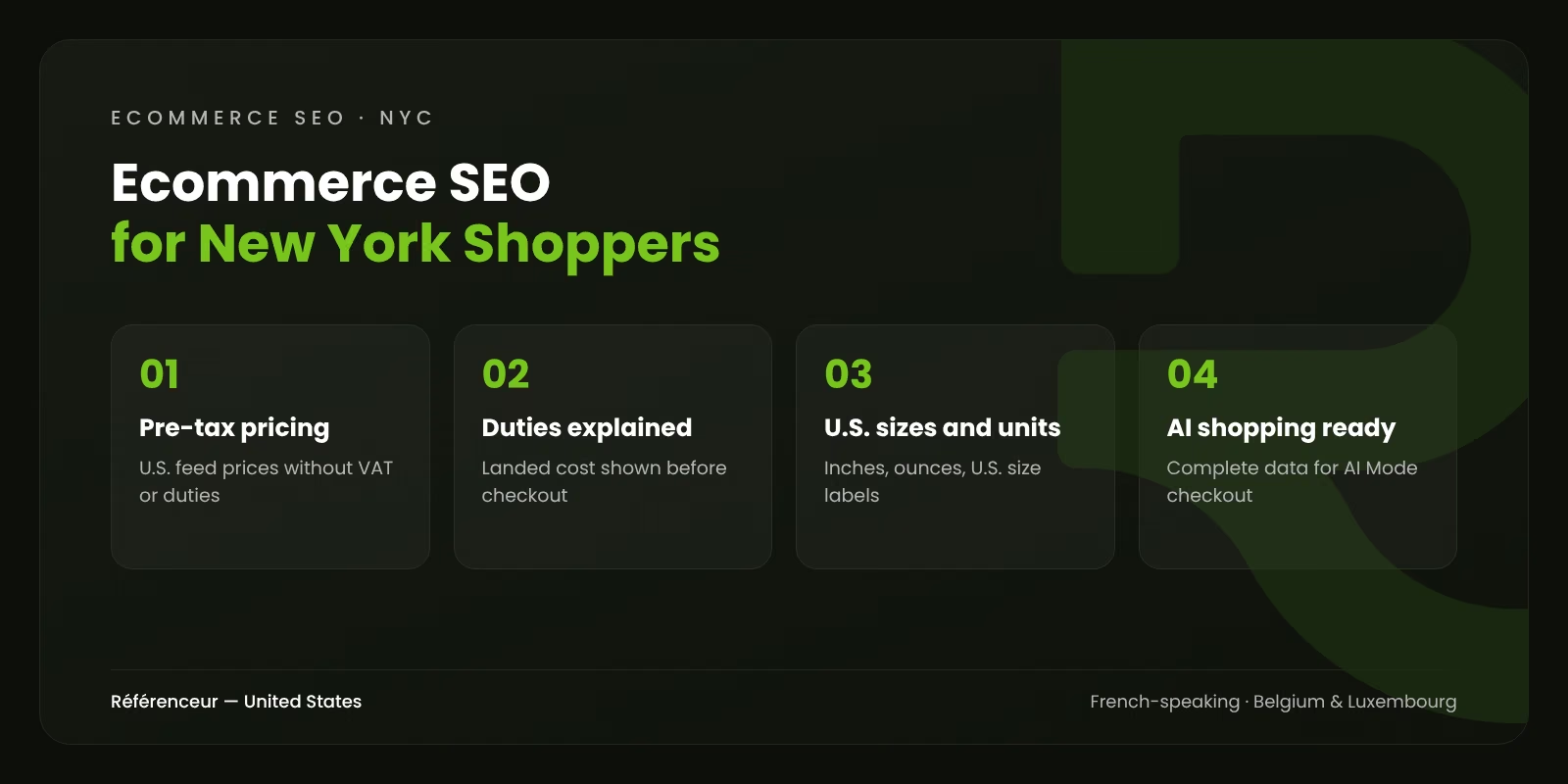
- A price that matches the search result. If Google shows one number and the page shows another, shoppers leave and Merchant Center can flag the item.
- A delivery estimate with a date, not “ships internationally.”
- Duties and taxes explained on the page, not discovered at the door.
- U.S. sizes and units: inches, pounds, ounces, and U.S. size labels.
- A returns policy written for the U.S., including who pays return shipping across the Atlantic.
- Origin and materials, stated plainly.
Most stores entering New York lose their first organic visitors on exactly these points.
Sales Tax, Duties, and the Price Google Displays
New York City’s combined sales tax rate is 8.875%: 4% for the state, 4.5% for the city, and a 0.375% Metropolitan Commuter Transportation District surcharge, according to NYC 311. In the city, apparel and shoes selling for less than $110 an item are exempt. For an apparel brand, that threshold can shape how you present a product line, and it is worth reflecting accurately in your FAQ and checkout copy.
Google handles tax differently in the U.S. than in Europe. Its Merchant Center price specification tells merchants targeting the United States and Canada not to include sales tax, VAT, or import tax in the price attribute; tax is configured separately. A European store that exports VAT-inclusive prices into a U.S. feed creates mismatches from day one.
Two more points matter for brands shipping from abroad:
- Remote seller nexus. New York requires out-of-state sellers to register for sales tax once their sales of goods delivered into the state exceed $500,000 and they have made more than 100 sales over the prior four sales tax quarters, per guidance summarized by the Sales Tax Institute.
- Duties on every parcel. U.S. Customs and Border Protection suspended duty-free de minimis treatment for low-value shipments from all countries on August 29, 2025, and a February 2026 executive order kept that suspension in place. Shoppers now ask, “Are duties included?” The answer belongs on the product page and in your shipping settings.
This is not legal or tax advice; check with your accountant or counsel. Our job is to make sure whatever your advisers decide is shown consistently on the page, in structured data, and in the feed.
Rewriting a European Catalog for U.S. Search
A translated catalog is not a localized one. Search vocabulary, units, and labeling rules all change when a product crosses the Atlantic. Here is how we adapt the fields that influence visibility.
| Field | Typical European version | U.S.-ready version | Why it matters |
|---|---|---|---|
| Product names | Trainers, jumper, gilet | Sneakers, sweater, vest | Matches the words New Yorkers type into Google |
| Sizes | EU 38, FR 40 | U.S. size plus a conversion chart | Google’s size system attribute accepts both U.S. and EU sizing; mixing them confuses filters |
| Measurements | Centimeters, grams | Inches, ounces, pounds | Shoppers search “18 inch tote,” not “45 cm tote” |
| Prices | VAT included | Pre-tax price in U.S. dollars | Required for U.S. Merchant Center listings |
| Origin | Often omitted | “Imported” or “Made in Portugal” | FTC textile rules require origin in catalog and online descriptions |
| Barcodes | EAN-13 | Same GTIN, correctly mapped | Helps Google match your product to the right listing |
The origin line deserves attention. Under 16 CFR 303.34, catalog and promotional descriptions of textile products must say whether the item was made in the USA, imported, or both, and the FTC has treated online stores as catalogs since at least 2001. For fashion and home textile brands, we put that statement in the product description where both shoppers and crawlers can read it.
Shopify SEO in New York: One Store, Markets, or Two Domains?
Most Shopify SEO projects we scope in New York start with a structural decision. Shopify Markets can serve a U.S. version of your store on its own domain, subdomain, or subfolder, and Shopify generates hreflang tags automatically for each market that has one (our international SEO guide covers the options). Since May 2023, new single-country markets no longer get a subfolder by default, so a store can show a U.S. market in its admin while Google still sees a single set of URLs.
Shopify’s own documentation warns that redirecting crawlers based on location would cause them to index only one version of the store. We check that geolocation pop-ups and automatic redirects exclude search engines, that each market has its own URLs, and that U.S. pages carry U.S. prices and copy rather than a currency switch on European text.
On WooCommerce, the same goal usually means a multilingual plugin with separate U.S. English URLs and manually verified hreflang, which our web design agency team can set up.
New York’s Algorithmic Pricing Disclosure and Your Product Templates
Since November 10, 2025, New York’s Algorithmic Pricing Disclosure Act, codified at Section 349-a of the General Business Law, has required businesses that use an algorithm to set a price from a consumer’s personal data to display, on or near that price, a clear and conspicuous notice: “THIS PRICE WAS SET BY AN ALGORITHM USING YOUR PERSONAL DATA.” The New York Attorney General enforces it, and a federal judge in the Southern District of New York dismissed a retail industry challenge to the requirement.
For SEO, the practical question is template design. If your store personalizes prices, the disclosure must render next to the price without breaking the page layout, the Product markup, or the price that Googlebot sees. If you don’t personalize prices, we make sure no app quietly does it for you. Again, this isn’t legal advice; your counsel decides whether the law applies to you.
AI Shopping Was Announced in Manhattan
On January 11, 2026, at the National Retail Federation’s annual show in New York City, Google announced the Universal Commerce Protocol and checkout directly inside AI Mode in Search and the Gemini app, starting with participating U.S. retailers. The shopper asks a question, compares options in the answer, and pays with Google Pay, while the retailer fulfills the order.
For DTC brand SEO in NYC, that raises the bar on product data. An AI assistant can only recommend what it can read (see Google’s guide to AI Mode optimization): complete attributes, accurate stock, clear shipping and return terms, and reviews that mention real use. The work we described above (pre-tax prices, U.S. sizes, origin, delivery dates) is the same work that makes a product eligible for these new surfaces, and it sits at the core of our ecommerce SEO guide.
Launching or Scaling in New York With a Remote Team
We have no office in New York. Our strategists are based in Francorchamps, Belgium, and Wemperhardt, Luxembourg. Video calls land in your morning, which is our afternoon, with shared dashboards and a monthly report in between. For a European brand, that means strategy conversations can happen in French while every product page ships in native U.S. English. For a New York brand, it means an outside team with 15+ years of SEO work across languages and borders.
If your brand sells at the premium end, our page on luxury brand marketing in New York covers flagship and wholesale questions that this page doesn’t. The broader method behind our store work is on our ecommerce SEO agency page, and if you also sell on the West Coast, see how the priorities shift for ecommerce SEO in Los Angeles. Service businesses will find a better fit with our SEO agency in New York, and every channel we run in the city is listed on our New York digital marketing agency page.
Want a French- and English-speaking team from Belgium and Luxembourg to review your catalog before your next New York launch? Get a Free Assessment. We’ll look at your feed, your top category, and five product pages, and tell you what to fix first.
Frequently Asked Questions About Ecommerce SEO in New York
Should Our U.S. Store Use a Subfolder, a Separate Domain, or a Second Shopify Store?
For most brands, a U.S. subfolder or market domain inside one Shopify store is easier to maintain than a second store, because inventory, reviews, and authority stay connected. A separate store makes sense when U.S. pricing, assortment, and fulfillment are run by a different team.
Whichever you choose, each version needs its own crawlable URLs and correct hreflang. We’ll recommend a structure during your free assessment.
Do Product Pages Need to Show New York Sales Tax?
U.S. shoppers expect pre-tax prices on product pages, with tax added at checkout based on the delivery address. A short note such as “sales tax calculated at checkout” reduces surprises. Your tax adviser should confirm when and where you must collect.
Can We Reuse Our European Product Photos and Descriptions?
Photos, usually yes, as long as they show scale clearly for U.S. buyers. Descriptions need rewriting rather than translating: U.S. product vocabulary, imperial units, U.S. sizes, and an origin statement where it applies. We typically start with your 20 to 50 best-selling products and the categories they sit in.
Which Product Categories Should We Launch With in New York?
Start where your margins are healthy, your sizing or specifications are easy to convert, and U.S. search demand already exists for the product type. A focused launch with a few strong category pages usually earns visibility faster than a full catalog with thin pages. We size that demand with U.S. keyword data before you commit.
How Will We Know Whether SEO Is Paying Off in the U.S. Market?
We track non-branded organic sessions and revenue from U.S. visitors separately from your home market, plus Merchant Center free listing clicks and the share of products approved without errors. Early signals are product approvals and impressions; revenue trends take longer and depend on competition. To see what that baseline looks like for your store, request a free assessment.