 0498 70 98 60
Multilingual Website Design Miami: English, Spanish, French, and Beyond
The multilingual website design Miami companies need has little to do with a row of flags above an English site. It starts with a harder question: which languages can your team actually answer in when a customer writes back? A Spanish page that leads to an English-only phone line, or a Haitian Creole page nobody on staff can read, costs you trust instead of earning it.
Référenceur is a French-speaking agency that builds multilingual websites from Belgium and Luxembourg, two countries where several official languages share the same streets, offices, and government forms. Working across languages is the default for us, not a specialty we added. French and English are our own working languages; for Spanish, Portuguese, or Haitian Creole, we set up the structure, the workflow, and the quality checks, and native speakers you approve write or review every page.
Miami’s Language Map Changes From One Neighborhood to the Next
County averages hide the picture you actually sell into. The Miami-Dade Beacon Council reports that about 66% of county residents speak Spanish at home and 54% were born outside the United States, and its own website runs in English, Spanish, Haitian Creole, and Brazilian Portuguese. That last detail says a lot about who does business here.
The 2024 American Community Survey, as published by Data USA for the Census Bureau’s local statistical areas, shows how much the mix shifts:
- In the area that covers Doral, Miami Springs, and the airport, about two-thirds of residents were born abroad, and Venezuela is the most common birthplace.
- Around Miami Beach, Surfside, and Bay Harbor Islands, Spanish leads, but French and Portuguese each account for roughly 2% to 3% of households.
- In the downtown Miami area, Portuguese and Haitian Creole are the most common home languages after Spanish, though each accounts for less than 1% of households, with Cuba, Nicaragua, and Honduras the leading birthplaces.
A medical practice in Little Haiti, a real estate developer selling Brickell condos to Brazilian buyers, and a logistics firm courting Venezuelan importers need three different language plans. If your clients cluster around the airport and the warehouses, our Doral digital marketing page covers that market in more depth.
Choosing Your Languages: A Decision Table
We decide languages page group by page group, based on who reads them and who answers them.
| Language and code | Typical Miami audience | Add it when | Watch for |
|---|---|---|---|
| English (en-US) | Every U.S. buyer, partners, search engines | Always, as the reference version | Writing for Americans, not translating into English |
| Spanish (es-US or es) | Local consumers, Latin American buyers and distributors | Someone on staff can handle Spanish inquiries | Vocabulary that differs between Cuban, Venezuelan, Colombian, and Mexican readers |
| French (fr) | European headquarters, Belgian, French, Swiss, and Quebec clients, some Haitian families | You sell to French speakers or report to a French-speaking parent | European versus Canadian conventions |
| Haitian Creole (ht) | Patients, families, and community services | Your service is local and personal, such as health care, insurance, or education | Uneven machine translation; every page needs a native reviewer |
| Portuguese (pt-BR) | Brazilian buyers, investors, and visitors | Brazil is a sales or investment target | Brazilian and European Portuguese differ noticeably |
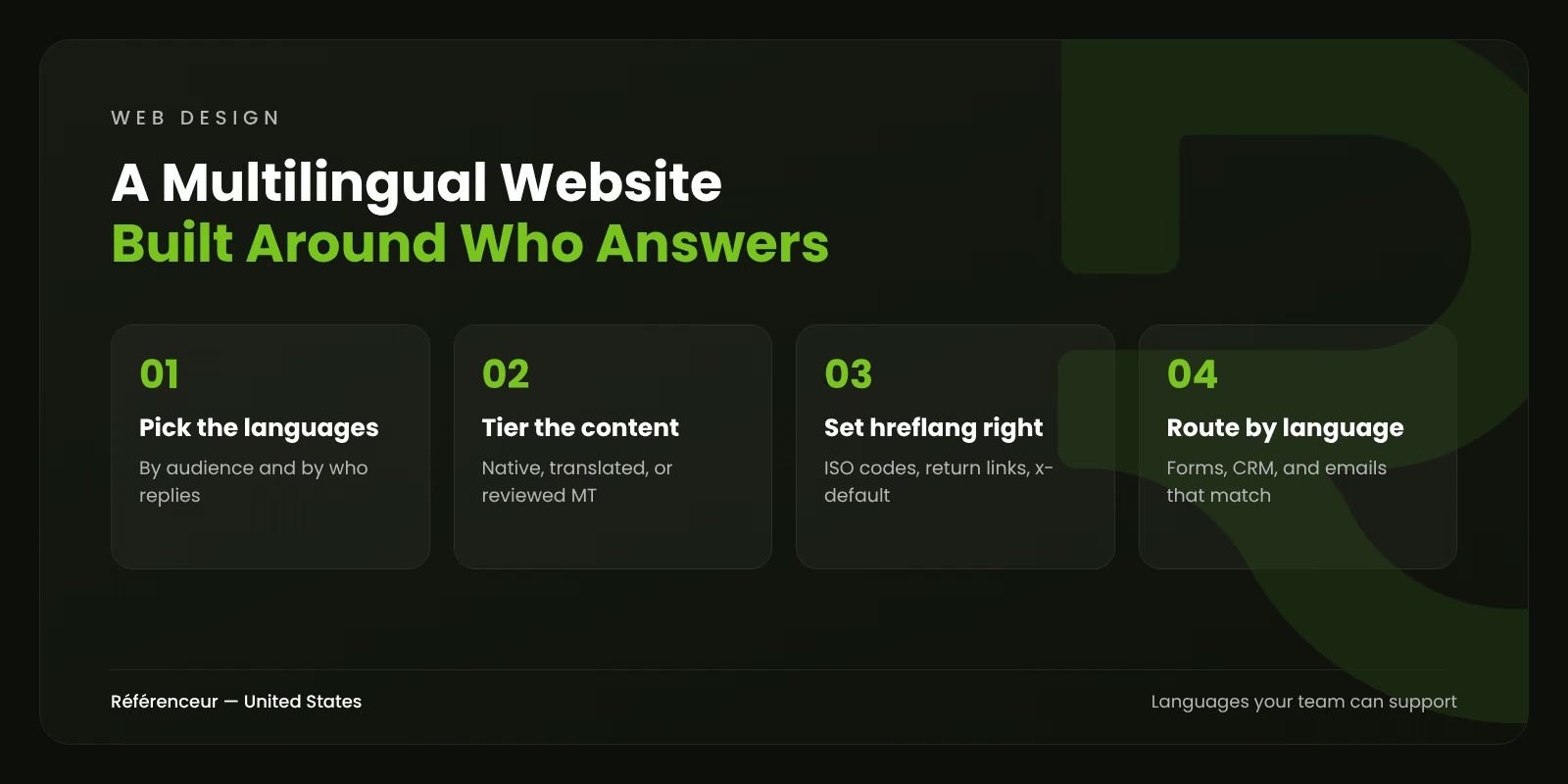
Starting with two languages done well beats launching five done badly. We usually build the architecture for all the languages you may need and publish only the ones you can support.
Translation, Transcreation, and Machine Output: Where Each Fits
Not every page deserves the same budget. Our workflow sorts content into three tiers:
- Written natively. Homepage, key service pages, and calls to action are written directly in each language from a shared brief, so headlines sound local rather than translated.
- Human translation from a glossary. Product pages, FAQs, and long-form content are translated by native speakers working from a term list we build first: your product names, regulated terms, and the words customers actually search.
- Machine draft, human review. Large catalogs or help-center articles can start from machine translation, but a native reviewer approves every page before it goes live.
Legal pages are a separate case. Privacy notices, terms, and disclaimers in a second language should be approved by your attorney, because a translation that changes meaning can create obligations you didn’t intend.
Each language also needs its own search research. A Spanish-speaking customer in Hialeah doesn’t type a literal translation of your English keyword, and a Brazilian investor uses different terms than an investor from Portugal. We research, plan, and track rankings language by language, so the Spanish English website Miami customers find in search is built on real Spanish queries.
Hreflang, URLs, and WordPress Settings for Three to Five Languages
Google’s documentation on localized versions, updated in September 2026, sets a few rules (our international SEO guide covers the strategy behind them) that matter more as languages multiply:
- Language codes follow ISO 639-1, with an optional region. “ht” is valid for Haitian Creole, and “pt-BR” targets Brazilian Portuguese. A country code can’t stand alone: “be” means Belarusian, not Belgium, a mistake a Belgian team spots right away.
- Every version must list itself and all the others. If two pages don’t point to each other, Google ignores the annotations. With five languages, each page carries five entries, or 25 across the set, and all of them must stay in sync.
- An “x-default” version tells Google which page to show visitors whose language you don’t cover, usually English or a language chooser.
On the WordPress sites our web design agency builds, we typically use WPML or Polylang, depending on the plugins already on the site. The details that break most often are the strings outside the main content: form labels, error messages, cookie banners, menu items, WooCommerce emails, and image alt text. We translate them all and test each language as a visitor would.
Forms, CRM Routing, and Accessibility by Language
A multilingual site only pays off if the reply comes back in the right language. We set up:
- Separate thank-you pages per language, so Google Analytics 4 reports conversions by audience.
- A hidden language field on every form, passed to your CRM (we’re a HubSpot partner), so Spanish inquiries reach a Spanish speaker automatically.
- Confirmation emails and appointment reminders in the language the visitor used.
- Phone numbers and business hours stated per language, especially when only some staff speak Creole or Portuguese.
Accessibility needs attention too. The Web Content Accessibility Guidelines ask you to declare the language of each page (success criterion 3.1.1) and of passages in another language (3.1.2), so screen readers switch pronunciation. Language switchers should show each language in its own name, such as Español, Kreyòl ayisyen, and Português, rather than country flags, since a flag stands for a country, not a language. Our website accessibility guide covers the rest of WCAG.
Why a Team From Belgium and Luxembourg Builds Multilingual Sites by Default
We don’t have a Miami office. Our designers and writers are in Francorchamps, Belgium, and Wemperhardt, Luxembourg, and every project runs on video calls, shared staging sites, and a monthly report. What we bring is habit. Multilingual sites are routine in our home markets, and as a French-speaking team we write French and English ourselves. For a French Spanish English website serving a European subsidiary and its Miami customers, that covers two of the three languages without a middleman.
We hold partner status with Google, HubSpot, Semrush, and Microsoft Advertising, and clients have rated us 4.7/5 in 107 Google reviews. Our references, such as Menuiserie Rosen, are European clients. Our web design agency in Miami page explains the overall build process, the Miami digital marketing hub covers ads and SEO, and our bilingual French-English website design service focuses on two-language sites. For European groups planning a regional base, see European companies expanding to Miami. Share your current site and target audiences, then get a free assessment with a language plan to match.
Frequently Asked Questions About Multilingual Websites in Miami
How Many Languages Should a Miami Business Start With?
Usually two: English plus the language most of your customers prefer, which in Miami is often Spanish. Add a third once you can answer inquiries in it and you see demand in search data or sales conversations.
Should Our Spanish Pages Use One Country’s Vocabulary?
Aim for clear, neutral Spanish that any Spanish-speaking reader understands, then adjust key terms if your customers come mainly from one country. Food, construction, and automotive vocabulary vary the most, so check those with someone from your main audience.
Can We Add Haitian Creole or Portuguese Later Without Rebuilding?
Yes, if the site was planned for it. We set up URL structure, hreflang, templates, and form routing so a new language becomes a content project, not a redesign.
Will Machine-Translated Pages Hurt Our Google Rankings?
Google’s spam policies target pages produced at scale mainly to manipulate rankings without adding value. Unreviewed machine translation of hundreds of pages can fall into that category, and it also reads badly to customers. Reviewed translations of useful pages are fine.
What Does Our Staff Need to Do After Launch?
Answer inquiries in each published language, flag terms that customers use differently, and send new content for translation so it doesn’t go live in English only. If that sounds like more than your team can handle, request a free assessment or tell us which languages you’re considering.