 0498 70 98 60
Ecommerce SEO Agency Los Angeles: Organic Growth for Beauty, Wellness, and Apparel Brands
Picture a serum brand in Silver Lake, a supplement label shipping from the Valley, or a denim line cut in the Arts District. Any ecommerce SEO agency that Los Angeles founders hire has to understand that these stores sell under California rules that most of the country doesn’t face, from Prop 65 warnings to strict privacy enforcement, and that each rule shows up somewhere on a product page.
Référenceur is a digital marketing agency rooted in Belgium and Luxembourg, which makes us French-speaking by default: everyone on the team writes in French and English every day, and we come from markets where one online store often serves shoppers in several languages under several sets of regulations. Checking every template against local rules before optimizing it is a habit for us. California ecommerce rewards that habit.
Amazon or Your Own Store: Which Searches Each One Should Win
Plenty of LA brands sell on Amazon and on their own Shopify store at the same time. Treating both as competitors for the same query wastes effort. Here is how we split the work for DTC brand marketing in LA:
| Search type | Example | Where the sale usually belongs | What we optimize |
|---|---|---|---|
| Brand plus product | “[your brand] vitamin C serum” | Your own store | Product page, reviews, brand-name category pages |
| Generic product, price-led | “cheap vitamin C serum” | Marketplace listing | Listing content; we don’t chase it on your site |
| Ingredient or concern | “serum for hyperpigmentation” | Your own store | Educational category and ingredient pages |
| Comparison | “retinol vs bakuchiol” | Your own store | Guides that link to the products they discuss |
| Replenishment | “[brand] refill” | Your own store | Subscription and refill pages that rank and convert |
The aim is not to beat Amazon everywhere. It’s to keep the searches that carry your margin, your customer data, and your repeat purchases on a site you control. Our ecommerce SEO guide covers the rest of the playbook.
Shopify SEO for LA Brands: Shades, Bundles, and Subscriptions
Shopify SEO in Los Angeles often means beauty and apparel catalogs with dozens of variants per product. Three patterns cause most of the problems we see:
- Shade and size variants. A foundation in 40 shades is one product page with 40 variant URLs. When shoppers search for a specific shade, the page should load with that shade selected, with its own swatch image and alt text, while the canonical URL stays the main product.
- Bundles and kits. A “morning routine set” built from three products often reuses the three descriptions word for word. We give each bundle its own copy that explains the routine, so it can rank for routine searches instead of competing with its own components.
- Subscription pages. Subscribe-and-save apps sometimes create duplicate product URLs or hide pricing in scripts. We make sure the subscription option, price, and frequency are visible in the HTML that search engines read.
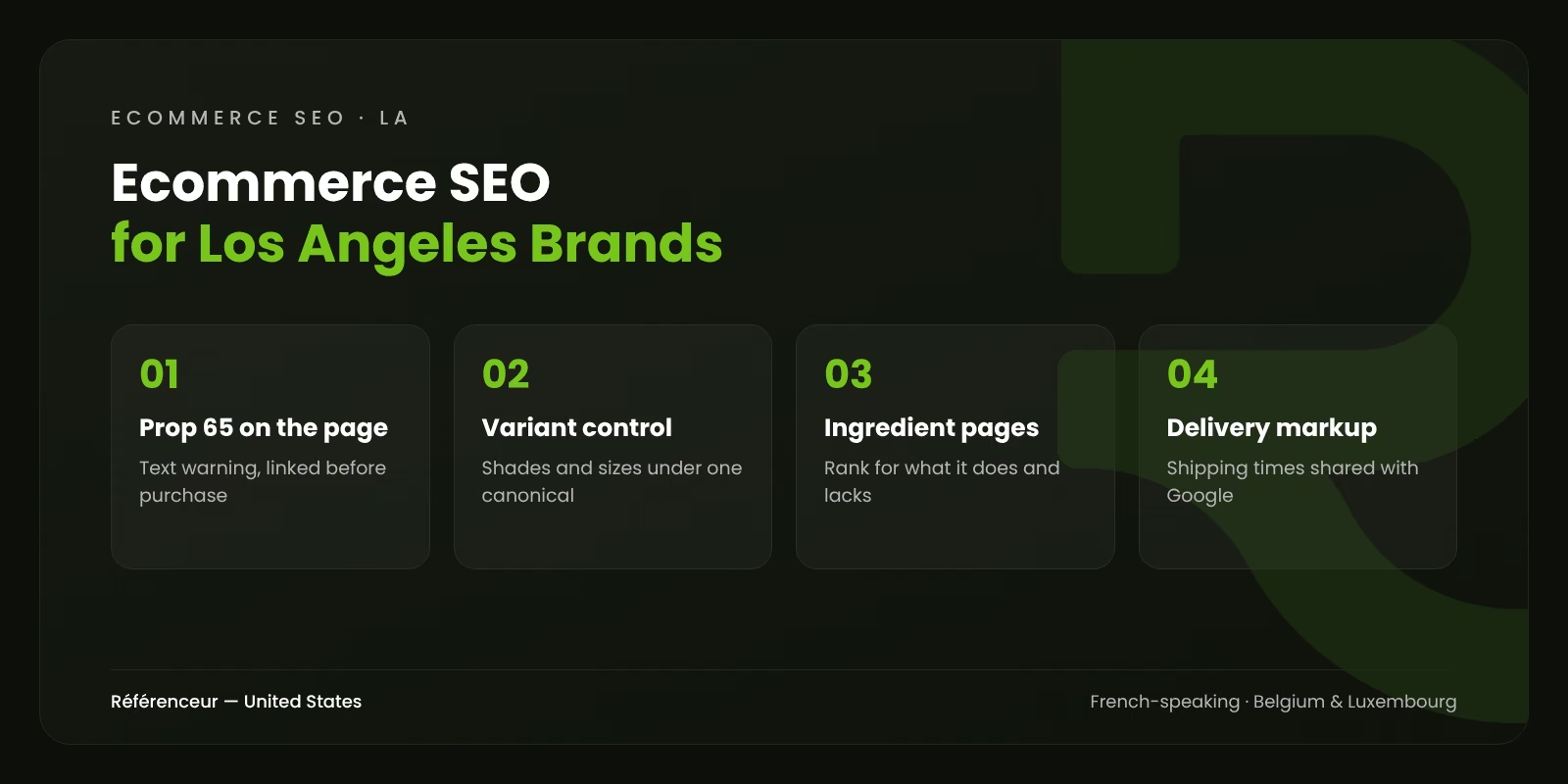
Prop 65 Warnings Without Damaging Your Product Pages
California’s Proposition 65 requires warnings for products that can expose consumers to listed chemicals. Amendments that took effect January 1, 2025, changed the short-form warning so it must name at least one listed chemical, and gave businesses until January 1, 2028, to move to the new format. For online sales, the warning has to appear on the product display page, be reachable through a clearly marked “WARNING” (or “CA WARNING”) hyperlink on that page, or be shown as a prominent notice before the purchase is completed. A warning that shoppers must hunt for does not qualify. OEHHA’s guidance also reads the rules as requiring a second warning on or with the product when it is delivered, a point some lawyers dispute, so settle it with counsel.
Product pages are also SEO assets, so the implementation matters:
- Render the warning as text in the page, not as an image or a pop-up that crawlers and screen readers can’t parse.
- Keep it out of your meta description; Google’s data-nosnippet attribute can stop it from becoming the snippet without hiding it from shoppers.
- Apply it only to the products that need it. A site-wide warning on every page reads as noise and erodes trust.
Whether and how a product needs a warning is a question for your counsel or compliance team. This isn’t legal advice. We make sure their decision displays correctly on every template.
Ingredient Pages After California’s Cosmetics Ban
The California Toxic-Free Cosmetics Act (AB 2762), signed in 2020, has prohibited 24 intentionally added ingredients in cosmetics sold in the state since January 1, 2025, including formaldehyde, mercury, and 13 PFAS chemicals. A separate law, AB 2771, has banned all intentionally added PFAS in cosmetics from the same date. Many shoppers now search for what a product does not contain, and for what a specific ingredient does.
That opens a content opportunity that most beauty sites handle poorly. An ingredient glossary with one solid page per active ingredient (what it does, concentrations you use, which products contain it) can rank for informational searches and pass shoppers straight to products. Any “free from” claim should match your formulation records and your regulatory team’s sign-off. Our European background helps here: the EU had already banned many of these substances, and our team is used to ingredient rules that change from one market to the next.
Tracking Organic Revenue When Shoppers Opt Out
In August 2022, California’s Attorney General announced a settlement with Sephora, the first publicly announced enforcement settlement under the California Consumer Privacy Act. The allegations included letting third-party trackers collect shopper data in exchange for analytics or advertising services without telling consumers, and ignoring Global Privacy Control signals sent by shoppers’ browsers. Under the California Privacy Rights Act, in force since January 1, 2023, that kind of tracking can count as a “sale” or “sharing” of personal information.
For SEO reporting, honoring opt-outs and consent choices means some organic sessions and orders won’t be attributed in GA4 the way they used to be. We plan for that gap rather than fight it, using GA4 attribution models with care: compare GA4 to Shopify order data, track organic revenue by landing page group, and report the share of unattributed orders openly. If your tagging needs a rebuild, our web analytics team handles consent-aware setups. What your store must do under California privacy law is a legal question, so put it to your attorney; this page isn’t legal advice.
From San Pedro Bay to the Search Result: Delivery Promises
The Port of Los Angeles handled 10.2 million TEUs (twenty-foot equivalent units) in 2025, the third year it passed 10 million, FreightWaves reported in January 2026. Many LA brands import packaging, ingredients, or finished goods through the port complex shared with Long Beach, and a delayed container quickly becomes a stock problem on the website.
Search engines pick that up. We set up product availability so pre-order and back-in-stock states are explicit instead of turning pages into dead ends. Delivery promises are now easier to share with Google as well: since November 2025, Google has supported site-wide shipping policy markup nested under Organization, and stores can also enter shipping and return policies directly in Search Console. Accurate delivery times help your listings compete with marketplaces that display next-day badges.
How Our Belgian and Luxembourgish Team Runs SEO for an LA Store
We have no California office. Los Angeles is usually nine hours behind Belgium and Luxembourg, so we work asynchronously: written briefs, shared dashboards, and a monthly video call set for your morning, which falls late in our afternoon. Product page fixes, feed changes, and template requests are documented so your developers or your Shopify partner can ship them during your working day.
If you run a fashion label, our page on fashion brand marketing in Los Angeles covers creators, launches, and the garment industry side. Brands that sell on the East Coast too can compare priorities with our page on ecommerce SEO in New York. Our national ecommerce SEO agency page explains the core method. Local service companies should start with our Los Angeles SEO agency page, and all of our services in the city sit on the Los Angeles digital marketing agency page.
Bringing a European formula or a California brand to more U.S. shoppers? Our French- and English-speaking team in Belgium and Luxembourg can review your store’s California-specific pages first. Get a Free Assessment and we’ll start with your three busiest product templates.
Frequently Asked Questions About Ecommerce SEO in Los Angeles
Does a Prop 65 Warning Hurt Rankings or Conversions?
There’s no sign that Google treats a warning as a negative ranking signal. Conversion is a different question: a warning placed carelessly, or shown on products that don’t need it, can unsettle shoppers. Clear, product-specific placement and an explanatory page linked from the warning usually work best. Your counsel decides the wording.
Can Our Product Pages Rank for Ingredient Searches?
Yes, but product pages alone rarely do. Searches such as “niacinamide benefits” are informational, so they’re won by ingredient pages and guides that then link to products. Your product pages should still list key ingredients in text, not only inside an image of the packaging.
How Should We Handle Limited Drops and Seasonal Collections?
Keep a permanent URL for recurring collections (for example, a summer edit) and update its products each year instead of creating a new page every season. For one-time drops, publish the page before launch to collect waitlist sign-ups, then keep it live afterward with links to related products. Deleting sold-out drop pages throws away the links and attention they earned.
Will Honoring Global Privacy Control Make Our SEO Results Look Worse?
Attributed numbers in GA4 may drop, but actual sales don’t change. That’s why we report organic performance against your Shopify order data and landing page trends, not GA4 alone. Discussing the method up front avoids a false alarm when consent rates shift. You can request a free assessment to see how your current setup handles opt-outs.
Do We Need a Los Angeles Address to Rank?
Not for ecommerce. Product and category pages rank nationally without a local address. A physical location matters only if you run a showroom, studio, or pickup point and want to appear in Google Maps, which requires a real address that customers can visit. For a showroom brand, we handle both, and you can contact our team to plan it.