 0498 70 98 60
Fashion Brand Marketing Los Angeles: From the Cutting Room to the Checkout
A Los Angeles label can design on Monday, sample in the Fashion District on Wednesday, and post the first photos on Friday. Marketing rarely keeps that pace. Fashion brand marketing in Los Angeles has to move as fast as production while staying accurate about where clothes are made, who is paid to wear them, and what happens when a hoodie comes back in the wrong size.
We run Référenceur from Belgium and Luxembourg, and the people who write your copy switch between French and English without effort. That helps in two situations common in fashion: an LA label that wants to sell to customers in France or Quebec, and a European label opening a showroom or pop-up in Los Angeles that needs U.S. copy that does not read like a translation. For the wider view of channels, see our Los Angeles digital marketing hub.
Made in LA Is a Marketing Claim. Make It Hold Up.
Downtown’s Fashion District covers about 100 blocks, with thousands of retail and wholesale businesses selling apparel, footwear, accessories, and fabric. Many labels cut and sew a few blocks from their offices, and “Made in Los Angeles” is one of their strongest selling points. It is also a claim that customers, journalists, and competitors can check.
California has specific rules for this supply chain. The Garment Worker Protection Act (SB 62) took effect on January 1, 2022. It requires garment workers to be paid at least minimum wage by the hour, bans piece-rate pay, and makes “brand guarantors,” meaning companies that contract for garment manufacturing, jointly liable with contractors and manufacturers for unpaid wages. Businesses engaged in garment manufacturing must also register with the Labor Commissioner.
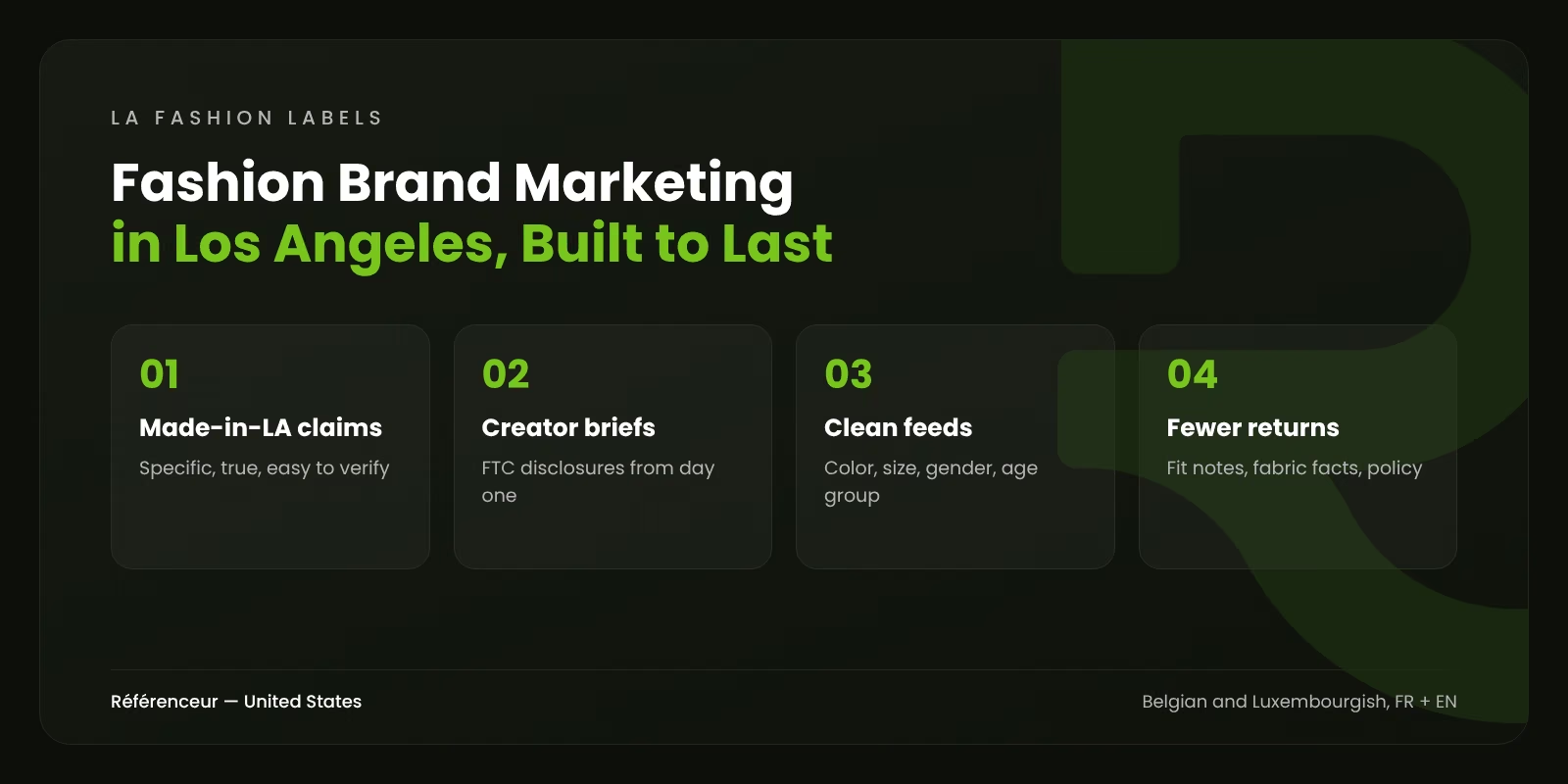
For marketing, the takeaway is simple. Anything you publish about your production should match what your operations team can document:
- Name the neighborhood or the type of workshop only if you are sure of it.
- Avoid words like “ethical” or “fair” without saying what they mean in practice.
- Keep the About page, product pages, and press kit consistent with each other.
- Update the copy when you change a contractor.
We do not assess compliance; your attorney does. This is not legal advice. Our job is to make sure the story on the site is specific, true, and easy to verify.
Creator Partnerships After the FTC’s 2023 and 2024 Changes
For many LA labels, creators are the main way new customers discover the brand. The rules around them tightened in two steps.
On June 29, 2023, the FTC adopted revised Endorsement Guides. Among the changes: tagging a brand in a post can count as an endorsement, disclosures must be “clear and conspicuous,” meaning hard to miss and easy to understand, and online disclosures must be unavoidable. A “click for more” link or a disclosure buried in a profile bio is not enough. Virtual influencers are covered too.
A second step followed on October 21, 2024, when the FTC’s trade regulation rule on reviews and testimonials became enforceable. It bans fake reviews and testimonials, prohibits offering incentives conditioned on a positive review, requires disclosure when officers or managers post reviews, and bans buying fake followers or views to misrepresent influence for commercial purposes. The FTC can seek civil penalties for each violation.
A creator brief we would use for an LA label covers:
- The exact disclosure wording and where it goes (on screen and in the caption, not only in a hashtag at the end).
- What the creator received: gifted product, payment, commission, or a mix.
- A ban on promising discounts in exchange for positive reviews.
- Who approves the post and how quickly.
- How long the brand can reuse the content in ads, if at all.
The LA social media service page explains how we build these briefs into each campaign. Your counsel should review the contracts.
Product Feeds Google Shopping Will Actually Show
For a fashion store, Google Shopping ads and free product listings depend on the product feed in Merchant Center. Apparel has stricter requirements than most categories. Google’s Merchant Center help states that apparel offers need gender, age group, and color to show, and shoes need size as well.
| Attribute | Why it matters | Common mistake |
|---|---|---|
| Color | Shoppers filter by it, and it must be specified to show | Marketing names only (“Sunset”) with no plain color |
| Size | Required for shoes and needed for variants | Sizes in a mixed system across products |
| Gender and age group | Required for apparel offers | Left blank on unisex pieces instead of set to “unisex” |
| Item group ID | Links variants of the same product | Each size listed as a separate product |
| Title | Drives matching with search queries | Collection names instead of what the item is |
A useful title format for apparel is brand, product type, key attribute, color, and size, for example “Label Name Heavyweight Cotton Hoodie, Washed Black, Size M.” It reads less poetically than a lookbook caption, but it matches what people type.
We audit the feed before spending a dollar on Shopping or Performance Max campaigns, as part of our Google Ads management. A feed with clean data can also appear in free listings, which cost nothing per click.
Fewer Returns Start on the Product Page
Returns are where fashion margins disappear. According to the National Retail Federation’s October 2025 returns report, U.S. consumers were expected to return 15.8% of annual retail sales in 2025, and an estimated 19.3% of online sales. The same report estimated that 9% of all returns are fraudulent, and close to two-thirds of consumers admitted to at least one costly return habit, such as wardrobing (wearing an item, then returning it) or bracketing (buying several sizes and keeping one).
Marketing cannot fix sizing, but it can reduce surprises:
- Fit notes in plain words. “Runs large, size down if between sizes” is more useful than a size chart alone.
- Model details. Height and the size worn, on every product photo set.
- Fabric facts. Weight, stretch, and care, because a heavyweight fleece and a light jersey fit differently.
- A clear return policy. Google recommends describing a standard return policy with MerchantReturnPolicy structured data (schema markup), nested under your Organization markup, so it can appear in Search.
- Reviews that mention fit. Ask for them honestly, without conditioning anything on the rating.
Every return reason your customer service logs is also a content idea. If “too short” comes up often for a style, the product page should say so.
Apparel Brand SEO: What LA Labels Can Build Between Collections
Collections change, but the questions shoppers ask do not. For apparel brand SEO, LA labels get the most from pages that stay live while the products rotate:
- Category pages by product type, such as heavyweight tees, wide-leg denim, or linen sets, each with a short paragraph on fabric and fit.
- Fabric and construction pages explaining your materials, which also support the “made in LA” story.
- Fit guides by body type or by product family.
- Lookbook pages that are indexable, with text and product links, not only image galleries.
Fashion ecommerce marketing in LA also needs search and social to share a calendar. When a collection launches on Instagram, the category page should already be live with the right products, so that people searching your brand name land on it. For the technical side of online stores, our ecommerce SEO in Los Angeles page goes further, and our ecommerce SEO optimization guide lists 17 practical fixes.
Textile Recovery and the Sustainability Story
California’s Responsible Textile Recovery Act (SB 707) creates an extended producer responsibility program for apparel and household textiles. Covered producers had to join the approved producer responsibility organization, Landbell USA, by July 1, 2026. Businesses with less than $1 million in annual global sales and sellers of secondhand goods are excluded. The program then runs through a needs assessment, regulations, and an approved plan, with full implementation planned for 2031.
For marketing, this matters in two ways. First, a sustainability page should describe what the brand actually does, including its participation in the program if it applies. Second, take-back, repair, or resale programs are worth explaining on their own pages, because shoppers search for them. None of this is legal advice; check with your counsel on whether the law covers your brand.
A label in Los Angeles does not need a local agency to get this right, but it does need one that pays attention to detail. Our people are French speakers based in Belgium and Luxembourg, equally comfortable writing for a shopper in Silver Lake or in Lyon. We would work with an LA brand from a distance: scheduled video meetings, screens shared during reviews, and a written summary at the end of each month. To begin, request a free assessment covering your product feed, creator process, or product pages, and you will know which fix comes first and why.
Frequently Asked Questions About Fashion Brand Marketing in Los Angeles
How Should Creators Disclose Gifted Product?
Clearly, in the post itself. If a creator received your product for free, that is a material connection, and viewers should understand it without clicking anything. Words like “gifted by” or “#ad” placed at the start of the caption and said or shown on screen in a video are more visible than a hashtag at the end.
Your counsel should review the exact wording for your campaigns.
Can We Offer a Discount in Exchange for a Review?
You can offer an incentive for a review, but you cannot make it depend on the review being positive. Since October 21, 2024, the FTC’s reviews rule specifically bans incentives conditioned on a particular sentiment.
The safest approach is to ask every customer for an honest review, with the same incentive regardless of the rating, and to publish negative reviews as well as positive ones.
Which Feed Errors Keep Apparel Out of Shopping Results?
The most frequent ones are missing color, gender, or age group, missing sizes on shoes, and variants that are not grouped. Wrong product categories cause problems too, because the required attributes depend on the category.
Merchant Center lists these issues in its diagnostics. We start every fashion account by clearing them. If you would like a second opinion on your feed, request a free assessment.
Should We Say “Made in Los Angeles” on Product Pages?
Yes, if it is true for that product, and only for that product. If some items are made locally and others abroad, the label should appear only where it applies.
Specific details make the claim stronger: the type of workshop, the neighborhood, or the step done locally, such as cutting, sewing, or dyeing.
Do Wholesale Buyers Need Their Own Pages?
If wholesale is part of your business, yes. Boutique buyers search for line sheets, minimums, lead times, and showroom appointments. A short wholesale section with a contact form keeps those requests away from consumer customer service.
It does not need to rank widely, but it should be easy to find from your homepage and from your brand name. Talk to us if you want help structuring it.