 0498 70 98 60
Luxury Brand Marketing Miami: Win the Season, Keep the Client All Year
In Miami, a luxury client may buy a watch in December, sail off in March, and not set foot in the boutique again until the following winter. Luxury brand marketing Miami houses can count on has to work with that rhythm: intense weeks around art and the high season, long quiet stretches in summer, and clients who switch between English, Spanish, Portuguese, and French in the same conversation.
Our team is French-speaking and works out of Belgium and Luxembourg, so a client who writes to a boutique in French is not an exception for us; French is the language we work in every day, alongside English. For European houses with a store in the Design District or Bal Harbour, that means we can read the head office’s brief in the original, keep its nuance, and build campaigns for an American, Latin American, and European clientele at the same time. For a broader view of every channel, our Miami digital marketing hub covers the basics.
A Calendar Built Around the Season, Not the Fiscal Year
Marketing plans are often built by quarter. The client base plans by season. We start a Miami plan with a calendar like this one, then adjust it to your category.
| Period | Who is in town | What to publish and promote |
|---|---|---|
| Late October to November | Early arrivals, second-home owners reopening residences | Appointment pages, new-season arrivals, private shopping invitations |
| Early December | Art Basel Miami Beach, held each December; in 2026, VIP days are December 2 and 3 and public days December 4 to 6 | Event pages, invitations, boutique hours, collaborations with artists or galleries |
| January to April | Peak season, part-time residents and international visitors | Collection stories, gifting, clienteling follow-ups, local search ads |
| May to September | Fewer visitors, local residents, clients traveling | Care and servicing content, waitlists, email for the next season |
The point is not the table. It is the order of work. Pages and ads for December must exist in October, or they will not be indexed, approved, and tested in time. Content written in July is what ranks in January.
Three Luxury Addresses, Three Ways Clients Search
Miami’s luxury retail is spread across several districts, and the client searching for each one behaves differently.
The Miami Design District. Developed by Craig Robins’ Dacra with L Catterton as a partner, the district gathers flagships from houses such as Hermès, Dior, Louis Vuitton, Cartier, and Bulgari among galleries and design showrooms. People search it as a destination: “Design District stores,” “Design District parking,” “art in the Design District.” Miami Design District marketing therefore leans on discovery. A boutique there benefits from pages about the neighborhood, events, and architecture, not only products.
Bal Harbour Shops. The open-air center north of Miami Beach is in the middle of a long expansion, with construction rerouting part of its access since early 2026. New European names keep arriving. The Swedish label Toteme, for one, opened its first Miami store there on July 1, 2026. Clients searching Bal Harbour often already know what they want, so product availability and appointment booking matter more than storytelling.
Brickell. In the financial district, shoppers are often residents and professionals who live in the towers around Brickell City Centre. Searches are more practical: hours, pickup, “open now.” Accurate Google Business Profile data does a lot of the work here, as our Google local SEO guide explains.
If your brand has a boutique in two of these areas, each location needs its own profile, photos, hours, and landing page. One generic store locator page cannot rank for three different neighborhoods.
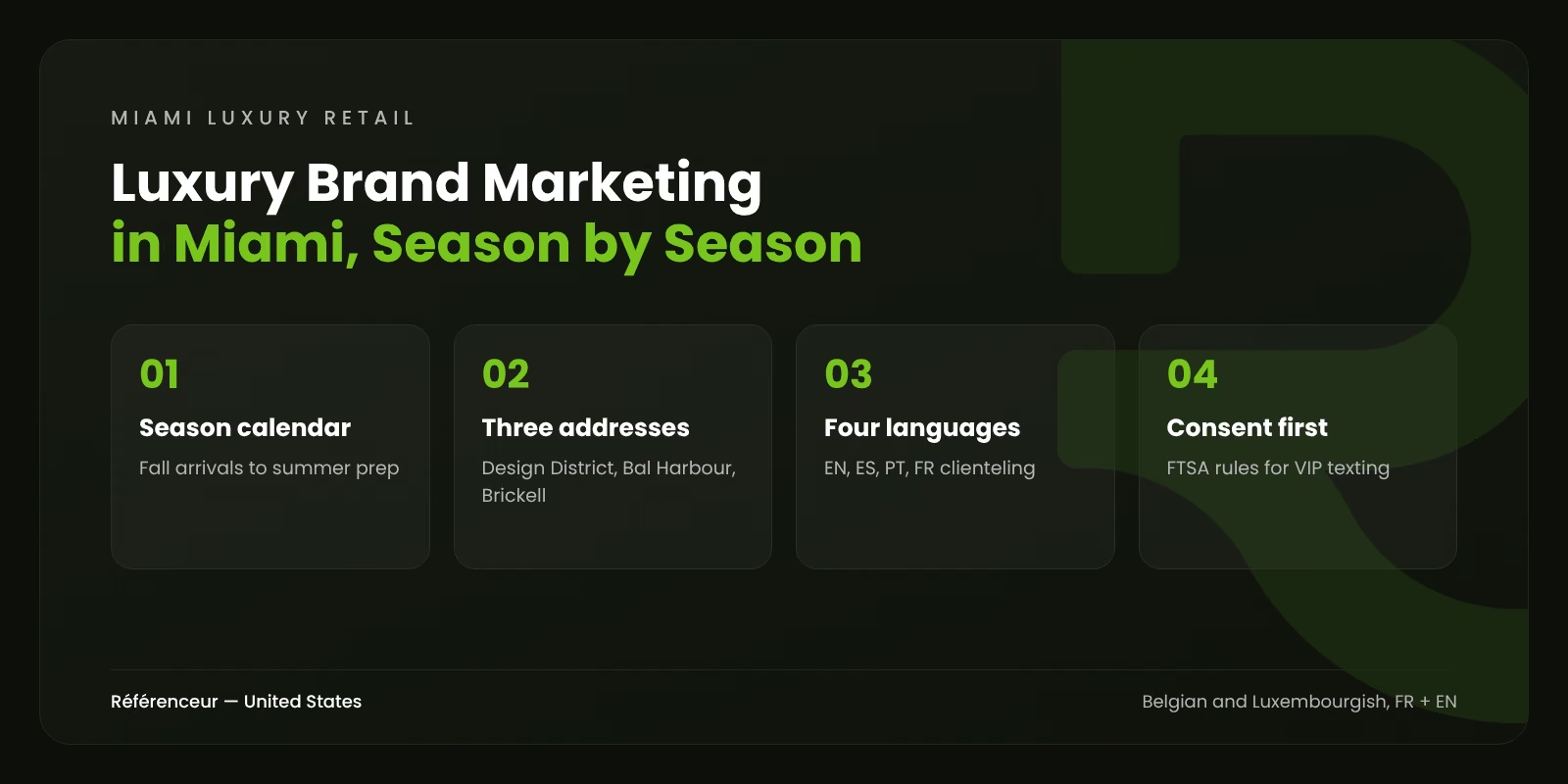
One Client, Four Languages
Miami-Dade County is deeply multilingual. According to the Census Bureau’s American Community Survey, more than half of the county’s residents were born abroad, and roughly three in four residents aged five and over speak a language other than English at home.
For a luxury brand, that changes three things:
- Search terms. A client from São Paulo may search in Portuguese, a client from Mexico City in Spanish, a Parisian in French. Your key pages need versions in the languages your sales associates actually use, with proper hreflang tags so Google shows the right one (see our international SEO guide).
- Tone. Formal “usted” or familiar “tú,” “vous” or “tu”: the choice says something about the house. It should be decided once, written down, and applied everywhere, from product pages to text messages.
- Clienteling templates. The follow-up after a boutique visit should go out in the client’s language. That means templates in several languages, approved in advance, so associates do not improvise translations on their phones.
Our own team works natively in French and English. For Spanish and Portuguese, we set up the structure, keywords, and templates, and we work with your native-speaking associates or translators for the final wording.
Texting VIP Clients Under Florida’s Telephone Solicitation Act
Text messages are the fastest way to tell a client that the piece they asked about has arrived. In Florida, they are also regulated by the Florida Telephone Solicitation Act (FTSA), sometimes called Florida’s “mini-TCPA.”
The 2023 amendments (HB 761) narrowed the law but kept its core. Unsolicited marketing calls and texts made with an automated system still require prior express written consent, and that consent can be given by checking a box or replying yes to a text. The definition of an automated system now covers only equipment that both selects and dials numbers. Before suing over unwanted texts, a consumer must reply “STOP,” and the sender then has 15 days to comply.
A practical checklist for boutique texting:
- Collect consent in writing, with a clear checkbox on forms and in-store tablets.
- Store the date, the channel, and the wording the client agreed to.
- Process “STOP” replies immediately, not within 15 days.
- Keep personal messages from associates separate from automated campaigns.
- Review the setup with your counsel before the season starts.
This is a summary for marketers, not legal advice; have your attorney check how the statute fits the tools you use.
Art Basel Week in Three Phases
For many luxury brands, the first week of December is the most visible week of the year in Miami. It is also the most crowded, with every house hosting something. A plan in three phases keeps the effort from vanishing on Monday morning.
- Before (October and November). Publish an event page with a date, address, and RSVP form, indexed well in advance. Prepare search ads on your brand name plus “Art Basel” and “Miami Beach,” and update the Google Business Profile with extended hours.
- During. Capture contacts with a short form and an explicit consent checkbox. Post content the same day in the languages of the guests. Keep paid social tightly targeted around Miami Beach and the Design District.
- After (December to January). Send personal follow-ups within days, in the guest’s language. Turn the event into a lasting page with photos and the story of the collaboration, which keeps attracting searches the following year.
Social media carries much of this week. Our social media team for Miami plans the posts and ads with the same calendar as search.
Luxury Retail Marketing Miami Brands Can Run in the Quiet Months
Summer in Miami is slow for luxury retail, which makes it the best time to build what the high season will need. Luxury retail marketing Miami teams often skip this phase, then rush in October.
- Care and servicing content. Watch servicing, leather care, jewelry cleaning, tailoring. These pages answer real searches all year and bring clients back to the boutique.
- Adjacent worlds. Miami’s luxury clientele overlaps with yachting, private aviation, and high-end real estate. Editorial content about a summer wardrobe for a boat, or a guide to the Design District for new residents, reaches those clients without discounting anything.
- Email for the next season. A short, well-written series in each client language, sent in September, prepares appointments for October; our email marketing service handles it end to end.
- Technical cleanup. Page speed, structured data, broken links, and language versions are easier to fix when traffic is low, using a technical SEO audit checklist.
If your house is also present in Manhattan, the New York version of this approach shows how the same principles adapt to a different calendar. Both rely on the same Belgian and Luxembourgish team, at home in both French and English, which works remotely: video calls, shared screens, and one monthly report. Get a Free Assessment before the next season starts, and we will tell you which pages and campaigns to prepare first.
Frequently Asked Questions About Luxury Marketing in Miami
How Early Should We Plan an Art Basel Week Campaign?
Start in September. New pages need several weeks to be crawled and indexed, ad approvals can take a few days, and invitations in several languages need time to be written and approved by the head office.
A plan finalized in late November usually means paid ads only, with nothing organic to support them.
Should Each Boutique Have Its Own Google Business Profile?
Yes, if each is a real store with its own address and staff. A brand with a boutique in the Design District and another at Bal Harbour should have two profiles, each with its own photos, hours, and appointment link.
Pop-ups and event spaces are different. They usually belong on an event page rather than in a separate profile.
Can We Write Differently to Brazilian and Mexican Clients?
You can, and you probably should for key messages. Portuguese and Spanish are different languages, and within Spanish, vocabulary and formality vary by country.
In practice, we suggest one Portuguese version and one Spanish version of your main pages, with clienteling templates adjusted by your associates for each client. If you are unsure where to start, ask us for an outside view of your current language setup.
Is WhatsApp a Good Channel for Luxury Clienteling in Miami?
For many international clients, it is the channel they already use. The same rules apply as for text messages: written consent, a clear way to stop messages, and a record of what the client agreed to.
Meta also has its own business messaging policies, which your team should read before launching. Check with your counsel on how Florida’s rules apply to your setup.
What Should a Luxury Brand Do Online in a Slow Summer Month?
Build. Write the care guides, update collection pages, fix technical issues, translate key pages, and prepare the October email series.
Then measure quietly: which pages gained impressions, which languages bring the most engaged visitors, and which boutique pages lead to calls or directions. Contact us if you would like a second pair of eyes on that summer plan.