 0498 70 98 60
AI Search Optimization Silicon Valley Teams Can Measure in English and French
AI search optimization Silicon Valley companies can rely on starts with an uncomfortable fact: the engineers and procurement leads who evaluate your product now ask an assistant first, and they ask with constraints. “Low-power edge inference module under 5 watts with a Linux SDK.” “SOC 2 Type II observability platform with an on-prem option.” If your specs, docs, and proof sit in places those engines can’t read, the answer names someone else.
At Référenceur, our team in Belgium and Luxembourg writes in French and English as first languages. That bilingual base matters here because many companies in San Jose, Santa Clara, Sunnyvale, Mountain View, and Palo Alto start selling in Europe and Canada soon after their U.S. launch. We make your company easy to cite in American AI answers, then build a separate, native French-language footprint for buyers in France, Belgium, Switzerland, Luxembourg, and Quebec. Our national generative engine optimization method explains the core approach; this page covers what changes for Valley companies.
Technical Buyers Write Prompts Like Requirements Documents
A marketing team tends to imagine prompts such as “best AI startup.” Real prompts from Valley buyers look more like a filtered parts search. They name a voltage range, a protocol, a compliance standard, a deployment model, or an integration. The engine then looks for pages that state those attributes in plain text and can be matched line by line.
That is where hardware, semiconductor, and infrastructure software companies lose citations they should win:
- Specs locked in PDFs. Datasheets, application notes, and reference designs often exist only as downloads. Some engines read PDFs, but an HTML spec table with the same numbers is easier to parse, quote, and link.
- Part numbers without context. A product family page that lists SKUs but never says what each one is for gives an assistant nothing to match against a use case.
- Docs on a separate subdomain. Developer documentation hosted on its own platform may block crawlers by default or render only with JavaScript.
- Undated claims. “Industry-leading throughput” means nothing to a model. “Benchmarked at X on Y hardware, March 2026” can be cited.
Fixing those four gaps often does more for AI visibility than a stack of new blog posts.
French-Language AI Answers Run on a Different Set of Sources
Going after French-speaking markets is not a matter of translating your U.S. pages and waiting. The answer engines, the indexes, and the publications behind them differ by language and country, and the landscape moved fast over the past year.
On October 7, 2025, Google announced that AI Mode was reaching more than 40 additional countries and territories and more than 35 additional languages. Belgium’s rollout started the next day, according to ITdaily, and Swiss outlet blue News listed Switzerland in the same wave. In Canada, AI Mode launched on August 21, 2025, in English, and Google’s Canadian blog announced a French version on October 14, 2025. France came last: AI Overviews and AI Mode only began rolling out there on July 22, 2026, after a long dispute over publishers’ neighboring rights, according to Blog du Modérateur.
Outside Google, Europe is building its own infrastructure. Qwant and Ecosia announced Staan, a European search index run by their joint venture, European Search Perspective, on August 6, 2025. French users were the first to get results from it, and the index is offered to other companies building search and generative AI tools, TechCrunch and Search Engine Journal reported. French AI company Mistral signed a deal with Agence France-Presse on January 16, 2025, giving its Le Chat assistant access to AFP newswire stories; Mistral says AFP produces 2,300 wires a day in six languages, French included.
The practical consequence: a French buyer’s assistant may lean on French trade press, wire copy, and European indexes that never see your U.S. press coverage. For AI visibility in French, Silicon Valley companies need French-language sources that exist on their own.
A Market-by-Market Source Map
Every engagement begins with a map of who answers buyers in each market and which sources those answers cite. The table below shows the starting hypotheses we test; the real map comes from running your prompts.
| Market | Engines we test first | Sources we look for in answers |
|---|---|---|
| U.S. (Bay Area buyers) | Google AI Overviews and AI Mode, ChatGPT, Perplexity, Microsoft Copilot | Your docs and spec pages, analyst and review sites, developer forums, U.S. trade press |
| France | Google AI Mode, ChatGPT, Le Chat | French tech and trade press, wire-based news, French comparison sites, French partner listings |
| Belgium | Google AI Mode, ChatGPT | Belgian business press in French, regional innovation agencies, distributor pages |
| Switzerland (Romandy) | Google AI Mode, ChatGPT | Swiss French-language business media, university and lab partners, integrator sites |
| Luxembourg | Google AI Mode, ChatGPT | Chamber of commerce and trade agency pages, local tech community sites |
| Quebec | Google AI Overviews and AI Mode, ChatGPT | Quebec business press, provincial innovation networks, French-Canadian partner pages |
Two patterns come up often. First, the same product gets described with older facts in French because the last French-language article predates your current version. Second, local partners such as distributors and integrators often turn out to be the most-cited source, so their product pages shape what the engine says about you.
What an AI Search Optimization Silicon Valley Program Covers
We scope the work after a free assessment. A typical program for a Valley company with French-speaking markets in view includes:
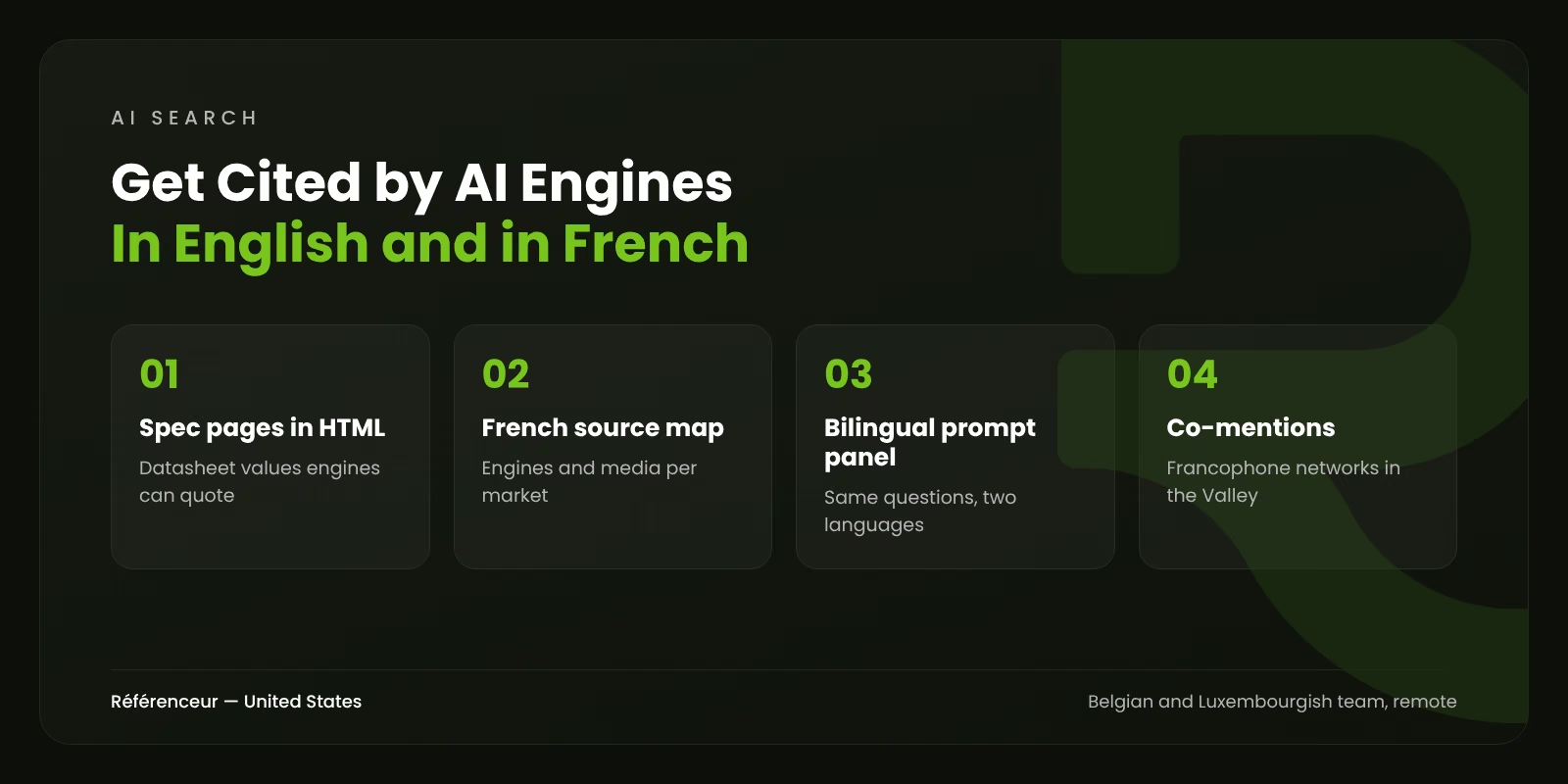
- A bilingual prompt panel. Buyer questions in U.S. English and in French, written separately rather than translated, with variants for France, Belgium, Switzerland, and Quebec where vocabulary differs.
- HTML spec and capability pages. Key datasheet values, supported standards, and integration lists published as crawlable tables, with the PDF kept as a download.
- Entity alignment across countries. The same product names, founding facts, and leadership across your site, LinkedIn, Crunchbase, and each local subsidiary or distributor page.
- Native French pages. Written by French speakers from Belgium and Luxembourg, with local number formats and terms, and correct hreflang so each market gets its own version.
- French-language mentions. Bylined technical articles, partner case notes, and event coverage that give European engines something recent to cite.
- Crawler and rendering checks. Robots rules, JavaScript rendering, and docs subdomains tested for each engine that matters to you.
If your French site is still on the roadmap, our page on French SEO for SaaS companies covers the groundwork, and the French-language marketing agency page explains how we run campaigns in French end to end.
Co-Mentions Through the Valley’s Francophone Networks
AI engines trust facts that several independent sources repeat. Silicon Valley already hosts institutions that publish about French-speaking companies and their American partners, which creates citable, third-party mentions in both languages.
The Quebec government runs a trade office in Silicon Valley that covers the region and the rest of Northern California and supports small and midsize Quebec companies, notably in technology. Luxembourg’s Chamber of Commerce led a trade mission in October 2025 whose Bay Area program included Microsoft’s Silicon Valley campus, Stanford University, Plug and Play, and Berkeley SkyDeck, according to Luxembourg Trade & Invest.
When your company partners with a delegation, hosts a visit, or co-authors a pilot with a French-speaking firm, that activity can turn into dated, factual pages on both sides of the Atlantic. We plan those mentions so they state the same facts your own pages do. Our guide to brand mentions in SEO and AI search explains why unlinked mentions still count.
How We Measure Citations Across Two Languages
Because an assistant may phrase things differently on every run, one screenshot proves nothing. We run the same panel each month, in each language and engine, and record three things: whether you appear, how you are described, and which sources the engine relied on.
| What we track | Why it matters |
|---|---|
| Share of prompts where you are named | The headline trend, by market and engine |
| Accuracy of the description | Old specs or a former product name signal a source to fix |
| Sources cited alongside you | Shows which publications and partners to work with next |
| Gap between English and French results | Tells you whether the French footprint is catching up |
Citations are decided by the engines, and nobody outside them controls that. What we can do is remove the reasons an engine would leave you out. For the difference between ranking and being cited, read our SEO vs. GEO guide.
A GEO Agency for Silicon Valley, Working From Belgium and Luxembourg
We don’t have an office in California, and we don’t claim American clients. Our people work in Francorchamps, Belgium, and in Wemperhardt, Luxembourg. Live calls fit into your early morning, draft pages are shared in documents your team can comment on, and the panel results arrive as a written report each month, with the sources behind every answer.
Hiring a French-speaking team in Belgium and Luxembourg gives you people who spot at once when an AI answer describes your product in stilted, machine-translated French, and who can write the pages that correct it. Our ChatGPT SEO work in Silicon Valley focuses on one assistant in depth, and every service we offer in the region is on our Silicon Valley digital marketing agency page.
Curious how AI engines describe your product in both languages right now? Get a Free Assessment and we’ll send the answers with their sources.
Frequently Asked Questions About AI Search Optimization in Silicon Valley
Should Our Technical Datasheets Stay in PDF Format?
Keep the PDF, because engineers download it. Add an HTML page with the key values, supported standards, and typical applications, and link the two. That page gives AI engines a clean source to quote and gives buyers a faster answer before they commit to a download.
Do French-Language AI Answers Use the Same Sources as English Ones?
Often they don’t. French answers lean on French-language pages, and European indexes and media partnerships add sources a U.S. team never sees. We check which publications appear in your French results and plan content and mentions around those, instead of assuming your U.S. coverage carries over.
Can Machine Translation Handle Our French Product Pages?
It can produce a draft, but it tends to miss local terms, units, and the way French buyers phrase requirements. We write the key pages natively, then use your glossary so technical terms stay consistent across markets.
What Should a GEO Agency in Silicon Valley Be Accountable For?
For measurable inputs: pages published, crawler issues fixed, mentions earned, and the monthly panel results by market. Citations themselves depend on engines no agency controls, so treat any promised placement with suspicion. Ask us for a sample report before you decide.
Do We Need Separate Pages for Quebec and France?
Not always. Start with one French version if your offer is the same, then add Quebec pages when pricing, support hours, partners, or terminology differ. Quebec’s language rules for commercial content may also apply to you; this is not legal advice, so check with your counsel. Tell us which markets come first, and we’ll suggest an order.