 0498 70 98 60
Google Ranking Factors 2019: What 1,584 SEO Pros Say Matters Most
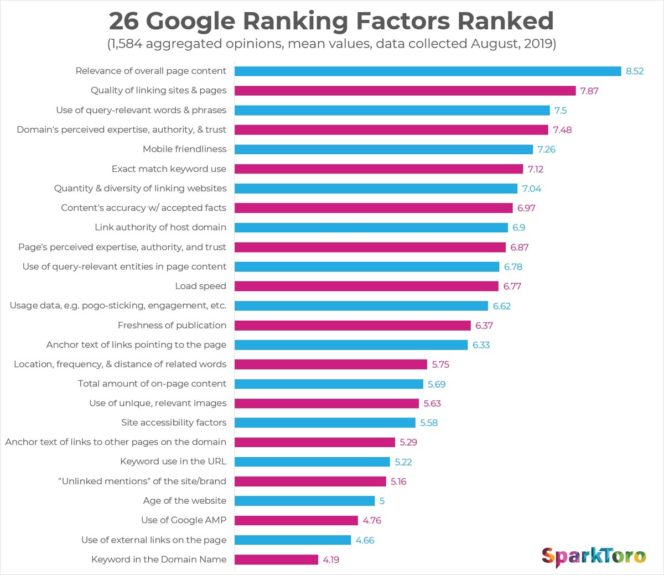
In August 2019, SparkToro ran a large survey of 1,584 SEO professionals. The goal: find out which Google ranking factors they believe influence rankings the most. Let’s break down the results, which also feature in our 2019 SEO year in review.
The Factors That Affect Rankings
Respondents rated a series of factors on a scale of zero to 10. The higher the score, the more important the factor in their eyes. The answers were then compiled into a top 26. One takeaway stands out: for the first time, content quality takes the top spot. In previous surveys, links led the ranking, so this is a big shift in how specialists see SEO.
Here’s the top 5:
- Overall relevance of the site’s content (8.52/10). The more relevant your site is, the better for SEO. That’s why it’s so important to publish strong content that makes your site relevant in Google’s eyes.
- Quality of the site’s backlinks (7.87/10). Link building still ranks near the top. But you should avoid over-optimization and piling too many links onto the same page, or that page could lose rankings. Links should be natural and make sense to users.
- Use of keywords and phrases that match search queries (7.5/10). To rank a page for a specific query, it needs to be optimized around specific keywords and phrases chosen in advance, a core part of on-page SEO.
- Perceived expertise, authoritativeness, and trustworthiness of the domain (7.48/10). Known as E-A-T, these criteria come from Google’s Search Quality Rater Guidelines. Expertise reflects the knowledge behind your content. Authoritativeness grows when credible sites link to you and talk about you: the more trusted sources mention you, the better. Trustworthiness comes from signals such as HTTPS, easy-to-find contact details, clear information about your company, and content that adds real value. Meet all three and you score points for strong organic rankings.
- Mobile-friendliness (7.26/10). The number of searches made on mobile keeps growing, so a site’s mobile-friendliness naturally carries special weight.
That said, for two-thirds of respondents, the importance of each factor depends on the query. For example, an SEO working for a news publisher might put AMP (Accelerated Mobile Pages) at the top of the list to make articles faster to read on mobile. Depending on a website’s goals, the priorities can vary a lot.
(Source: SparkToro)
The Future of SEO
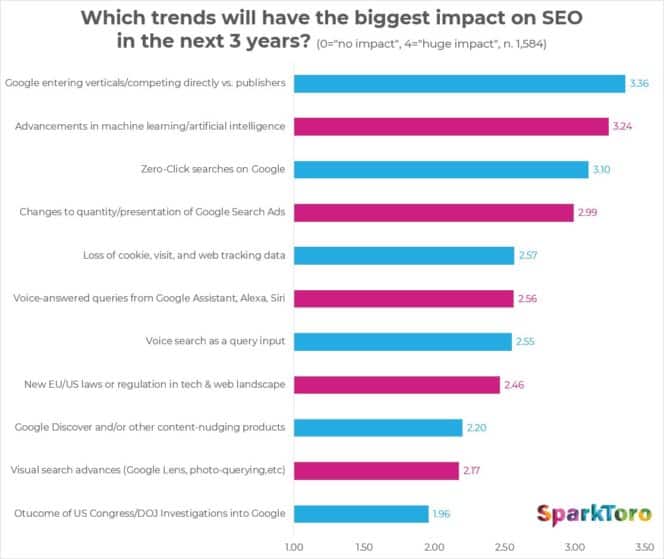
The survey also asked specialists where SEO is heading: which trends will have the biggest impact on SEO over the next three years. In first place: Google’s own verticals, which let people complete tasks directly on Google without visiting other websites. The clearest example is booking a flight. Search for a flight today and you can compare and book through Google Flights without ever going to an airline’s website.
Advances in artificial intelligence and machine learning came in second. Voice recognition, translation, query understanding, and other areas are expected to improve in the coming years, producing even more sophisticated search results.
Finally, third place goes to the zero-click trend. In short, in roughly half of searches, people don’t click on any website, because they’ve already found the answer on the results page itself (see our analysis of the 2019 zero-click study).
(Source: SparkToro)
SparkToro’s survey offers a snapshot of the SEO industry, showing how opinions evolve and where specialists think search is headed. For the full results, read SparkToro’s report: Google Ranking Factors 2019: Opinions from 1,500+ Professional SEOs.
Need Help Improving Your Visibility on Google?
Référenceur is a French-speaking SEO and digital marketing agency from Belgium and Luxembourg. We work with U.S. businesses remotely, through video calls, shared screens, and monthly reporting. Request a free assessment.
Where things stand in 2026: Google added a second “E,” for experience, to its quality rater guidelines in December 2022, turning E-A-T into E-E-A-T, a month after it published a guide to its ranking systems. AMP stopped being a requirement for the Top Stories carousel in 2021. And the zero-click trend the survey predicted has only grown with AI Overviews, which Google launched in the U.S. in May 2024.