 0498 70 98 60
Is Google Becoming an Answer Engine? The 2019 Zero-Click Study
Google is turning into an answer engine, and that ambition means fewer clicks on organic results. To understand what’s happening and adapt your strategy, let’s break down this trend.
Where Do Searchers’ Clicks Go?
A study based on Jumpshot data and published by SparkToro shows that out of 100 searches on Google (desktop and mobile), 49 end without a single click, about 3.5 go to paid ads, and about 6 go to sites owned by Google’s parent company, Alphabet. That leaves just over 41% of searches producing an organic click. Take these figures with a grain of salt, though: the study lumps together all types of searches, and some queries are known to generate far fewer clicks to websites than others.
Consider the Type of Keyword
Let’s look at a few concrete examples. Want the weather forecast in Chicago? Type “weather Chicago” into Google and you won’t need to go any further to get your answer. Even though queries like this are searched constantly, this kind of informational search doesn’t help businesses that want to improve their visibility on Google.
By contrast, a search like “self storage Chicago” gets far fewer searches, but the person typing it still has to click through to one or more storage companies’ websites to get what they need: prices, unit sizes, availability, and so on.
Taking it a step further, the broader keyword “self storage” is also relevant for attracting people looking for a storage unit. But it’s also searched by people who just want a definition. In that case, Google could eventually show a box with a direct answer, such as a definition, which would reduce the number of clicks for that search.
Since there are generally more informational searches (like “weather Chicago”) on the web than specific, commercial ones (like “caterer Chicago”), it makes sense that the Jumpshot study found more zero-click searches than searches with a click.
How Do Users Click After a Google Search, According to Jumpshot?
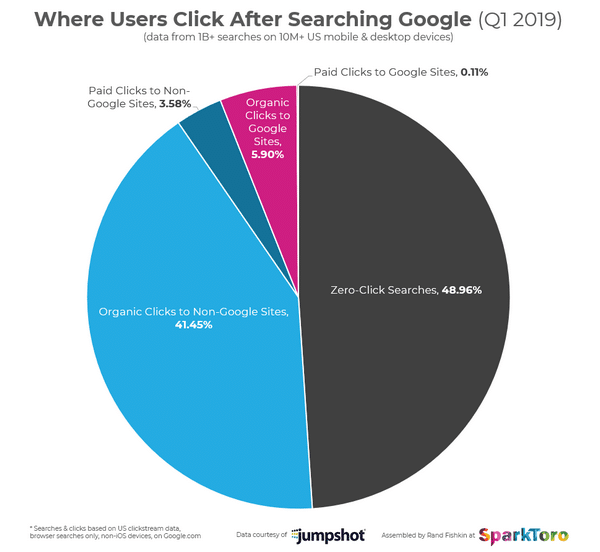
According to the data Jumpshot shared, in the first quarter of 2019, nearly one search in two ended without a click. How can that be explained? There are two main reasons for the lack of clicks on search engine results pages (SERPs): either the results don’t match what the user wanted, so they change their query, or the answer appears directly on the results page, in position zero, and the user doesn’t need to go any further. Position zero sits above the first organic result, where Google can show different boxes that answer the query directly.
The same study says the zero-click rate rose by 12% over three years. That growth is explained by the growing number of Google features designed to answer users directly, but also by the rise of voice and mobile search. Most voice queries get an answer read aloud by a voice assistant, and mobile search, while still showing traditional results, gives plenty of room to Google’s answer boxes.
Google, an Answer Engine
These results show how far Google has gone in becoming an answer engine. Google is pursuing its ambition to become a media company in its own right, aiming to provide answers to users’ queries itself. To do that, it has developed several answer formats that appear in position zero on the SERPs:
- the Knowledge Graph (an encyclopedia-style box)
- the Knowledge Panel (an encyclopedia-style box about a person or entity)
- OneBox results and direct answers (a direct answer in a box)
- featured snippets (a box with an answer taken from a web page, with its URL below), which Google was already testing in topic-based formats
- answer carousels
- and more
These features answer the user’s query directly, or nearly so, which means they cannibalize part of organic traffic.
What’s the Future of SEO?
The good news is that clicks on organic results are more than 11 times as common as clicks on ads and 4 times as common as clicks to Alphabet sites. And Google keeps growing: searches on desktop, mobile, and mobile apps continue to increase. Remember, too, that results shown in position zero can be an opportunity. They may not generate a click or a conversion, but they can still influence searchers. That’s why it’s important to optimize your site to become the best answer Google wants to give its users, with clear answers and structured data. SEO still has a bright future in Google’s world.
Where Things Stand in 2026
Jumpshot was shut down in early 2020. Since then, Google has gone much further in answering queries itself: AI Overviews launched in the United States in May 2024, followed by AI Mode in 2025. Being the source Google cites now matters as much as ranking; see our guide on how to optimize for Google AI Overviews and our comparison of SEO vs. GEO.
Need Help Growing Your Visibility on Google?
Référenceur is a French-speaking digital marketing agency from Belgium and Luxembourg, with a team that works natively in French and English and supports U.S. businesses remotely. Want to know how much of your market still clicks through? Get a free assessment of your search visibility.