 0498 70 98 60
Hotel Marketing Agency Miami: Keep More of Every Booking
A full house in Miami doesn’t always mean a profitable one. A good hotel marketing agency in Miami looks past occupancy to a harder question: how many of those guests booked through a channel that charged you a commission they didn’t need to? Demand is not the problem. Greater Miami and Miami Beach welcomed a record 28.3 million visitors in 2025, who spent about $22.7 billion, according to the Greater Miami Convention & Visitors Bureau’s annual review reported in June 2026. The same report said Miami led the top 25 U.S. hotel markets in occupancy, average daily rate, and revenue per available room over the first four months of 2026. With numbers like that, the margin is decided by where the booking happens.
Référenceur, an agency from Belgium and Luxembourg, runs its projects with a French-speaking team. That matters more for a Miami hotel than it might seem: a guest from Montreal or Lyon who reads a booking page, a confirmation email, and a pre-arrival message in natural French is more likely to book direct next time. This page covers hotels, boutique properties, and vacation rental operators in Miami and Miami Beach.
The Commission Math Behind a Full Hotel
Online travel agencies bring reach that a single property can’t buy on its own, and most hotels need them. The issue is dependence. When the same returning guest books through an OTA year after year, you pay to reacquire a customer you already had.
A healthy channel mix gives each source a clear job:
| Channel | What it does well | What it costs you | Its role in the plan |
|---|---|---|---|
| OTAs | Reach in markets you can’t afford to advertise in | Commission set in your contract, plus less control over the guest relationship | First stays, distant markets, slow periods |
| Google free booking links | Puts your official site next to OTAs in Search and Maps | No click cost; requires accurate rates | Capture guests already comparing prices |
| Google Hotel Ads (paid) | Wins the top slot for your own hotel name and nearby searches | Cost per click or per stay, depending on the bid strategy | Protect brand searches during peak dates |
| Your website and booking engine | Full price control, guest data, upsells | Hosting, development, and content | Where every other channel should lead |
| Email to past guests | Repeat stays at no commission | Time and a clean, consented list | Fill shoulder dates and reward loyalty |
The goal is not to drop OTAs. It’s to make sure a guest who already knows you can book direct more easily, at a price that is never worse.
Google Hotel Search: Free Links, Paid Ads, and Hotel SEO in Miami
Google is where most hotel comparisons end. In March 2022, Google extended its free hotel booking links to the main Search results page and Google Maps, and said individual hotels meeting its eligibility rules could enter rates manually through their Google Business Profile starting that April. Hotel Center also began reporting clicks on those links. For a 30-room boutique hotel without a channel manager, that was a real change: your official site can appear beside the OTAs without paying per click.
Free links only work if your rates are accurate and your site converts. Paid Google Hotel Ads, which grew out of the hotel campaigns Google added in 2018, then decide who wins the top spot on your own name. Our Google Ads agency in Miami runs those campaigns alongside search ads.
Hotel SEO in Miami is about place more than prestige. Travelers search by neighborhood and by reason for the trip: “hotel walking distance to Bayfront Park,” “quiet Mid-Beach hotel with pool,” “Brickell hotel for a business trip,” “pet-friendly hotel Coconut Grove.” Each of those deserves a page with real distances, photos taken from your property, and answers to the questions your front desk hears every day. Our SEO agency in Miami builds that structure and keeps it current.
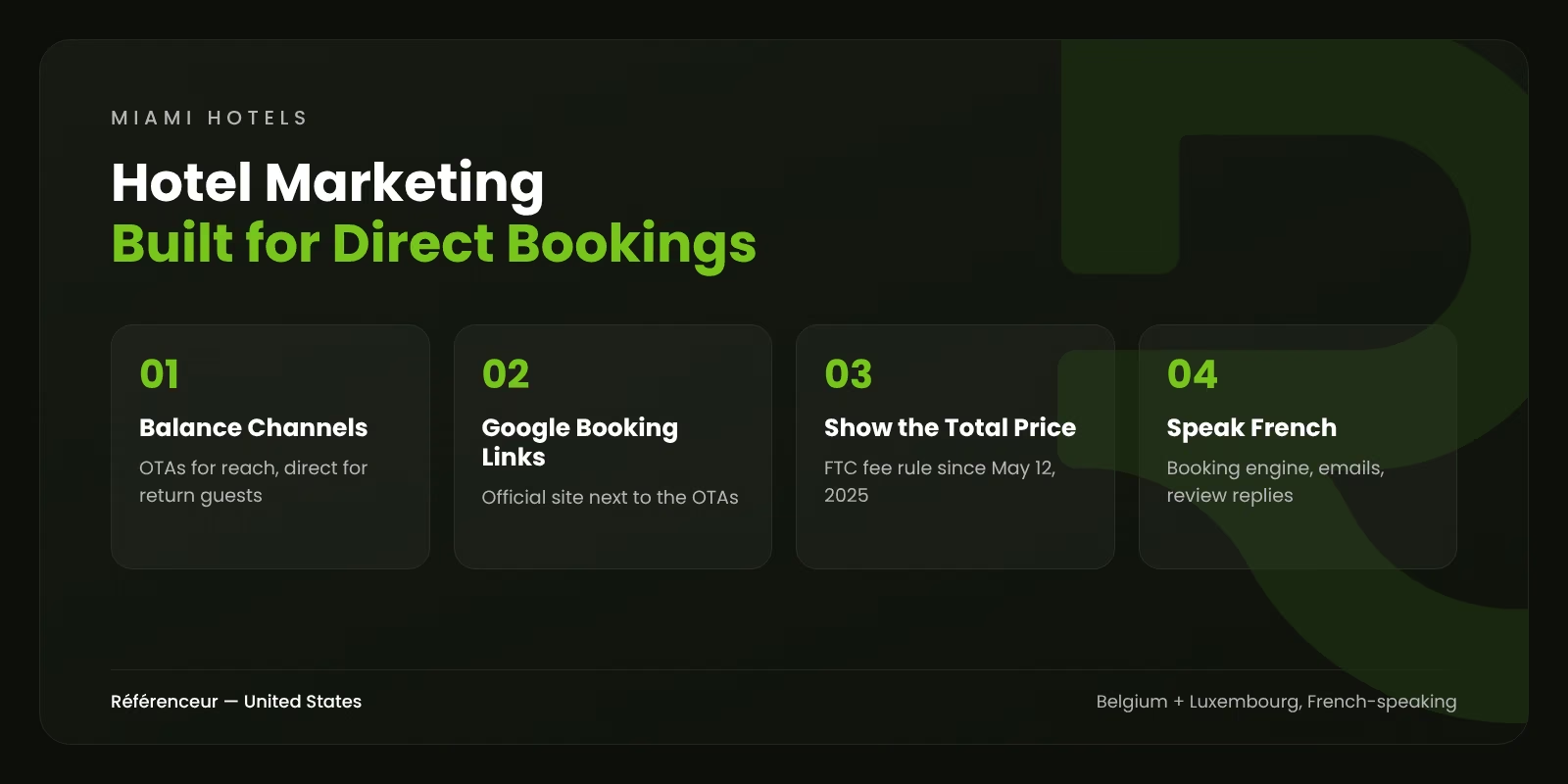
Total Price on Every Screen: The FTC Fee Rule
The Federal Trade Commission’s Rule on Unfair or Deceptive Fees took effect on May 12, 2025. It covers short-term lodging, including hotels, motels, inns, and vacation rentals, whether sold directly or through booking platforms. Whenever a business advertises or displays a price, it must show the total price, including all mandatory fees, and that total must be more prominent than any base or partial price. Government taxes, along with optional extras, can sit outside that total, but they must still be clearly disclosed before the guest pays.
In Miami Beach, taxes are a real part of the final bill. The city levies a 4% resort tax on hotel room rents, on top of state and county taxes, and a 2% tax on food and beverages. Guests don’t object to taxes nearly as much as they object to surprises.
Here is where we check prices first:
- The first screen of your booking engine, on mobile
- Rates sent to Google and other metasearch sites
- Ads and social posts that show a “from” price
- Email offers and landing pages for packages
- OTA listings, to keep the guest’s total consistent across channels
If a mandatory resort or destination fee appears anywhere after the first price a guest sees, that page needs attention. This isn’t legal advice; your attorney should confirm how the rule applies to your property.
A Demand Calendar Built on Flights, Events, and Weather
Miami’s year has a shape, but the details differ by neighborhood. A Downtown hotel and a South Beach hotel don’t peak on the same weekends.
| Period | What drives demand | Marketing move |
|---|---|---|
| January to April | Winter travelers, including Canadians; airlines add seasonal flights from Canadian cities such as Ottawa each winter | French and English campaigns aimed at Canadian cities, booked well before departure dates |
| Late March | Miami Music Week, March 22 to 28, 2027, with Ultra at Bayfront Park from March 26 to 28, 2027 | Event landing pages for Downtown properties; clear minimum-stay and noise policies for all |
| June 1 to November 30 | Atlantic hurricane season | Flexible-cancellation messaging, in-state drive markets, and honest weather updates |
| Summer | Floridians and families on shorter trips | Staycation packages and email to past guests with local ties |
| Early December | Miami Art Week | Rate pages, transport tips, and booking windows published months ahead |
Plan content at least one booking window ahead of each period. Canadians in particular book winter trips early.
Speaking to Canadian and French-Speaking Travelers
According to the Greater Miami Convention & Visitors Bureau, 323,000 Canadians traveled to Miami in 2024. Many of them, especially travelers from Quebec, would rather read in French. French-speaking guests also arrive from France, Belgium, Switzerland, and the Caribbean. Most hotels give them an English-only experience and lose part of the relationship along the way.
Hospitality marketing that Miami hotels can actually measure starts with small, specific steps:
- A French version of the booking engine, at minimum the room descriptions, policies, and cancellation terms.
- A confirmation email and pre-arrival message in the language the guest booked in.
- A handful of French landing pages for real Canadian searches, such as winter stays or family trips.
- Ad campaigns targeted by language and city, with French copy written by a native speaker, not a plugin.
- Review replies in the reviewer’s language, following a clear framework for negative reviews.
Done well, French content signals care at every step. Done badly, a machine-translated policy page does more harm than an English one. Our team builds the structure with our multilingual website design in Miami service.
Boutique Hotels and Vacation Rentals: Same Rules, Smaller Teams
Small properties face the same pricing rules as large resorts, with far fewer people to handle marketing. The FTC rule covers vacation rentals as well as hotels, and Miami Beach restricts short-term rentals in most residential zones. Before advertising any unit, confirm that the city allows it at that address.
For a boutique hotel, a few things usually matter most: one accurate Google Business Profile (our Google local SEO guide covers the setup), direct booking from the profile, photos updated each season, and a short list of past guests to contact before every slow month. Our email marketing team can run that last part on a simple, consented schedule.
Working With a Belgian and Luxembourgish Team
We work out of Francorchamps, Belgium, and Wemperhardt, Luxembourg; there is no Florida or other U.S. office. Belgium is typically six hours ahead of Miami, so revenue reviews and campaign changes can be ready when your morning team arrives, and our video calls land in your late morning or early afternoon. Every month, you get one report showing direct bookings, the share of each channel, and what we changed.
Because we work natively in French and English, we can write for your Quebec guests and report to an owner in Paris with the same care we give your American guests. For our wider work in the city, visit our Miami digital marketing agency page. Curious how much of your demand leaks to commissions? Start on our contact page.
Frequently Asked Questions About Hotel Marketing in Miami
Should a Miami Hotel Stop Working With OTAs?
Rarely. OTAs bring first-time guests from markets you can’t reach alone. The aim is balance: let OTAs win the first stay, then give that guest every reason to book direct the next time, through email, a loyalty perk, and a booking page that is never more expensive.
Do Free Booking Links Replace Google Hotel Ads?
No. Free links put your official site in the comparison at no click cost, while paid Hotel Ads are a separate, auction-based placement. Many properties use both, with paid budget focused on peak dates and searches for their own name.
Can We Still Charge a Resort Fee?
The FTC rule doesn’t ban mandatory fees; it requires the total price, including them, to be shown up front and more prominently than any partial price. Government taxes can be listed separately if they’re clearly disclosed before payment. This isn’t legal advice; your counsel should review your rate display.
How Do We Market During Hurricane Season Without Scaring Guests?
Be clear rather than silent. Publish your cancellation and storm policies on the booking page, focus campaigns on in-state travelers who can adjust plans quickly, and send short, factual updates when a storm is forecast. Guests remember hotels that told them the truth.
Is It Worth Translating Our Booking Engine Into French?
If Canadian or European guests already make up a visible share of your bookings, usually yes. Start with the pages that decide a booking: rooms, policies, and checkout. To see what that share looks like in your own data, request a free assessment.